Google to Integrate WeatherNext 3, 5 km Weather Model
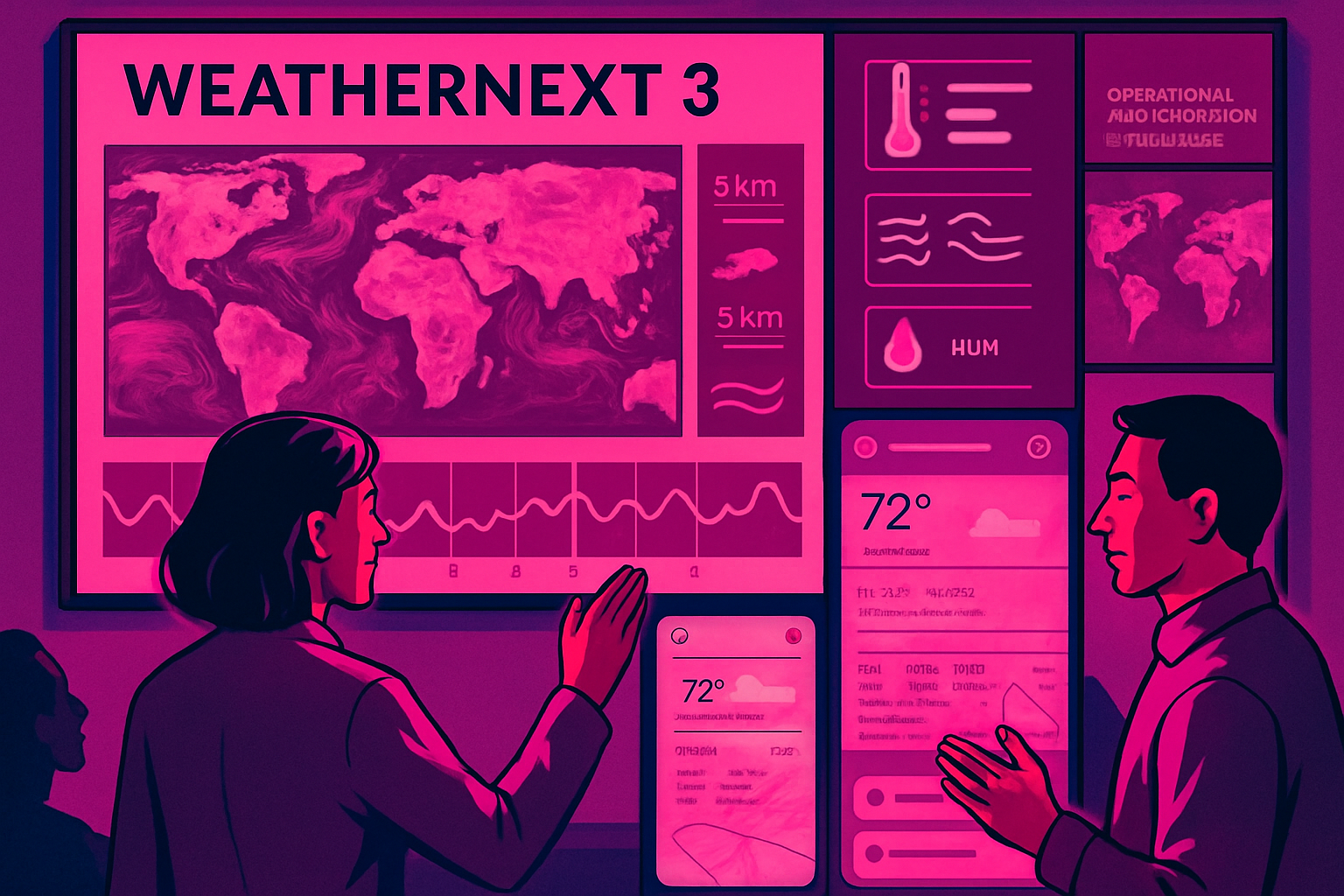
Google introduces WeatherNext 3, an AI weather model deemed more accurate than historical and competing benchmarks, featuring hourly forecasts and a resolution of up to 5 km. The company plans to integrate it into Google Search, Maps, and Gemini, and to make it available on its cloud platforms. Google claims direct use of raw observations, but a startup asserts it is already doing so, while all these models still rely on national datasets.
Raw Data, Contested Primacy, and Persistent Dependencies
Google asserts that WeatherNext 3 is the first AI model to directly utilize raw observations to provide high-resolution forecasts on a global scale. Meanwhile, the startup WindBorne claims that its WeatherMesh 6 model has been using raw observations from its fleet of weather balloons and other sources since late 2025. Google counters with superior global resolution. In both cases, these models still depend on national weather datasets to produce their forecasts, and further progress is needed before achieving full and direct assimilation of data. Although the integration of raw empirical observations into AI models is presented as a means to enhance accuracy, it remains technically complex to operate these models with data that has not been pre-formatted.
Announced Integration into Google Products and Cloud Access
Google plans to integrate the outputs of WeatherNext 3 into its search results, Google Maps, and Gemini, and to offer access to users and researchers via its cloud platforms. Samier Merchant, a senior engineer at Google, notes that this is the first time certain key variables from these forecasts will feed into numerous Google products. Ferran Alet, a researcher at DeepMind, believes that Google's goal is to provide useful information to users, as a significant portion of user searches pertains to weather.
What WeatherNext 3 Changes in Capabilities and Frequency
According to researchers, WeatherNext 3 achieves a prediction resolution of up to 5 km and improves precipitation assessment by 60% compared to WeatherNext 2. The model can now provide hourly forecasts instead of every six hours. It explicitly addresses the main weaknesses of previous approaches. WeatherNext 3 is larger, with 2.4 times more parameters than its predecessor, and has been fine-tuned to deliver responses deemed more useful. Designers have trained it to target specific weather stations to increase granularity and compare its performance to local benchmarks. The ability to ingest real-time satellite data at an hourly cadence also accounts for an increased update frequency.
Le brief IA que les pros lisent chaque soir
Les 7 actus IA du jour, décryptées en 5 min. Gratuit.
Inclus dès l'inscription : notre sélection des meilleurs guides & comparatifs IA.
Choisissez votre rythme
Gratuit · Pas de spam · Désabonnement en 1 clic
Industry Status and Target Uses Beyond Google
AI models are already employed by weather agencies in Europe and the United States in their forecasting solutions. Their speed and low cost are highlighted as economic impact factors in areas where cutting-edge equipment and supercomputers are not accessible. Bill Gates cites AI weather forecasting as a significant advantage, with associated agricultural yield gains in developing countries. Ferran Alet from DeepMind indicates that high-resolution forecasts of wind, rain, and cloud cover could make renewable energy projects more reliable. In this context, the spread of transformers in meteorology is described as as significant as the rise of LLMs in other fields.
Testing, Benchmarks, and Historical Limits of AI Approaches
WeatherNext 3 achieved the highest accuracy on the Operational WeatherBench developed by Brightband, outperforming major competitors. This benchmark compares variables such as temperature, wind speed, and humidity. The model is reported to surpass deep learning approaches from Google, Microsoft, Nvidia, and ECMWF, as well as traditional forecasts from the National Weather Service and ECMWF. Historically, weather forecasting has relied on public supercomputers solving physics equations, which are costly and relatively slow. The ECMWF's release of over fifty years of data in 2018 enabled the training of faster AI models with comparable accuracy. Ferran Alet emphasizes the chaotic nature of weather and the value of AI in learning patterns from abundant data despite incomplete information. However, AI models have shown limitations, including a typical spatial resolution of 15 to 25 km², uneven performance on rainfall, and dependence on formatted datasets from agencies. Current advancements are attributed to design choices, and previous work has already visualized cyclone trajectories. Daniel Rothenberg from Brightband reminds us of the pursuit of the most comprehensive execution possible in many AI applications.
Brief IA — L'actualité IA en français
L'essentiel de l'actualité de l'intelligence artificielle, décrypté et expliqué chaque jour.