Hugging Face: $12.9 Billion Mentioned for a Strategic Crossroads
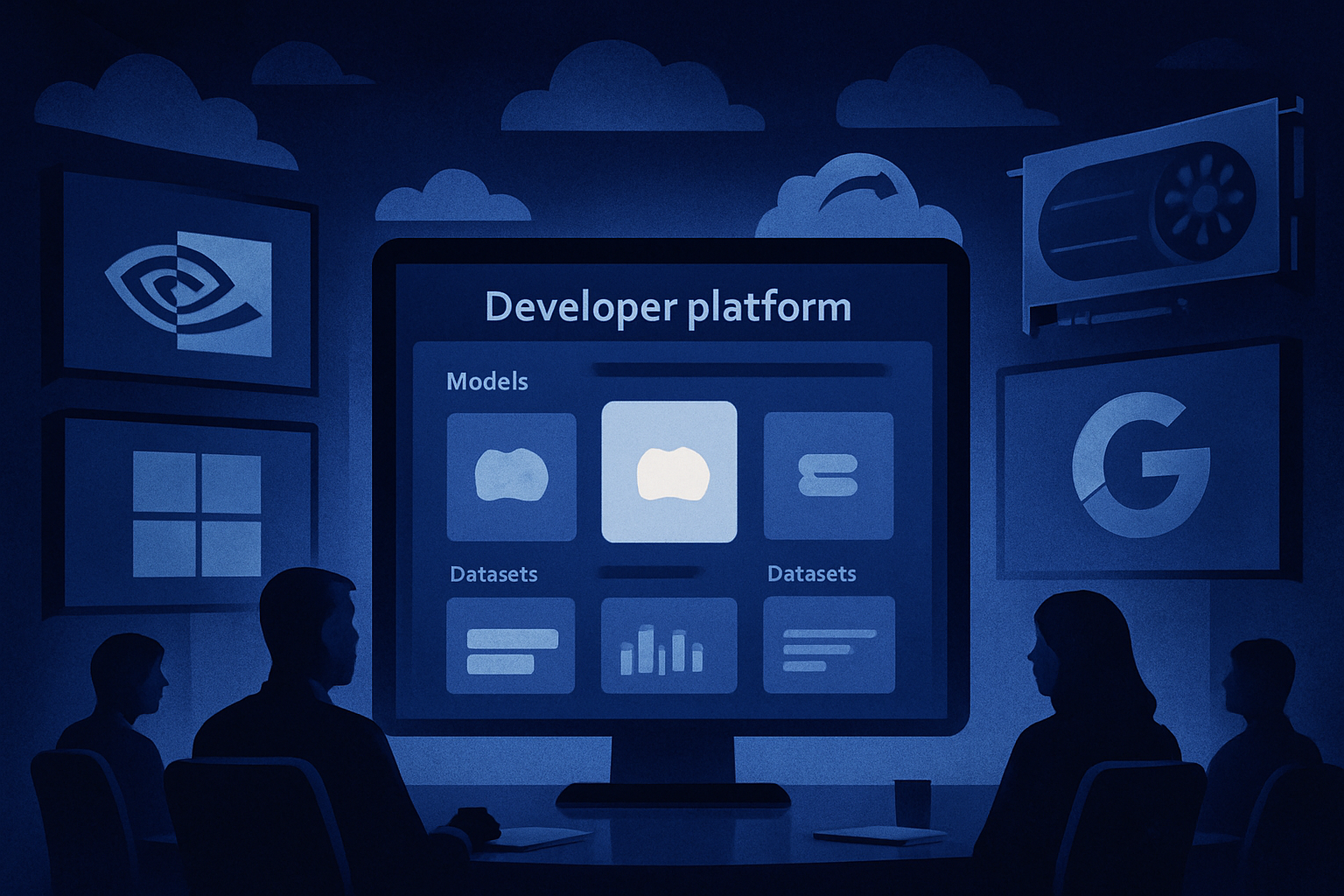
A sum of $12.9 billion is being discussed for taking control of Hugging Face. The platform, which has become a crucial link between model selection and cloud spending, is attracting interest from players with very different agendas. With threatened neutrality, regulatory risks, and product overlaps, each acquisition scenario would redistribute part of the AI value chain.
Neutrality and Concentration: Safeguards Under Pressure
A buyer that primarily steers the platform towards its own offerings risks undermining the neutrality that gives it value. A takeover by Microsoft would combine code repositories, model repositories, development environments, global cloud services, and enterprise AI interfaces, which would pose regulatory challenges. At Google, managing overlaps between already existing components could reduce the Hub to a mere gateway to Google Cloud, whereas its value lies in not being just another cloud product. Kaggle already offers hosting for datasets, notebooks, and models, while Vertex AI Model Garden provides model discovery and deployment. In any case, each potential buyer would have the opportunity to transform Hugging Face into a distribution vector for its own chips, cloud, or software.
Amazon and Google: Integrate the Platform or Block Competition
Hugging Face is connected to AWS services, from SageMaker to Bedrock, EC2, ECS, and EKS, and both partners facilitate the use of models on Trainium and Inferentia. These accelerators, developed by AWS, also aim to reduce dependence on Nvidia GPUs. If Nvidia were to take control of the Hub, AWS might see more models optimized first for CUDA and NIM; if Microsoft acquired it, Azure would enhance its appeal to developers; if Google won, TPU distribution would increase. Google, for its part, has its own models, Gemini and Gemma, and strengthened its partnership with Hugging Face in 2025 to accelerate model loading into Vertex AI and GKE, adding native TPU support and security features, notably from Mandiant.
Microsoft: Continuity from Code to Model, Under Surveillance
Microsoft already controls, via GitHub, an environment where a large portion of global software is developed and stored, provides Visual Studio and VS Code, operates Azure, and develops Microsoft Foundry and Copilot. Over 11,000 models from Hugging Face are deployable in Microsoft Foundry and Azure Machine Learning. Since acquiring GitHub for $7.5 billion in 2018, the brand, interfaces, and the freedom to deploy outside of Azure have been preserved. Microsoft might seek to replicate this approach with Hugging Face by avoiding too rapid an integration into the "Microsoft aisle."
Le brief IA que les pros lisent chaque soir
Les 7 actus IA du jour, décryptées en 5 min. Gratuit.
Inclus dès l'inscription : notre sélection des meilleurs guides & comparatifs IA.
Choisis ton rythme
Gratuit · Pas de spam · Désabonnement en 1 clic
Nvidia: Connecting Model Discovery and Execution on GPU
Nvidia has extended its footprint beyond the chip: CUDA has established itself as a software environment, the acquisition of Mellanox brought interconnection technologies for clusters, Run:AI orchestrates resources, and NeMo and NIM cover model construction, optimization, and deployment. DGX Cloud brings the company closer to a service provider role. Hugging Face would offer the entry point for developers: models optimized for Nvidia are already executable as NIM microservices from the platform, integrated into DGX Cloud Lepton. An acquisition would complete the journey from discovery to execution on Nvidia GPUs, especially since Google has TPUs, Amazon has Trainium and Inferentia, Microsoft has its own accelerators, and labs like OpenAI and Anthropic are looking to diversify their infrastructures.
Hugging Face Facilitates the Research and Use of AI Models
The Hugging Face platform goes beyond simple code hosting: it allows users to search for a model, access its documentation, identify associated datasets, download weights, try a demo, modify it, and then launch inference with a provider. The sequence of steps, from selection to the use of computing resources, is almost seamless. As soon as a developer makes their choice, training, fine-tuning, or execution incurs costs for GPU, storage, network, and cloud. It is at this point that the technical decision can turn into a bill, which explains why the interest in acquiring the platform is stronger among infrastructure sellers than among model producers. In this chain, Nvidia, AMD, Intel, and Qualcomm manufacture processors, Amazon and Google sell infrastructure, IBM and Salesforce aim for integration, and Hugging Face has positioned itself at the center without choosing a side. GitHub remains focused on code, while Hugging Face covers the journey to inference.
Usage Figures, Mentioned Price, and IBM Scenarios
By the summer of 2026, the platform is expected to host nearly 3 million public models, over a million datasets, and 1.44 million Spaces applications. The platform claimed 13 million users by the end of 2025, and more than 30% of Fortune 500 companies had a verified account, according to the company. A sum of $12.9 billion is mentioned for a takeover, which is nearly 86 times the estimated annualized revenue of about $150 million. This valuation is partly explained by Hugging Face's position in the developers' journey: the multiple rewards a network, standards, and a position in the flow, beyond just subscription software. In 2023, its funding round included players covering the entire value chain, and this snapshot sheds light on the list of potential acquirers today. On IBM's side, the collaboration initiated in 2023 allows enterprise clients to select, customize, and deploy community models, while Granite models are published on the platform. IBM could make Hugging Face the open layer of Watsonx and maintain an open infrastructure around which to sell services, similar to Red Hat.
Brief IA — L'actualité IA en français
L'essentiel de l'actualité de l'intelligence artificielle, décrypté et expliqué chaque jour.