Hugging Face and Cerebras Revolutionize Voice AI with Gemma 4
Le brief IA que les pros lisent chaque soir
Les 7 actus IA du jour, décryptées en 5 min. Gratuit.
Inclus dès l'inscription : notre sélection des meilleurs guides & comparatifs IA.
Choisis ton rythme
Gratuit · Pas de spam · Désabonnement en 1 clic
A Major Breakthrough for Voice AI
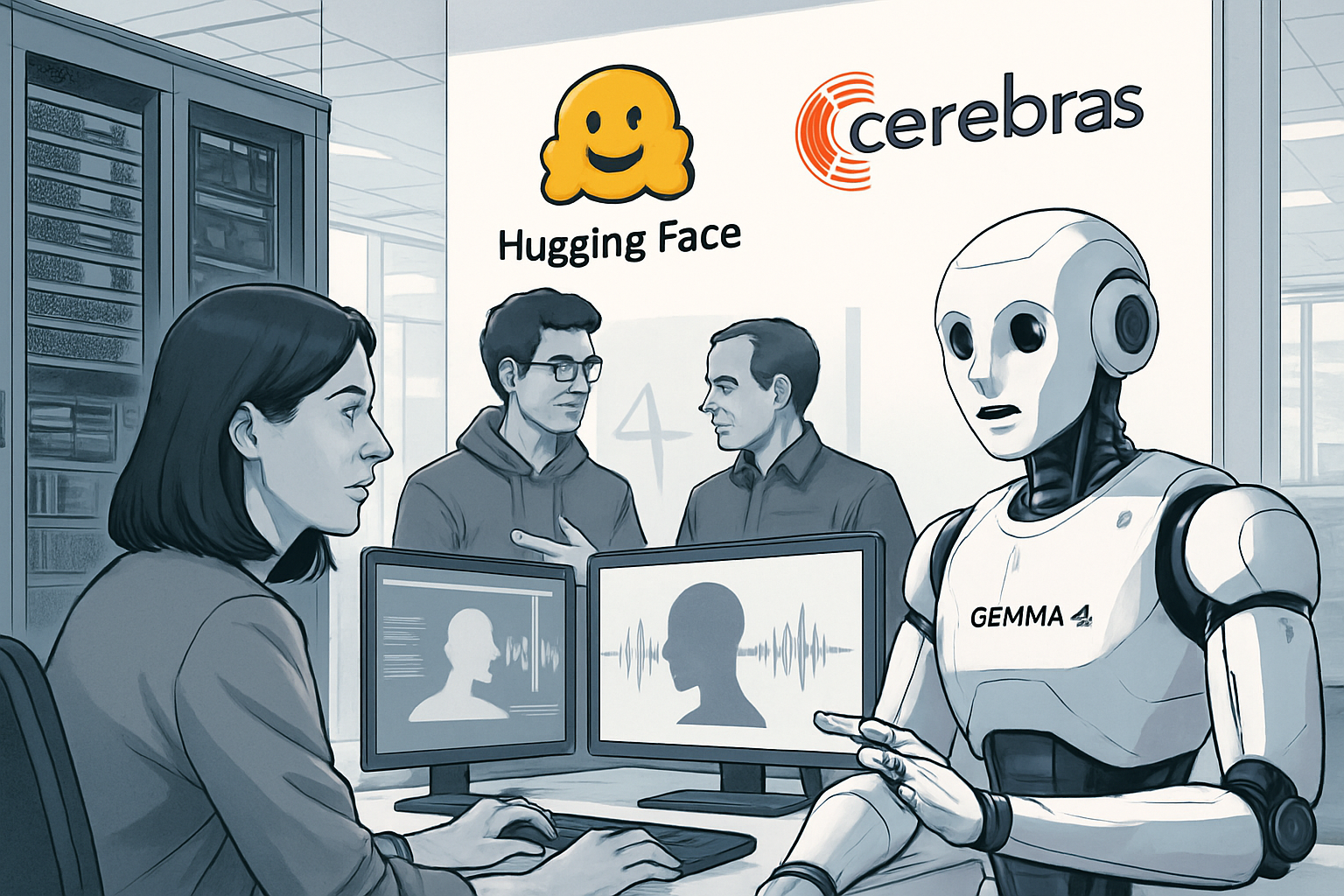
In the field of voice artificial intelligence, latency is a critical factor for user experience. Although the quality of models has seen significant advancements, response times remain a barrier. Hugging Face and Cerebras have partnered to transform this experience by introducing an open and modular voice AI architecture capable of delivering unmatched inference speed.
Thanks to this innovation, speech-to-speech interactions become more natural. Users are no longer forced to wait for a response from the AI, making conversations as fluid as those with a human interlocutor.
An Open and Modular Architecture
The demonstration of this technology relies on a real-time speech-to-speech pipeline, where each component is modular, open, and interchangeable. This allows for easy adaptation of the stack for various uses, whether for assistants, robots, or research projects.
This comprehensive speech-to-speech system includes several stages:
- Speech recognition via Nvidia's Parakeet
- VLM inference with Gemma 4 on the Cerebras platform
- Speech synthesis thanks to Alibaba's Qwen3TTS
- Oral response
The architecture leverages the open-source AI ecosystem, combining Cerebras' inference speed, Google DeepMind's advanced language model Gemma 4, and Qwen's speech synthesis. Each layer is accessible for inspection, modification, and extension by developers.
A Strategic Partnership
In current systems, even though an acceptable median latency is often achieved, frustrating delays can occur, particularly during tool calls or multimodal steps. Cerebras addresses one of the main obstacles: the response time of the language model. By accelerating and stabilizing inference, Cerebras allows the rest of the Hugging Face pipeline to operate optimally.
This stability is crucial, especially in extreme situations where slow responses can compromise the reliability of conversations. By improving the speed and consistency of responses, Cerebras and Hugging Face make interactions more reliable.
A Concrete Application in the Real World
The speech-to-speech pipeline developed by Hugging Face is already in use with Reachy Mini robots, which have over 9,000 units in service. For these robots, as well as for voice assistants and other embodied AIs, responsiveness is essential. It is not just an aesthetic improvement but fundamental to making interactions lively.
The use of Cerebras is not solely aimed at reducing costs but at ensuring low latency, predictable performance, and the creation of real-time experiences that feel natural at scale.
This collaboration between Hugging Face and Cerebras illustrates a shared vision: a future of AI that is both open and high-performing. Open-source models, open infrastructure, and revolutionary inference speed lay the groundwork for the next generation of conversational AI.
Developers are encouraged to explore this demonstration, experiment with the code, and contribute to the evolution of real-time voice AI.
Brief IA — L'actualité IA en français
L'essentiel de l'actualité de l'intelligence artificielle, décrypté et expliqué chaque jour.