Hugging Face: The Essential Pillar of Modern AI
Le brief IA que les pros lisent chaque soir
Les 7 actus IA du jour, décryptées en 5 min. Gratuit.
Inclus dès l'inscription : notre sélection des meilleurs guides & comparatifs IA.
Choisis ton rythme
Gratuit · Pas de spam · Désabonnement en 1 clic
A Revolution in AI Development
Hugging Face has established itself as much more than just a Python library dedicated to artificial intelligence. It represents a true ecosystem that has profoundly changed the way researchers share models, how engineers design AI applications, and how newcomers explore cutting-edge machine learning techniques. The question that often arises is: why has Hugging Face become so important? After all, it did not originate the transformers or models like BERT, GPT, or Llama. To understand its current central role, it is essential to look back at the state of AI development before the emergence of Hugging Face.
AI Development Before the Hugging Face Era
Before the advent of Hugging Face, the process of testing a new language model was laborious. Imagine reading an article about an innovative language model. Intrigued, you want to try it out. The typical journey involved:
- Reading the research paper
- Finding the associated GitHub repository
- Cloning the code
- Installing dependencies
- Downloading the model weights
- Resolving version conflicts
- Running the model
In theory, this process seems straightforward, but in practice, each research group structured its projects differently. Some used TensorFlow, while others used PyTorch. Configuration files were scattered, dependencies were often broken, and reproducing published work could take hours or even days. Switching from one model to another often required learning a new codebase, with no common interface. With the acceleration of deep learning research, this fragmentation became increasingly difficult to manage, prompting the AI community to seek better infrastructure.
The Impact of Hugging Face's Arrival
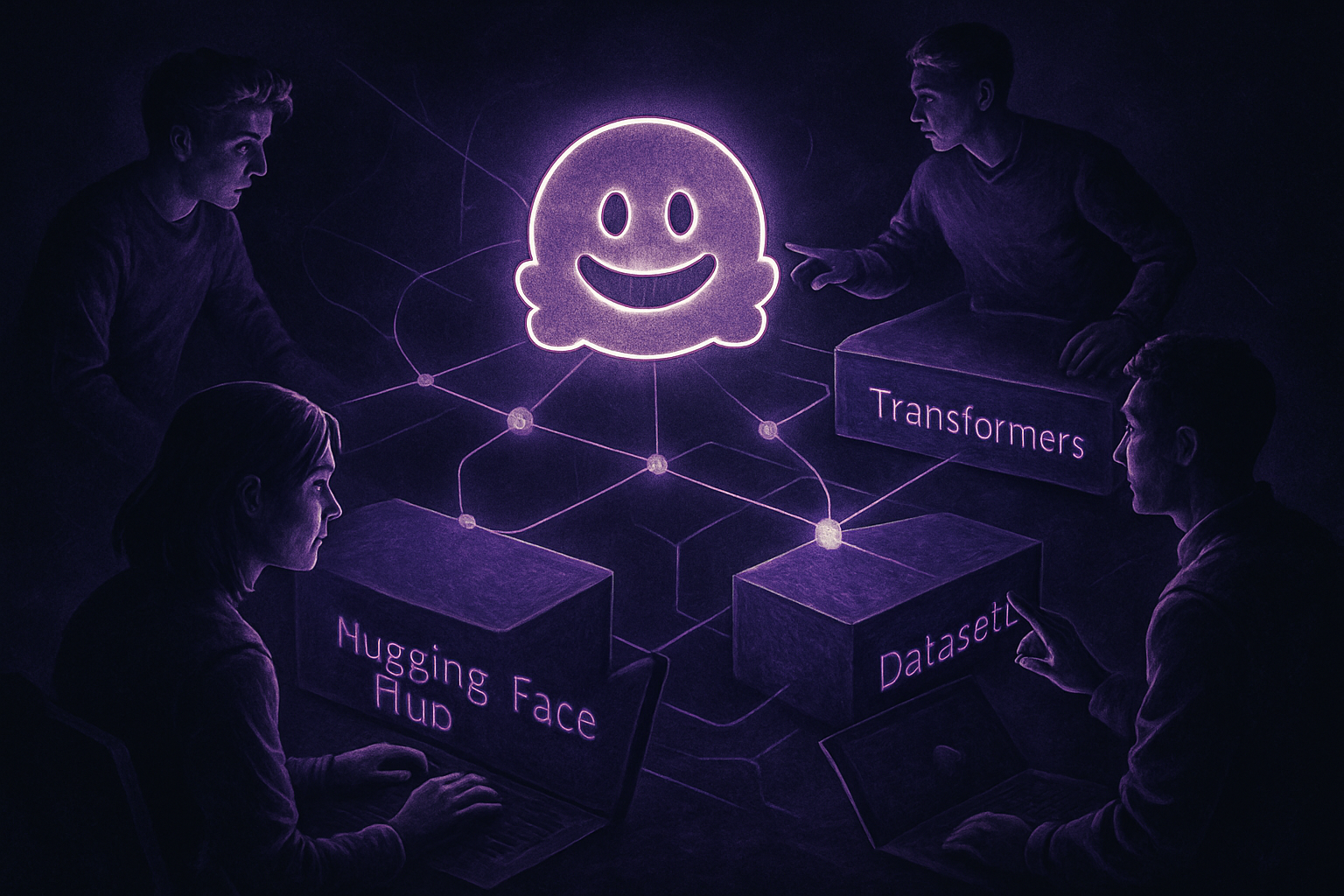
It is in this context that Hugging Face made its entrance. More than just a library, Hugging Face is an ecosystem. At the heart of this ecosystem is the Hugging Face Hub, a space where researchers can publish models, datasets, and AI applications. Surrounding this hub are specialized libraries that cover different stages of the machine learning workflow.
The Hugging Face ecosystem includes:
- Transformers: access to thousands of pre-trained language and vision models.
- Datasets: simplifies downloading and processing machine learning datasets.
- Tokenizers: efficiently converts text into numerical representations.
- Diffusers: supports models for generating images, videos, and audio.
- Accelerate: facilitates distributed training.
- PEFT: enables efficient parameter fine-tuning techniques like LoRA.
- Evaluate: provides standardized evaluation metrics.
- Safetensors: offers a safer and faster model serialization format.
These tools allow developers to discover, download, train, evaluate, and deploy AI models with a more consistent and accessible interface.
The Hugging Face Hub: A GitHub for AI
The Hugging Face Hub can be compared to GitHub, but for machine learning. Instead of hosting source code, it hosts AI assets. The Hub currently offers:
- Hundreds of thousands of pre-trained models
- Hundreds of thousands of datasets
- Thousands of interactive AI demonstrations, called Spaces
- Version-controlled repositories
- Documentation and model cards detailing the training and usage of models
To implement a new AI project, one simply needs to search the Hub. Each model comes with documentation, version information, licenses, and often sample code. The Hub has become the go-to reference for sharing machine learning models.
The Power of the Transformers Library
The Transformers library is undoubtedly the most impressive element of the Hugging Face ecosystem. Let's take the example of sentiment analysis:
from transformers import pipeline

analyzer = pipeline("sentiment-analysis")
result = analyzer("I love using Hugging Face!")
print(result)
In just three lines of code, Hugging Face performs complex work. But what actually happens when we call pipeline()?
This function hides the complexity of using a transformer model. When called, Hugging Face:
- Selects an appropriate pre-trained model.
- Downloads it if necessary.
- Downloads the corresponding tokenizer.
- Loads both into memory.
- Converts the text into tokens.
- Executes the model.
- Transforms the predictions into an understandable result.
Contrary to popular belief, Hugging Face is not limited to chatbots and language models. The Transformers library supports many AI tasks, such as question answering or image classification. This pipeline simplifies access to AI, allowing newcomers to focus on solving problems rather than assembling components. For experienced developers, Hugging Face offers direct access to each component, with Auto classes that automatically load the correct architecture for a given model.
The Origin of Datasets
Models are only part of the equation; data is equally crucial. The Datasets library from Hugging Face provides access to thousands of public datasets through a unified interface. A simple function call allows you to download, cache, and start working with a dataset, often without heavy preprocessing. The library also supports streaming large datasets, making it easier to work with large collections.
While many users start with pre-trained models, Hugging Face also offers tools for training and fine-tuning. Libraries like Trainer, Accelerate, and PEFT simplify tasks such as distributed training, mixed precision training, and efficient parameter fine-tuning. These tools allow for a seamless transition from a laptop experience to multi-GPU training without rewriting code.
Hugging Face has thrived not by creating the best language model, but by making their use more accessible. The company has standardized the sharing, loading, and utilization of models by developers. In many ways, Hugging Face has done for machine learning what GitHub has done for source code and PyPI for Python packages. It has transformed thousands of independent research projects into a connected ecosystem, lowering the barrier to entry for students, accelerating research, and turning AI into tools accessible to millions of developers with just a few lines of Python.
In the realm of research, the most significant innovation is often not the creation of something new, but the availability of powerful ideas.
Brief IA — L'actualité IA en français
L'essentiel de l'actualité de l'intelligence artificielle, décrypté et expliqué chaque jour.