AI for Marketing and Communication: The 2026 Reference Guide

According to HubSpot's State of Marketing Report 2025, 92% of marketers report that AI is already impacting their roles. The topic is no longer about isolated trials, but rather about work organization, data quality, human validation, and measuring gains. For marketing and communication departments, AI accelerates production, alters SEO, personalizes journeys, and automates part of media management. This guide presents effective use cases, tools, rules, pitfalls, and a plan to get started.
What AI Really Changes for Marketing and Communication
First, AI reduces the time between idea, brief, production, and analysis. Our analysis on creating marketing content with AI describes time savings in writing, optimization, and format adaptation. The decisive point is not to produce more to fill channels, but to test angles, messages, and formats faster, reserving human time for strategy, editorial arbitration, and business proof.
Next, it changes visibility. Content is no longer just read by internet users and traditional search engines. It is also sliced, summarized, and cited by assistants. Our analysis on B2B SEO in the face of AI Search recommends tracking brand presence in AI responses, not just organic traffic. For communication teams, this requires more structured pages, clearer sources, and less ambiguous formulations.
Finally, AI brings marketing, sales, customer service, and product closer together. CRM data, support feedback, customer verbatims, media campaigns, and content become common signals. This convergence increases the value of teams capable of framing a need, qualifying data, controlling outputs, and explaining decisions. It also makes visible old weaknesses: disorganized CRM base, vague editorial guidelines, poorly defined responsibilities, and lack of measurement before deployment.
 Marketing team in Paris sorting printed customer journeys
AI better serves campaigns when rules and validations are visible.
Effective Use Cases Today
The most useful applications combine a clear operational gain with simple human control. The most sensitive projects involve personal data, brand reputation, or automated dissemination.
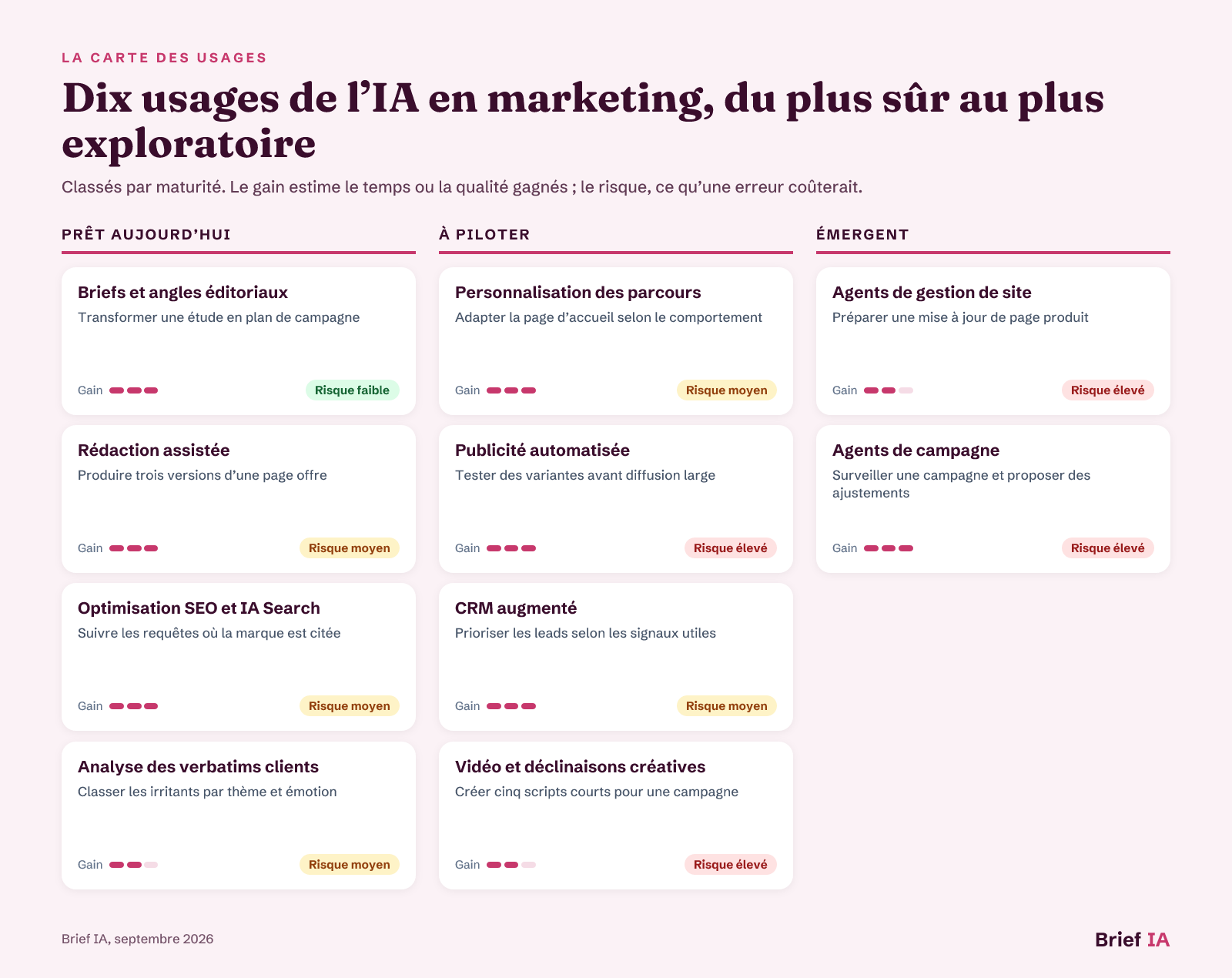 Map of AI use cases for marketing and communication professionals
Use cases classified by maturity, with expected gain and risk in case of error.
Ready-to-Use Applications
Briefs and Editorial Angles. A generalist assistant helps transition from a marketing objective to an actionable editorial plan: promise, audiences, objections, angles, formats, and timeline. The gain primarily comes from initial structuring. Best practice involves providing brand elements, available proofs, and channel constraints, then having the brief validated by the editorial or product lead before production.
Assisted Writing. Assisted writing is suitable for articles, offer pages, emails, product sheets, video scripts, and social media posts. It becomes reliable when the team imposes a brief, tone, internal sources, and business proofreading. Our analysis on SEO content optimized with AI emphasizes human enrichment, fact-checking, and structuring paragraphs for engines and assistants.
SEO Optimization and AI Search. AI-augmented SEO tools help produce briefs, compare competitors, enrich semantics, and track presence in assistant responses. To avoid blind management, measure classic positions, brand citations, pages picked up by models, and conversions from organic traffic separately. Content must remain accurate, dated, and easily interpretable.
Analysis of Customer Verbatims. Semantic analysis of reviews, chats, emails, and call transcripts allows for identifying recurring themes: delivery, product sheet, price, support, or returns. The overall score is insufficient. Each emotion or sentiment must be linked to a business cause and an action. A sample should be regularly reviewed to check for sarcasm, context, and classification errors.
Applications to Manage
Personalization of Journeys. AI-driven personalization adapts recommendations, messages, category order, and follow-ups based on available signals. Our analysis on personalizing the customer experience in e-commerce describes using session behaviors to act even with anonymous visitors. The project should start with simple segments, a clear legal basis, and measurement of effects on conversion, unsubscribing, and satisfaction.
Automated Advertising. Advertising platforms automate targeting, bidding, placements, budgets, and sometimes creatives. The gain is real when conversion signals are clean and objectives well-defined. The risk increases if visuals or messages are modified without validation. For each campaign, impose approval rules, archive disseminated versions, and compare results to original creations.
Augmented CRM. AI in CRM helps score leads, summarize exchanges, prepare emails, and trigger follow-ups. It does not fix a dirty database. Before any deployment, the team must remove duplicates, define key fields, limit segments, and verify the legal basis for profiling. Scores must remain explainable to marketing, sales teams, and, if necessary, prospects.
Video and Creative Variations. AI-generated or assisted video accelerates the creation of variants for social networks, advertisements, and product demonstrations. However, it requires strong vigilance regarding rights, representations, brand consistency, and reporting generated content when applicable. Human validation must cover the script, visuals, editing, legal mentions, and channel suitability.
Emerging Applications
Site Management Agents. Agents capable of modifying a site open up gains in publishing, comments, and editorial maintenance. Recent news on AI agents in WordPress.com shows that users must confirm actions. For a brand, this confirmation is not a detail: it must become a governance rule, with an action log and limited rights.
Campaign Agents. Marketing agents can chain research, brief, production of variants, performance analysis, and recommendations. Their interest lies in the continuity of the workflow, but their autonomy should remain limited at the start. Initial experiments should focus on recommendations, not on automatic modifications of budget, targeting, or creation without thresholds, validation, and the possibility of reversal.
Tools to Know
There is no single ranking to seek: good choices depend on use cases, available data, expected control levels, and channels to manage.
- Writing and Brief Assistants. They help frame campaigns, produce variants, rephrase, synthesize, and prepare long content. Our analysis on AI for digital marketing in 2026 notably cites Claude, ChatGPT, and Jasper for these tasks. Requirements: brand guidelines, team spaces, controllable history, exclusion of sensitive data, human validation.
- SEO Platforms and Visibility in AI Responses. They combine keyword research, briefs, semantic optimization, competitor tracking, and measurement of presence in generated responses. They are useful if the team also tracks brand citations, not just classic positions. Requirements: tracking of cited sources, export of queries, before-and-after comparison, separation of SEO and AI responses, conversion metrics.
- Augmented CRMs and Marketing Suites. They connect customer data, segmentation, scoring, campaigns, automation, and reporting. Their value mainly depends on the quality of fields, consents, segments, and the ability to explain the scores used. Requirements: data minimization, documented legal basis, score control, access rights, action logging.
- Visual and Video Creation Tools. They produce images, short videos, avatars, scripts, and creative variants. Our analysis on Higgsfield for marketing shows the interest of a multi-model hub, but also the need to track credits, quality, and validation. Requirements: usage rights, controlled watermark, validation of visuals, costs per campaign, reporting of generated content.
- AI-Augmented Media and Retail Media Platforms. They optimize bids, audiences, creatives, and budget allocation based on performance signals. Our analysis on Walmart's method for AI advertising emphasizes measurement linked to actual sales. Requirements: sales objectives, approval rules, access to variants, incremental measurement, budget caps.
Le brief IA que les pros lisent chaque soir
Les 7 actus IA du jour, décryptées en 5 min. Gratuit.
Inclus dès l'inscription : notre sélection des meilleurs guides & comparatifs IA.
Choisissez votre rythme
Gratuit · Pas de spam · Désabonnement en 1 clic
The Framework: AI Act, GDPR, and Internal Deployment Rules
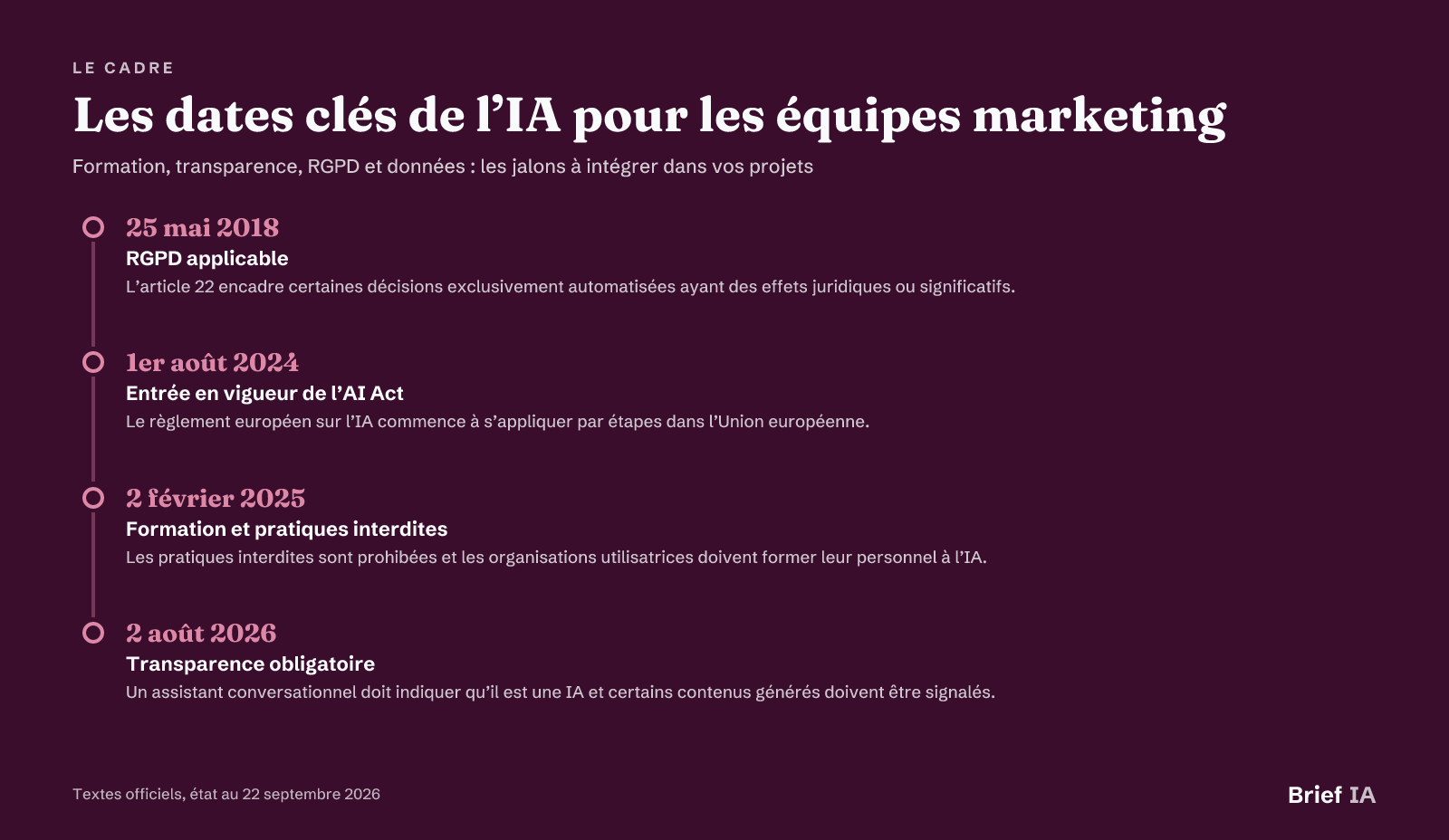 Key dates for AI for marketing teams
Key dates, status as of September 22, 2026.
AI Act: Training and Transparency
Regulation (EU) 2024/1689 came into effect on August 1, 2024, and applies in phases. Since February 2, 2025, any organization using AI systems must ensure a sufficient level of AI mastery among its staff. From August 2, 2026, transparency obligations apply: a conversational assistant must indicate that it is AI, and certain generated content must be flagged as such.
Common Marketing Uses
AI tools without high-risk uses, such as writing or summarizing, are not considered high-risk systems under the AI Act. However, marketing and communication teams are still subject to general training and transparency obligations. Sanctions under the AI Act can reach €35 million or 7% of global annual revenue for prohibited practices, and €15 million or 3% for other obligations.
GDPR and Automated Decisions
The GDPR has been in effect since May 25, 2018. Its Article 22 regulates decisions based solely on automated processing that produce legal or significant effects on a person. In marketing, this requires particular attention to profiling, lead scoring, personalization, and automated campaigns. The right reflex is to document the legal basis, limit data, inform individuals, and maintain human control over sensitive decisions.
Social Dialogue
The Labor Code stipulates that the social and economic committee must be informed and consulted when introducing new technologies in the company. A marketing AI project may therefore require this step when it modifies organization, tools, or working conditions. The framing must specify uses, affected populations, processed data, effects on jobs, and training measures.
Pitfalls to Avoid
Confusing Volume and Quality. Producing faster is not enough. Recent news on Google and automated content reminds us that quality, authenticity, and usefulness remain crucial. Generated content must provide evidence, examples, expertise, and regular updates.
Leaving Creatives Unchecked. Our analysis on Meta and its advertising AI shows the risk of visual variants being modified and disseminated without sufficient validation. Teams must check default settings, approve sensitive assets, and retain the versions actually exposed.
Optimizing Costs at the Expense of Experience. One report describes a team that reduced its inference costs by over 50%, only to see a drop in customer satisfaction. Cost per query should never be the sole indicator. Also track perceived quality, errors, conversions, and complaints.
Deploying Without Initial Measurement. KPMG indicates that nearly 70% of surveyed companies do not yet see significant results from their AI investments. Before purchasing licenses, establish a baseline: timelines, costs, conversion rates, editorial quality, and validation workload.
Neglecting Personal Data. Scoring, segmentation, personalization, and automated follow-ups can touch on profiling. The GDPR requires limiting data, informing individuals, and mastering sensitive automated decisions. Teams must involve marketing, legal, data, and security from the outset.
Taking Action: The 90-Day Plan
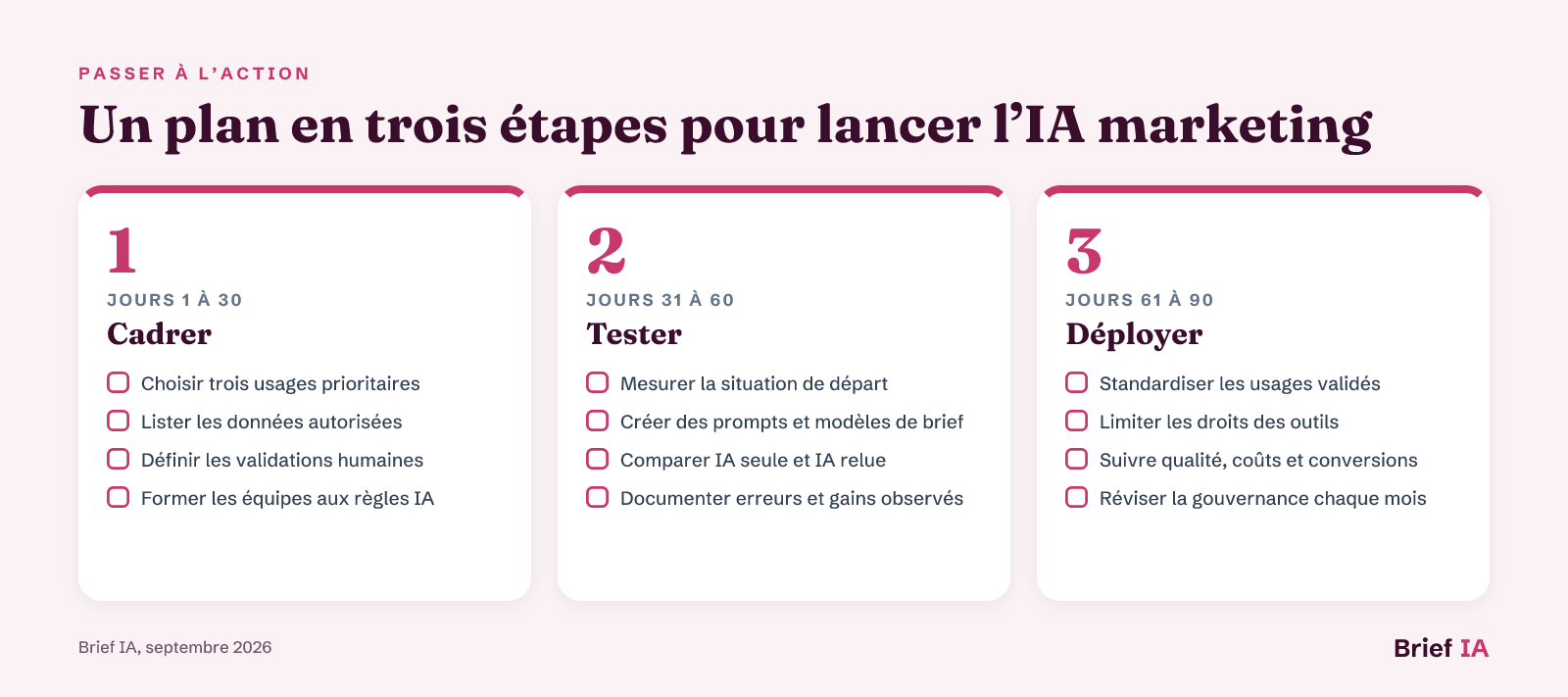 A three-step plan to launch marketing AI
Three steps: frame, test, deploy.
Start with three low-risk use cases: briefs, rewriting, and synthesizing insights. During the first month, formalize rules, allowed data, and validations. In the second month, test on a real campaign with before-and-after measurement. In the third month, deploy only the uses that demonstrate time savings, quality improvement, or measurable effects on performance.
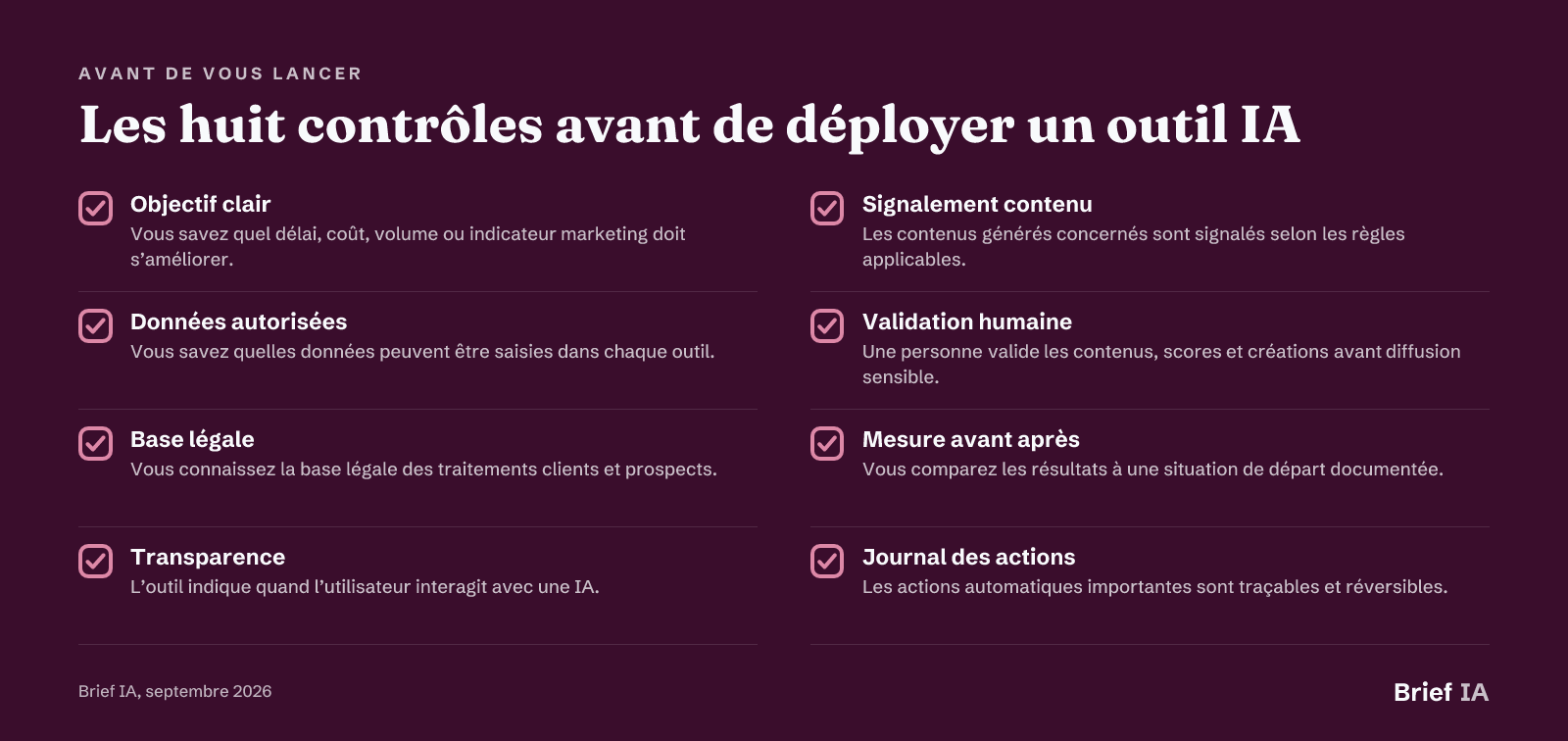 The eight checks before deploying an AI tool
Eight verifications to perform before each new use.
Further Reading
Our analyses for marketing and communication professionals
- Creating marketing content with AI without losing quality. Methods, tools, and checkpoints for integrating AI into a marketing editorial flow.
- Producing SEO content visible in AI responses. How to structure content for Google, assistants, and generative engines.
- Adapting B2B SEO to AI Search. Why tracking brand citations and share of voice in generated responses matters.
- Personalizing the customer experience with AI. A method for recommendations, messages, and journeys without drifting on data.
- Understanding the risks of advertising automation. The Meta case shows why default settings and creative validation matter.
- Optimizing a CRM with AI. Useful applications of scoring, summarizing, and follow-ups, provided data is cleaned.
Key News to Remember
- Google prioritizes content quality, whether AI-generated or not
- AI-powered CMSs are becoming proactive management platforms
- WordPress.com allows AI agents to modify sites with confirmation
- Reducing inference costs can degrade customer satisfaction
- KPMG warns of AI investments with still unclear returns
- Research on AI agents focuses on measurable capabilities
Do you offer a solution for marketing and communication?
This guide is read by marketing directors, communication managers, acquisition teams, CRM, content, social media, and agencies. Brief IA offers marketing, communication, CRM, advertising, content, and analytics solution providers dedicated articles, evening brief inserts, and promotion in the directory. Formats and rates at briefia.fr/partenaires.
The Essentials in Questions
How to Use AI in Marketing Without Degrading Quality?
Limit AI to stages where it provides a clear gain: brief, variants, synthesis, rephrasing, customer feedback analysis. Quality then depends on human proofreading, added evidence, brand consistency, and updates. Measure produced content with the same criteria as human content.
Can an AI-Generated Text Be Well-Indexed?
According to recent news about Google and automated content, Google does not specifically target AI-generated texts. The risk lies with poor, repetitive, or useless content. Teams must enrich productions with a human perspective, verified facts, useful examples, and regular updates.
What Are the Safest AI Marketing Uses to Start With?
The best initial uses are campaign briefs, study synthesis, rephrasing, email variant generation, and SEO optimization assistance. They involve few sensitive decisions and are easy to proofread. Initially, avoid automatic modifications of budgets, targeting, or disseminated creations without validation.
What AI Act Obligations Concern a Marketing Team?
Since February 2, 2025, organizations using AI systems must ensure a sufficient level of AI mastery among their staff. From August 2, 2026, a conversational assistant must indicate that it is AI, and certain generated content must be flagged. Writing or summarizing uses are not considered high-risk.
How to Measure the ROI of Marketing AI?
Start with a baseline: production time, cost per content, conversion rate, editorial quality, validation timelines, customer satisfaction. Then compare campaigns with and without AI, or AI alone and AI proofread. A time gain is only valuable if it does not degrade quality, brand, or performance.
Brief IA — L'actualité IA en français
L'essentiel de l'actualité de l'intelligence artificielle, décrypté et expliqué chaque jour.