Jeff Dean Leaves Google to Launch Discovery Loop
Le brief IA que les pros lisent chaque soir
Les 7 actus IA du jour, décryptées en 5 min. Gratuit.
Inclus dès l'inscription : notre sélection des meilleurs guides & comparatifs IA.
Choisis ton rythme
Gratuit · Pas de spam · Désabonnement en 1 clic
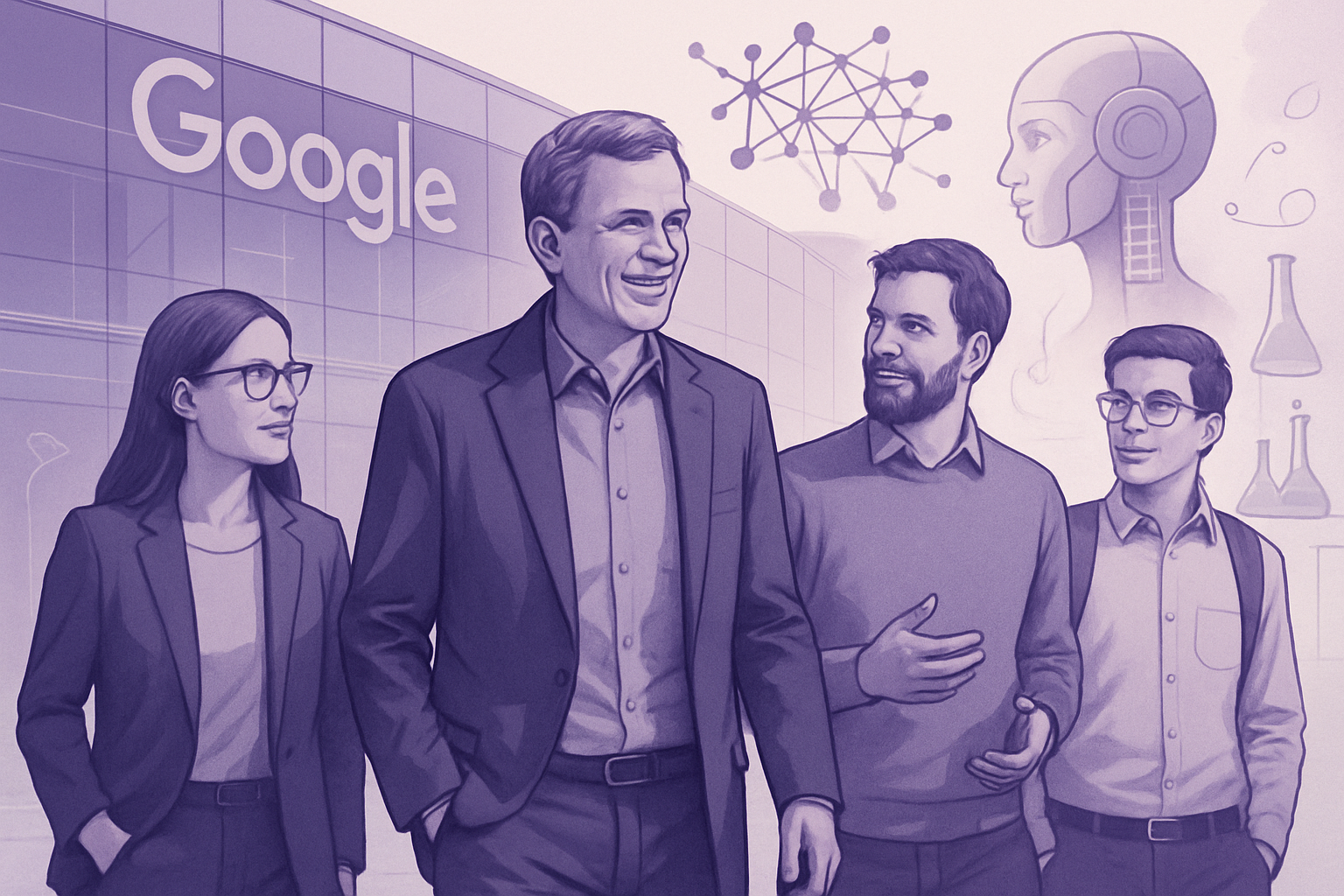
Jeff Dean, a central and influential figure at Google, has decided to leave the tech giant to embark on a new entrepreneurial adventure. He is teaming up with other renowned researchers from Google to create a startup dedicated to artificial intelligence. Among these collaborators are Sanjay Ghemawat, a recognized senior engineer and researcher, Quoc Le, a pioneer of Google Brain, and Oriol Vinyals, a senior research scientist at Google DeepMind. Jeff Dean will take the helm of this new company as CEO.
The group has founded Discovery Loop, a company distinguished by its status as a public benefit corporation. Their ambitious goal is to leverage artificial intelligence to give new momentum to scientific research. Discovery Loop plans to utilize advanced algorithms to conduct thousands of experiments simultaneously, aiming to automate part of the research process and increase the scale of possible experimentation.
One of the most innovative aspects of Discovery Loop is its interest in using artificial intelligence to create even more powerful AI systems. This concept, known as recursive self-improvement, aims to eliminate the need for human intervention in the iteration process.
In a press release, the company emphasized that while science and engineering have enabled significant advancements over the centuries, these progressions have often been hindered by slow and sequential human iterative processes. Discovery Loop intends to overcome this obstacle by developing AI systems capable of harnessing massive computing power to transform the speed and efficiency of innovation by automating complete experimental loops.
The idea of using AI to accelerate scientific discoveries is not new and has long piqued the interest of scientific and technological communities. However, until recently, it remained largely experimental with few concrete commercial applications.
Discovery Loop has already attracted the attention of several investors, including Google's parent company, Alphabet. The startup's first funding round is co-led by Radical Ventures and Khosla Ventures. Other notable investors, such as Kleiner Perkins, Lightspeed, and Doerr Capital, have also participated.
In a joint statement, the founding team expressed their vision for the future of AI, emphasizing that the next big step is to go beyond merely answering questions to start making discoveries. By accelerating the way scientific discovery and engineering are conducted, they hope to bring the benefits of transformative technologies to the world more quickly.
Jeff Dean, who joined Google in 1999 as the 30th employee, has played a crucial role in developing Google's research infrastructure. His work has included significant contributions to Google's crawling, indexing, and query serving systems. He has also influenced Google Gemini's multimodal models and has been a key player in the company's early artificial intelligence research.
In an interview with the New York Times, Dean expressed his belief that AI has the potential to more completely automate experimental loops, which have traditionally been very labor-intensive. According to him, this would allow for an increase in both the quantity and quality of experiments, leading to major breakthroughs and scientific advancements.
Brief IA — L'actualité IA en français
L'essentiel de l'actualité de l'intelligence artificielle, décrypté et expliqué chaque jour.