Google and Kaggle: World Record with Their Free AI Course
Le brief IA que les pros lisent chaque soir
Les 7 actus IA du jour, décryptées en 5 min. Gratuit.
Inclus dès l'inscription : notre sélection des meilleurs guides & comparatifs IA.
Choisis ton rythme
Gratuit · Pas de spam · Désabonnement en 1 clic
Google and Kaggle: An Ambitious Educational Partnership
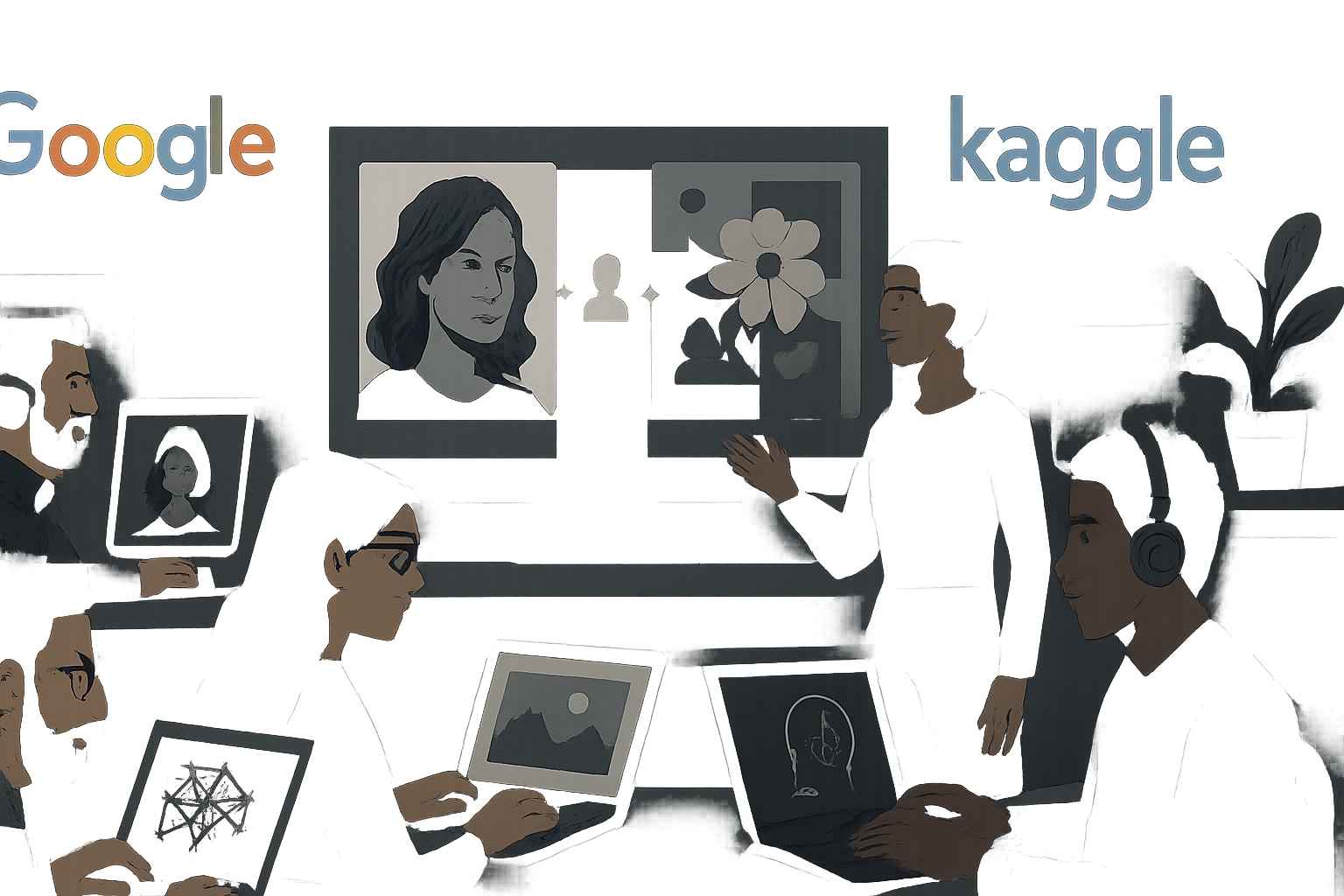
In an effort to make generative AI more accessible and understandable, Google and Kaggle have collaborated to offer an intensive five-day course. This program stands out for its depth and its ability to balance theory and practice effectively. Unlike many free courses that merely skim the theory, this initiative offers a detailed exploration of fundamental models, embeddings, AI agents, domain-specific large language models, and machine learning operations (MLOps). The course includes whitepapers, hands-on coding labs, and live expert sessions.
A Resounding Success and a World Record
The second edition of this program attracted over 280,000 registrations, setting a Guinness World Record for the largest virtual AI conference in a week. All course materials are now available as a self-directed Kaggle Learn Guide, completely free, allowing learners to progress at their own pace. This initiative has not only captured the attention of a wide audience but has also been recognized for its quality and impact in the field of AI education.
Course Structure and Content
The program is structured around five thematic days, each addressing a crucial aspect of generative AI. Participants have access to whitepapers written by Google experts, AI-generated summary podcasts with NotebookLM, and hands-on coding labs on Kaggle notebooks. The live sessions, initially broadcast on YouTube, included Q&A with experts and a Discord community of over 160,000 learners. This multi-channel approach allows participants to gain a deep understanding of concepts while having the opportunity to apply them immediately.
Day 1: Fundamental Models and Prompt Engineering
The first day focuses on the evolution of large language models (LLMs), starting with the original Transformer architecture. Participants explore advanced techniques for fine-tuning and inference acceleration. The section on prompt engineering covers practical methods for effectively guiding model behavior, going beyond basic instruction tips. Hands-on exercises utilize the Gemini API to test various prompt techniques in Python. For those who have used LLMs but have never explored the mechanisms of temperature tuning or few-shot prompt structuring, this section quickly addresses these knowledge gaps.
Day 2: Embeddings and Vector Databases
On the second day, the course covers embeddings and their practical applications, particularly in semantic search and retrieval-augmented generation (RAG). Participants learn the geometric techniques used to classify and compare textual data and build a RAG question-answering system. This session demonstrates how organizations anchor LLM outputs in factual data to mitigate hallucinations. By providing a functional overview of how embeddings fit into a production pipeline, this day is crucial for understanding the infrastructure necessary for implementing large-scale AI solutions.
Day 3: Artificial Intelligence Agents
The third day is dedicated to AI agents, which connect LLMs to external tools and real-world workflows. Participants learn the essential components of an agent, the iterative development process, and the practical application of function calling. Coding labs allow the development of an agentic command system with LangGraph, providing a technical foundation for interconnecting these systems. As agentic workflows become the norm for production AI, this section provides the technical basis needed to interconnect these systems.
Day 4: Domain-Specific Large Language Models
Participants explore specialized models for industries such as cybersecurity and healthcare, with examples like Google's SecLM for cybersecurity and Med-PaLM for healthcare. The course includes exercises for fine-tuning Gemini models, demonstrating how to adapt a model for specific tasks with labeled data. This section emphasizes the importance of fine-tuning to achieve accuracy and specificity in particular domains. Details regarding the use of patient data and protective measures are also addressed, highlighting the need for an ethical and secure approach in the development of AI models.
Day 5: Machine Learning Operations for Generative AI
On the final day, the course covers the deployment and maintenance of GenAI in production, with a code demonstration on Vertex AI tools. Although there is no interactive lab, this session provides essential context for transitioning models to a production environment. A live demo of Google Cloud's GenAI resources is also included, offering a practical overview of the available tools. This provides essential context for anyone considering moving models from a development notebook to a production environment for real users.
A Course for All Levels
This program is ideal for data scientists, machine learning engineers, and developers looking to specialize in GenAI. With a multi-format approach, the course caters to different levels of experience, and even beginners with a basic understanding of Python can benefit. The self-directed format of the Kaggle Learn Guide allows for complete flexibility, with no need for local setup. A Kaggle account verified by phone is all you need to get started.
In conclusion, Google and Kaggle offer a high-quality educational resource that combines theory and practice for a comprehensive learning experience in generative AI. The high registration numbers and industry recognition reflect the quality of the material. Whether your goal is to build a RAG pipeline or understand the underlying mechanisms of AI agents, this course provides the conceptual framework and code necessary for success.
Brief IA — L'actualité IA en français
L'essentiel de l'actualité de l'intelligence artificielle, décrypté et expliqué chaque jour.