King's Cross: From Troubled Neighborhood to Global AI Hub
Le brief IA que les pros lisent chaque soir
Les 7 actus IA du jour, décryptées en 5 min. Gratuit.
Inclus dès l'inscription : notre sélection des meilleurs guides & comparatifs IA.
Choisis ton rythme
Gratuit · Pas de spam · Désabonnement en 1 clic
King's Cross, the New Eldorado for AI Startups
In the rapidly evolving tech landscape of the UK, one burning question occupies the minds of every artificial intelligence startup: how to set up shop in King's Cross? This once notorious London district is now so sought after that a venture capital firm recently secured a deal by promising an entrepreneur office space in the area. The firm confirmed its commitment to doing everything possible to support founders, including helping them find offices, although it did not confirm the details of this rumor.
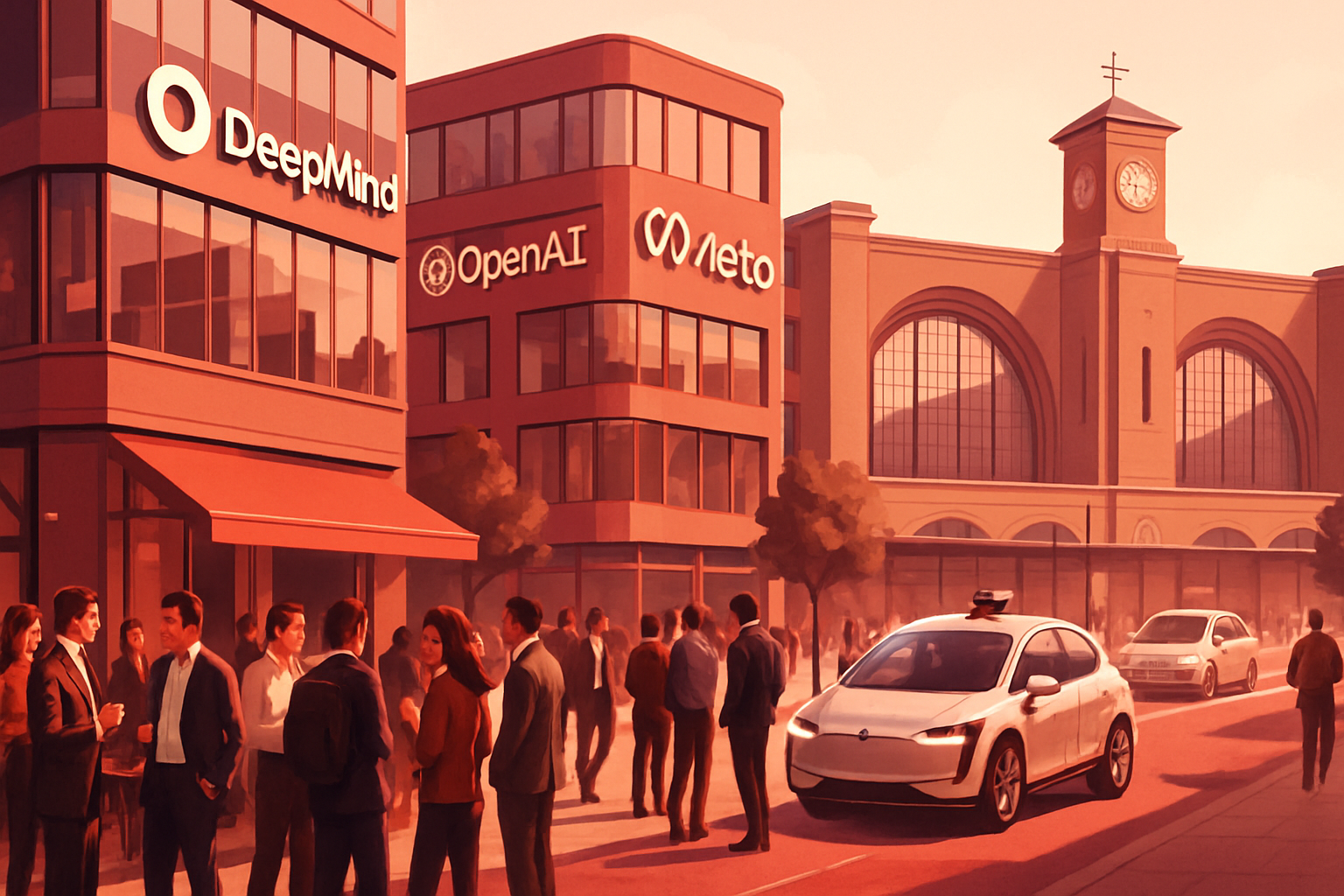
The transformation of King's Cross began in 2016 when DeepMind, freshly acquired by Google, chose to establish its headquarters there. This strategic decision attracted a multitude of AI startups eager to benefit from the aura of Google DeepMind and the ecosystem of AI talent that has developed in the area.
A Global Hub Rivaling San Francisco and Beijing
Today, King's Cross is recognized as one of the leading AI hubs in the world, rivaling giants like San Francisco and Beijing. In the London area, it is nicknamed the "Knowledge Quarter," housing renowned companies such as OpenAI, Meta, Isomorphic Labs, Cusp AI, Wayne, Recursive, as well as Synthesia and Anthropic, located a bit further away. The European Technology Network (ETN) recently opened new offices in the district, while University College London is just a stone's throw away.
The area is not limited to technological innovations. It is also home to trendy restaurants like Hoppers and BAO. Additionally, King's Cross offers exceptional connectivity: in 45 minutes, entrepreneurs can reach Cambridge to recruit talent, or Paris in two hours to close deals.
A Spectacular Transformation
It is hard to imagine that just over 20 years ago, King's Cross was one of the most notorious neighborhoods in London. Hussein Kanji, an investor at Hoxton Ventures, recalls the 1980s when drugs and heroin were rampant, turning the area into a major narcotics market. In 1982, the local church was even occupied by the English Collective of Prostitutes for 12 days. However, in the early 2000s, a real estate developer envisioned a different future for the area, and today, King's Cross has become the cradle of AI in the UK.
About 18 months ago, BioCorteX, a portfolio company, moved from Holborn to King's Cross, hoping to get closer to the area's vibrancy. Nik Sharma, co-founder of BioCorteX, noted that many tech giants, known as hyperscalers, are setting up in the region. Among them, Jeff Bezos's AI company, Prometheus, is reportedly in talks to move into the Jellicoe building.
Rapid Growth and Rising Rents
London is home to approximately 3,600 AI startups, which have collectively raised around $12.1 billion out of the $14.8 billion raised in the city since the end of July, according to Dealroom. Since June, AI-related startups have leased over 1 million square feet of office space in London, according to Knight Frank. As a result, rents in King's Cross have surged by 18% over the past three years, according to Chris Dunn, a partner in commercial insights. This percentage pertains to significant leases of at least 10,000 square feet, such as those signed by OpenAI and Prometheus. Shorter leases are negotiating at even higher rates, and the vacancy rate for conventional office spaces is now just 0.9%. "Demand has outstripped supply," he added.
The Question of Technological Sovereignty
A major topic in the region is technological sovereignty. The cessation of access to Mythos and Fable by Anthropic this summer was a wake-up call for many. Saul Klein, co-founder of Phoenix Court, emphasized the importance of developing and retaining AI capabilities unique to Europe, rather than simply renting these capabilities. Phoenix Court, located in King's Cross, has three portfolio companies in the area, including Olix, recently valued at $3.3 billion, Early Health, and CoMind.
Robin Klein, co-founder of Phoenix Court, stated that the closure of access to Fable and Mythos was a reminder that Europe must build and retain some of its own AI capabilities. King's Cross is a place where this construction is underway. "The more important question," he added, "is whether the UK is building the infrastructure, computing, energy, and capital to make this autonomy sustainable, rather than just hosting outposts of American labs."
Startup Founders Choose to Stay
Simon Kohl, founder of Latent Labs, has offices in both King's Cross and San Francisco. The London office is currently experiencing faster growth, and he is more optimistic than ever about the local ecosystem. "The current vibe is less about London trying to catch up and more about London becoming the default place to build a serious AI company," he said.
Wayve, founded in 2017 by Alex Kendall, is one of London's unicorns. "Ten years ago, starting a cutting-edge AI company from London seemed like an unusual choice," he said. "Now, it seems like an obvious choice." Wayve moved to King's Cross in 2018 in search of space that could serve as a garage, a rare combination in central London. Kendall has observed the ecosystem mature around him, and it is now clear that a startup can remain in London, raise significant capital, recruit world-class AI talent, and stay competitive on a global scale.
An Expanding Talent War
Near Anthropic's new 158,000 square foot office are AI agent builder Sierra and the AI video platform Synthesia. Laura Gonzalez Florez, chief of staff at Synthesia, explained that the company moved into its new building a year ago to accommodate its growing team. They were attracted to the area for its proximity to the airport and investors.
About two-thirds of Synthesia's engineers work remotely, allowing the company to tap into an affordable and diverse international talent pool, helping it grow faster. "From London, we can recruit and work, without any problem, with people from everywhere, from Slovenia to Portugal," she said.
The AI boom in London has also triggered a talent war. Job postings in AI in the UK have exploded in recent years, according to PwC. When Anthropic announced its arrival in the city earlier this year, it offered a salary range of £260,000 to £630,000 for a machine learning research engineer, while the average salary in London for this position is around £102,000. Some founders in the UK, like those in Silicon Valley, must raise larger amounts to keep pace.
Zain Ali, founder of Centuro, a legal AI company based in King's Cross, stated: "The real test is whether world-class AI companies are founded, funded, and developed from the UK, while continuing to attract the best talent in the world to build them here." If this continues, King's Cross will not only be an AI hub but will become one of the UK's most important strategic assets.
Brief IA — L'actualité IA en français
L'essentiel de l'actualité de l'intelligence artificielle, décrypté et expliqué chaque jour.