MuleSoft and LLM: A Revolution in Enterprise AI Orchestration
Le brief IA que les pros lisent chaque soir
Les 7 actus IA du jour, décryptées en 5 min. Gratuit.
Inclus dès l'inscription : notre sélection des meilleurs guides & comparatifs IA.
Choisis ton rythme
Gratuit · Pas de spam · Désabonnement en 1 clic
The Complex Integration of Enterprise Data
In today's business landscape, information is often fragmented across various systems such as CRMs, ERPs, databases, and a multitude of APIs. This dispersion creates a complex network of disconnected data. At the same time, the field of artificial intelligence (AI) is experiencing rapid growth with the emergence of advanced tools like language models (LLMs) for natural language processing and Image GPT for image creation. The major challenge for businesses is to successfully integrate these core systems with advanced AI models in a seamless and secure manner. AI orchestration appears to be the solution to unify these two worlds.
Understanding AI Orchestration
A Control Tower for AI
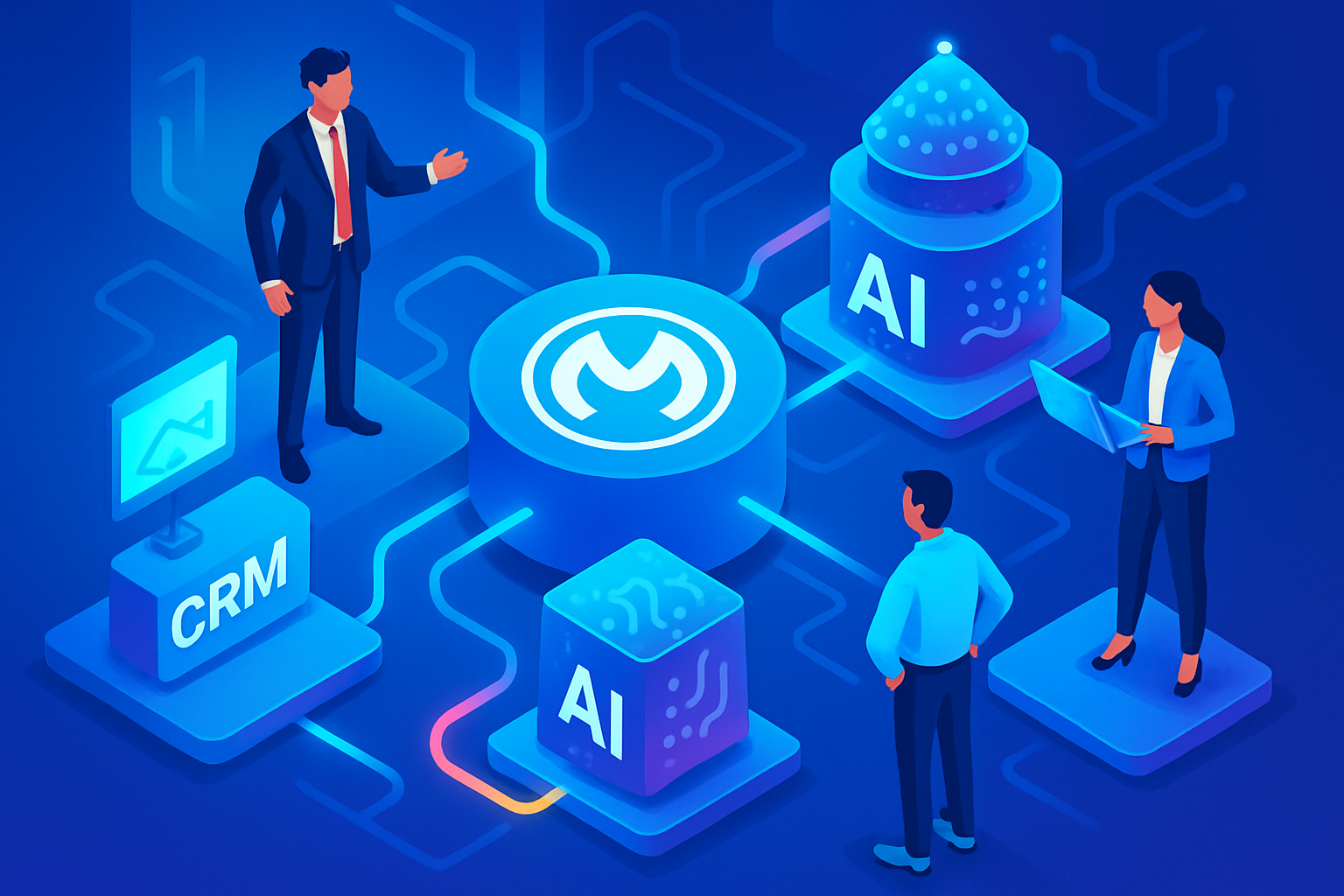
AI orchestration can be likened to a control tower that manages a company's intelligence and data. It orchestrates a complex sequence of actions with precision and efficiency. An AI orchestrator integrates directly with a company's core systems, whether it's an ERP, a CRM, or a custom database. It routes requests to the most appropriate AI model for each task, whether it's an LLM, an image model, or an analytics tool. Furthermore, it consolidates the final results powered by AI into secure and well-structured APIs that can be utilized by any application. The orchestrator is at the heart of the action, determining which data to retrieve, which AI model to apply, and how to merge and serve the final result.
MuleSoft: A Key Player in Orchestration
This is where a tool like MuleSoft, Salesforce's robust integration engine, comes into play. Once recognized for its API-driven integration strategy, MuleSoft is becoming the preferred platform for AI orchestration in enterprises. MuleSoft functions as an API gateway and a rendering engine, securing, managing, and exposing AI-powered APIs, making them robust and scalable. As an enterprise connector, MuleSoft has a comprehensive set of out-of-the-box connectors for Salesforce, SAP, Oracle, and many others, allowing data extraction from almost any system. As a governance layer, it provides a solid foundation for implementing authentication, controlling access, tracking usage, and maintaining compliance. Finally, as a lightweight orchestrator, MuleSoft can create simple yet powerful flows, such as retrieving data from a database, passing it to an LLM for processing, and returning a formatted result.
However, MuleSoft is not used for sophisticated native AI operations such as prompt chaining, multi-step reasoning, or conversational memory. While you can create a prompt model and fill it with information, sophisticated orchestration requires a hybrid solution. This is where frameworks like LangChain or LlamaIndex come into play to complement MuleSoft's capabilities by handling sophisticated AI logic while leaving the enterprise integration to MuleSoft.
A Concrete Example: AI-Orchestrated Business Intelligence Assistant
Consider a multinational company that wants to equip its sales and customer success teams with real-time data from all the data sources they have, such as the CRM and external databases. The goal is to build a business intelligence assistant capable of understanding natural language questions like: “Show me which enterprise customers in EMEA are at risk of leaving this quarter and draft a personalized retention email for each.”
This requires gathering fragmented enterprise data, performing intelligent analysis, and returning the results into the secure flow of the CRM. Here’s how the end-to-end flow would be realized through AI orchestration:
-
User Request: A sales manager types the question directly into the Salesforce service console. This request is sent as an API call to MuleSoft.
-
API Gateway and Security Layer (MuleSoft): MuleSoft acts as the entry point, authenticating the Salesforce user via OAuth, logging the request, and applying governance rules such as data masking, rate limits, and compliance.
-
Data Retrieval: MuleSoft orchestrates multiple data calls. All the following data will be aggregated in MuleSoft into a unified payload:
- Retrieves customer data, renewal dates, and sentiment from support tickets from Salesforce.
- Pulls usage metrics from an external analytics database.
- Queries contract and billing history from the external billing database linked to the payment service.
-
AI Orchestrator (MuleSoft + LangChain): MuleSoft passes the consolidated data to a microservice based on LangChain, hosted in AWS or Salesforce Data Cloud. The LLM analyzes the risk of churn by combining usage data, support sentiment, and renewal timelines. It generates personalized retention messages for each high-risk customer based on the retrieved data.
-
Response Packaging (MuleSoft): MuleSoft receives the AI results and formats them into a unified response. This is exposed to the Salesforce service console via a secure API without exposing the customer's personal data.
-
Salesforce Experience Layer: The results appear as a dynamic dashboard in Salesforce, showing at-risk customers with churn probability scores, automatically generated email drafts for approval to contact the customer, and suggested steps based on reasoning.
Why This Represents a Leap for Businesses
This choreographed strategy brings together the following transformative value: unified data access eliminates silos, presenting a single integrated view of enterprise data. Intrinsic governance ensures that security and compliance are part of the architecture and not added later. Native AI intelligence enables sophisticated reasoning, linking disparate AI functions together and allowing for multimodal outputs (text, images, etc.). Finally, the reusable API-driven architecture allows the same pipeline to feed not only chatbots but also internal analytics dashboards, marketing bots, and other applications.
More Than Just Chatbots: The Future of AI in Enterprises
Use cases extend far beyond customer service. Consider these examples:
-
Analytics Dashboards: “Summarize last quarter's sales trends in the EMEA region and create a corresponding chart.”
-
Automation Bots: “Create a personalized follow-up email for our top 10 clients, including images of the products they viewed and warranty information.”
-
E-commerce Assistants: “Create personalized product descriptions and lifestyle images for our new summer collection without exposing the entire database to an external AI model.”
The future of enterprise AI is not just about building smarter models. It’s about constructing a smarter, more secure, and deeply integrated fabric that connects your enterprise data, APIs, and AI tools.
Brief IA — L'actualité IA en français
L'essentiel de l'actualité de l'intelligence artificielle, décrypté et expliqué chaque jour.