Google Gemma 4: The Open-Source AI for Local Devices
Le brief IA que les pros lisent chaque soir
Les 7 actus IA du jour, décryptées en 5 min. Gratuit.
Inclus dès l'inscription : notre sélection des meilleurs guides & comparatifs IA.
Choisis ton rythme
Gratuit · Pas de spam · Désabonnement en 1 clic
Google Opens Gemma 4 to Open Source
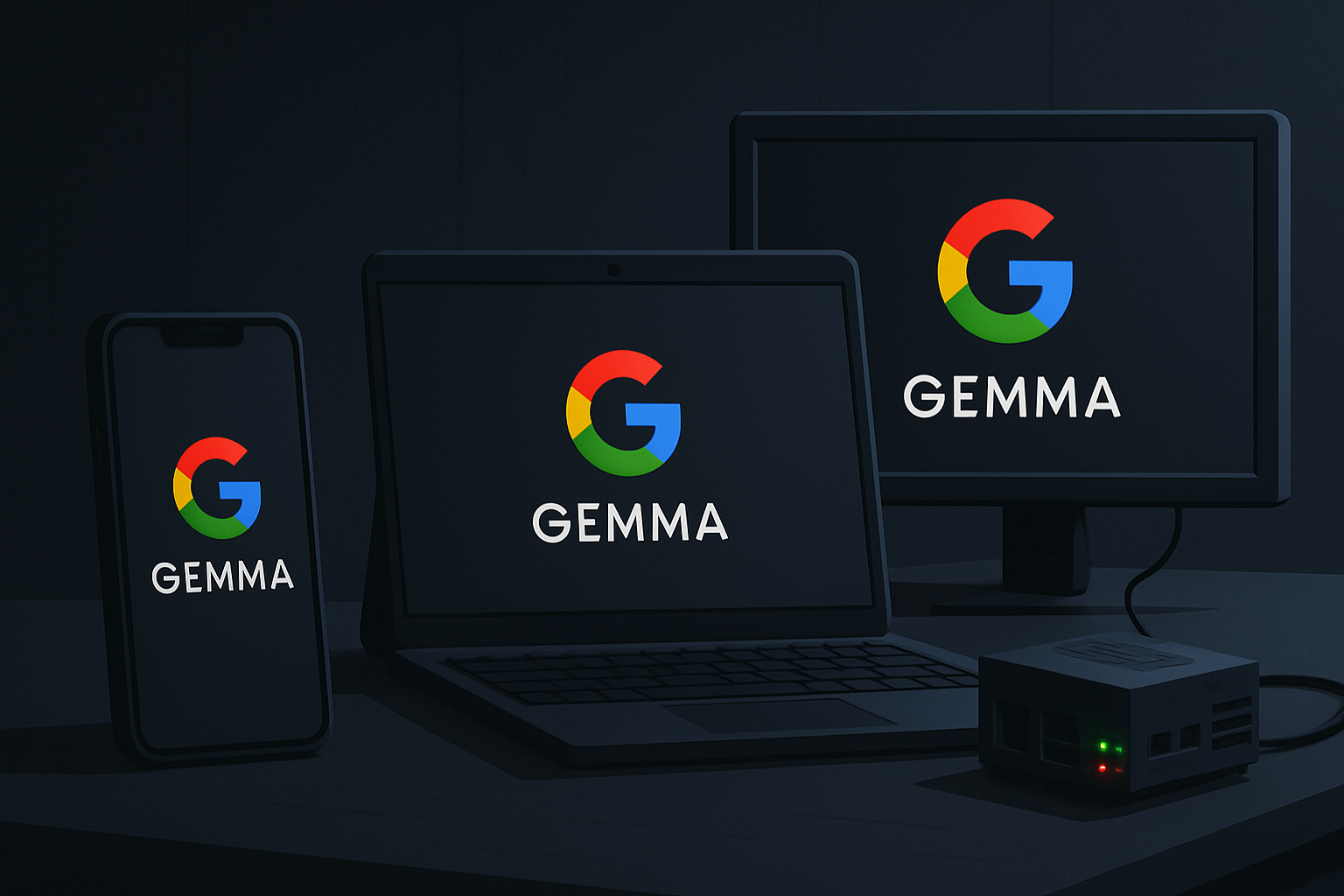
Google's Gemma 4 model, developed by its artificial intelligence research division DeepMind, is now fully open-source under the Apache 2.0 license. This initiative allows developers to deploy multimodal AI locally on various devices such as servers, phones, and Raspberry Pi, providing total control over local deployments.
Advantages of Local AI
Using AI locally presents several significant advantages. First, it ensures data privacy, which is crucial for businesses with strict data sovereignty requirements. By processing data locally, there is no need to send it to the cloud, thereby reducing privacy-related risks. Additionally, local AI enables offline use, which is particularly beneficial for devices with intermittent network connectivity. Finally, by avoiding costs associated with using cloud services, businesses can achieve substantial savings.
Gemma vs Gemini: Two Different Approaches
Gemma is a language model (LLM) that focuses on the AI processing engine, unlike Gemini, which is oriented towards the chatbot interface. While Gemini is a closed product requiring a subscription, Gemma is an open model that users can download and run locally at no cost.
New Rights with the Apache 2.0 License
Previous versions of Gemma were subject to specific terms of use, limiting their usage and redistribution. With the new Apache 2.0 license, users now have the ability to use the software for personal, commercial, or business purposes without royalties. They can also modify and redistribute the code, including creating derivative works.
Massive Adoption and Impact
Since its launch in February 2024, Gemma has been downloaded over 400 million times, creating a dynamic ecosystem with more than 100,000 variants. With the transition to a truly open-source model, even wider adoption is expected.
Technical Capabilities of Gemma 4
Gemma 4 consists of four distinct models:
- 26B and 31B: These models are intended for high-end servers equipped with powerful GPUs, focusing on reducing latency and maximizing raw power.
- E2B and E4B: Designed for mobile and IoT devices, these models have parameter footprints of two and four billion, respectively, allowing for efficient execution on portable devices.
Advanced Features
The Gemma 4 models offer several advanced capabilities, including advanced reasoning with multi-step planning and deep logic capabilities. They also enable the deployment of autonomous agents interacting with various tools and APIs. In terms of security, the Gemma 4 models are subject to the same security protocols as Google's proprietary models. Additionally, they support offline code generation, which is useful for users without connectivity. The models also include native processing of videos and images, with built-in speech recognition for the E2B and E4B models. Finally, they are trained in over 140 languages, providing extensive multilingual support.
Conclusion
Gemma 4 outperforms models 20 times larger in terms of intelligence per parameter, achieving cutting-edge capabilities with fewer hardware resources. Developers can now consider deploying Gemma 4 on local devices for various tasks, paving the way for new innovative applications.
Brief IA — L'actualité IA en français
L'essentiel de l'actualité de l'intelligence artificielle, décrypté et expliqué chaque jour.