Machine Learning and Quantum: Protecting States, Not the Paradox
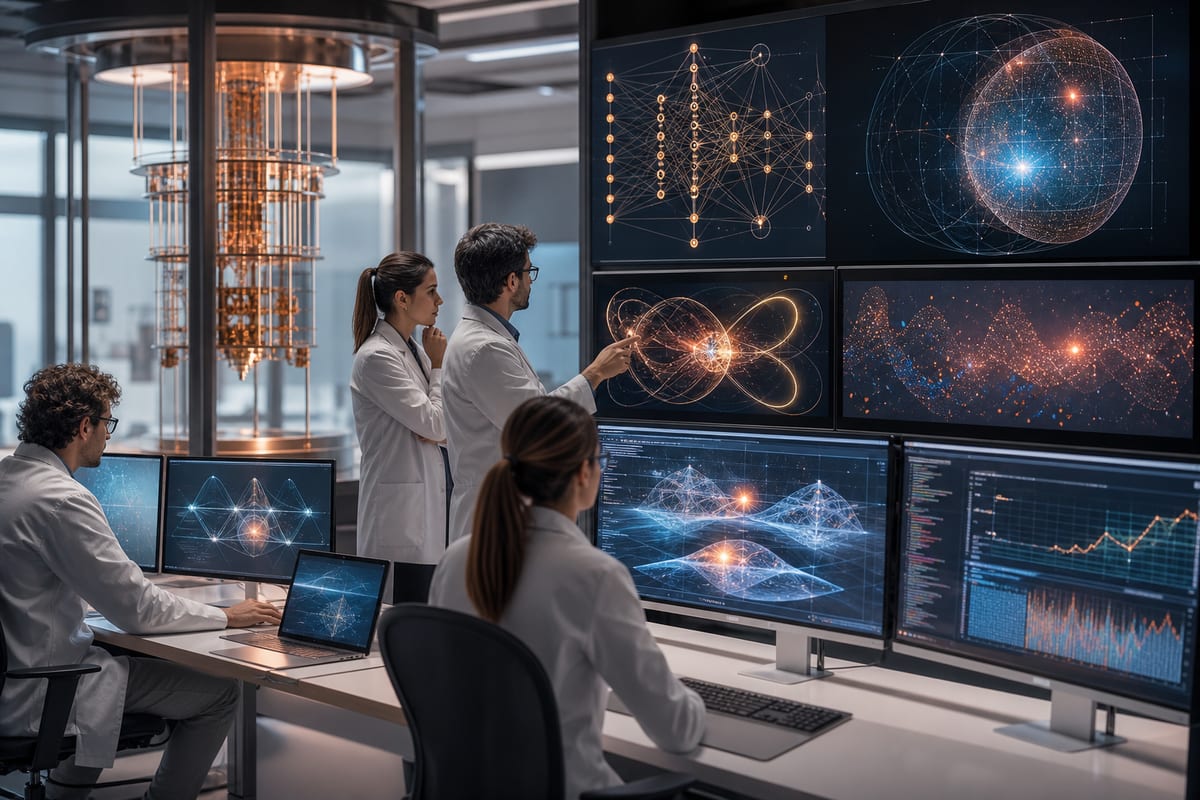
Machine learning is making its way into quantum laboratories with practical applications: it helps preserve fragile states and anticipate experimental outcomes. However, these advancements do not resolve fundamental questions: the Schrödinger's cat paradox and the measurement problem remain open.
Protecting Fragile States from Decoherence
Machine learning can help preserve quantum states from decoherence, a major obstacle in the development of quantum computers. These approaches also change the way we protect superpositions of quantum states.
Le brief IA que les pros lisent chaque soir
Les 7 actus IA du jour, décryptées en 5 min. Gratuit.
Inclus dès l'inscription : notre sélection des meilleurs guides & comparatifs IA.
Choisissez votre rythme
Gratuit · Pas de spam · Désabonnement en 1 clic
Predicting and Exploring Complex Quantum Systems
Machine learning algorithms are used to anticipate the results of quantum experiments based on experimental data. They also serve to analyze and model complex quantum systems, explore and better understand state superpositions, and provide new insights into their behavior.
What AI Does Not Resolve: Measurement and the Cat Paradox
Neural networks do not solve the measurement problem in quantum mechanics. The Schrödinger's cat paradox, which highlights the inconsistencies of quantum theory, continues to spark discussions. While machine learning changes the way we approach quantum mechanics and allows for new advancements, it does not provide a definitive solution to this philosophical question.
Brief IA — L'actualité IA en français
L'essentiel de l'actualité de l'intelligence artificielle, décrypté et expliqué chaque jour.