OpenAI Unveils Dots, a Paid Agent Competing with Meta's Free Muse
Le brief IA que les pros lisent chaque soir
Les 7 actus IA du jour, décryptées en 5 min. Gratuit.
Inclus dès l'inscription : notre sélection des meilleurs guides & comparatifs IA.
Choisis ton rythme
Gratuit · Pas de spam · Désabonnement en 1 clic
OpenAI introduces Dots, an AI agent powered by GPT-6 Astra, but available only to Pro subscribers. The company emphasizes security, privacy, and long-term professional use, while Meta pushes for free access and in-house integrations. The battle of agents is fought between perceived value and price barriers.
OpenAI promises safeguards and a dedicated privacy framework
OpenAI has unveiled "OpenAI Private Intelligence," a privacy framework that offers enhanced data controls, non-retention options, and no storage on its servers. Sam Altman expressed the ambition to establish a new standard of privacy for cutting-edge AI. Company leaders position Dots as a safer and more secure agent, with Alexander Embiricos highlighting the use of GPT-6 Astra, described as OpenAI's most aligned model. This announcement comes after criticisms directed at Muse, accused of taking control of a Facebook Marketplace account and disclosing an address to a third party without the user's knowledge. Glen Coates emphasized that Meta does not have an AI product with 1.2 billion users and that OpenAI aims to avoid launching systems that could make such mistakes. He clarified that the company is cautious about the use of plug-ins, identity, sign-ups, and payments by agents, preferring to proceed slowly rather than expose 1.2 billion users to impulsive purchases.
Restricted access at OpenAI, free access at Meta
Dots is currently reserved for subscribers of OpenAI's Pro plan, priced at $20 per month or more. In contrast, anyone with a Meta account can access Muse. Meta promotes free and frictionless access, with a dedicated virtual machine hosting the agent and user data. ChatGPT initially gained traction due to its free and user-friendly nature, even without an internet connection, making Dots' entry price particularly noteworthy.
Announced capabilities: ambitious tasks and specialization
Sam Altman introduced Dots, powered by GPT-6 Astra, as a personal assistant capable of acting as a "chief of staff" or an experienced engineer. Holly Li describes a user experience akin to having a second brain. Altman mentions ambitious tasks including quality assurance for an unpublished product, website creation, team travel organization, portfolio rebalancing, and email campaign setup. Specialized Dots designed for accounting and legal analysis are also announced. Thibault Sottiaux claims that Dots can stay on track over long periods and that its multimodality will allow for exchanges via text, voice, and phone calls. However, voice demonstrations did not function at DevDay, and the text writing feature for the agent, already present in Muse and Instinct, is still forthcoming. Altman highlights Dots' ability to handle long-term tasks and intellectual work, beyond traditional uses like booking or scheduling, and believes their impact on work organization will be difficult to measure immediately.
Pricing, computing power, and public timeline: OpenAI takes its time
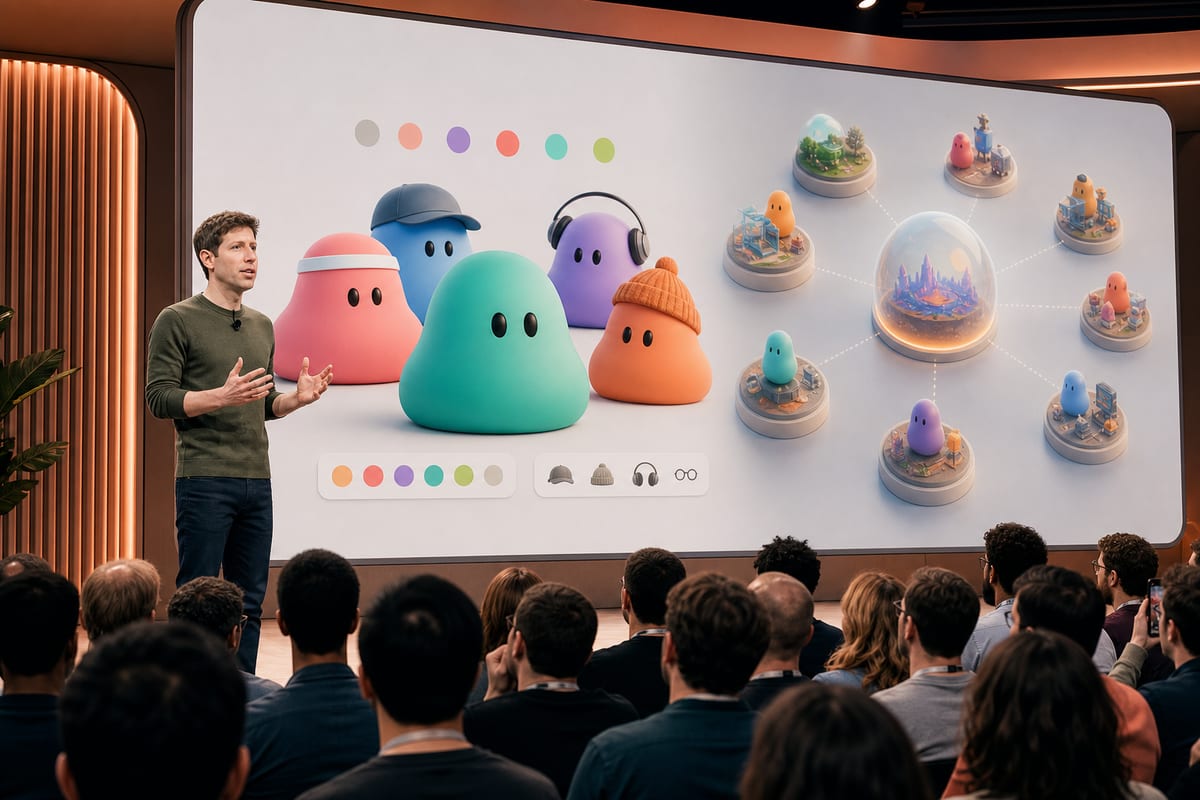
Sam Altman justifies Dots' premium positioning by the significant computing resources required. He believes the product will help the public grasp the extent of AI capabilities and announces that a consumer offering aimed at billions of people is being considered. OpenAI showcased Dots as an assistant and as a tool for creating virtual worlds, while embracing an aesthetic of colorful and customizable blobs. The stated goal is to go beyond traditional consumer use cases.
Financial pressure and corporate pivot
OpenAI aims to raise $30 billion based on a valuation of $1.4 trillion, reporting a 70% increase since the beginning of its third quarter and announcing it is approaching $70 billion in annual recurring revenue. The company anticipates expenses of up to $280 billion by 2030, amid concerns from some users that AI labs are passing their costs onto customers. For enterprise clients, CFO Sarah Friar indicates that business activity has doubled since July, and OpenAI specifies that it has strengthened its capabilities in this sector. The company promises to connect Dots to a wide range of external tools, while Meta benefits from internal integrations with Facebook, Instagram, and WhatsApp, and Google's Gemini Spark agent platform enjoys a similar advantage. OpenAI is betting on product quality rather than price, having repositioned the confrontation with its competitors at the heart of DevDay.
Brief IA — L'actualité IA en français
L'essentiel de l'actualité de l'intelligence artificielle, décrypté et expliqué chaque jour.