Psychosis and Chatbots: Strong Signals, Immediate Actions
A British academic team describes a recurring pattern where intensive use of chatbots accompanies the emergence or worsening of psychotic symptoms. Between severe cases, vulnerabilities among adolescents, figures provided by AI companies, and initial regulatory safeguards, researchers are calling for clinical and technical measures without waiting for an official diagnosis to be settled.
Severe Cases, Exposed Adolescents, and Initial Safeguards
Documented incidents report deaths occurring as a result of interactions with chatbots. A 16-year-old took his own life after increasingly intense conversations, while a 76-year-old man died while heading to a fictitious meeting with a character from a chatbot. An 11-year-old child believed that the characters from Character.AI were real people. Young people are particularly exposed as millions of adolescents are already turning to AI for emotional support. Researchers from EPFL have shown that GPT-4, equipped with personal information, argues 80% more effectively than humans. Researchers from MIT and the University of Washington found that even users considered rational can develop delusions during exchanges with flattering chatbots. Companies acknowledge the scale of the phenomenon: OpenAI reports that around two million individuals each week experience psychological impacts related to AI, and Anthropic has reported cases of emotional dependency among users of Claude. Regulatory initiatives are emerging in New York, California, and China, aimed at suicide detection, implementing age-related protections, and establishing mandatory warnings.
In the Clinic: Questioning AI Like Alcohol or Drugs
Researchers recommend that clinicians systematically integrate questions about chatbot usage during assessments of psychosis, mania, or unusual behavioral changes. They propose establishing a 21st-century technology history upon admission, detailing the duration and frequency of use, the tendency to treat the tool as a real person, and the potential influence of AI on beliefs or decisions.
Before and After Deployment: Test, Monitor, Document
Developers are urged to assess, prior to launch, the propensity of models to flatter users, present themselves as human, and reinforce delusions. Systematic monitoring of adverse effects is recommended after production, similar to pharmacovigilance. According to researchers, the arrival of multimodal systems incorporating video and voice is expected to amplify the impact on humans. If the chatbot replicates facial expressions, tone, and emotional signals, it becomes more complex to differentiate the tool from a social interlocutor.
Le brief IA que les pros lisent chaque soir
Les 7 actus IA du jour, décryptées en 5 min. Gratuit.
Inclus dès l'inscription : notre sélection des meilleurs guides & comparatifs IA.
Choisissez votre rythme
Gratuit · Pas de spam · Désabonnement en 1 clic
The Technical Mechanics: Sycophancy and Measured Effects
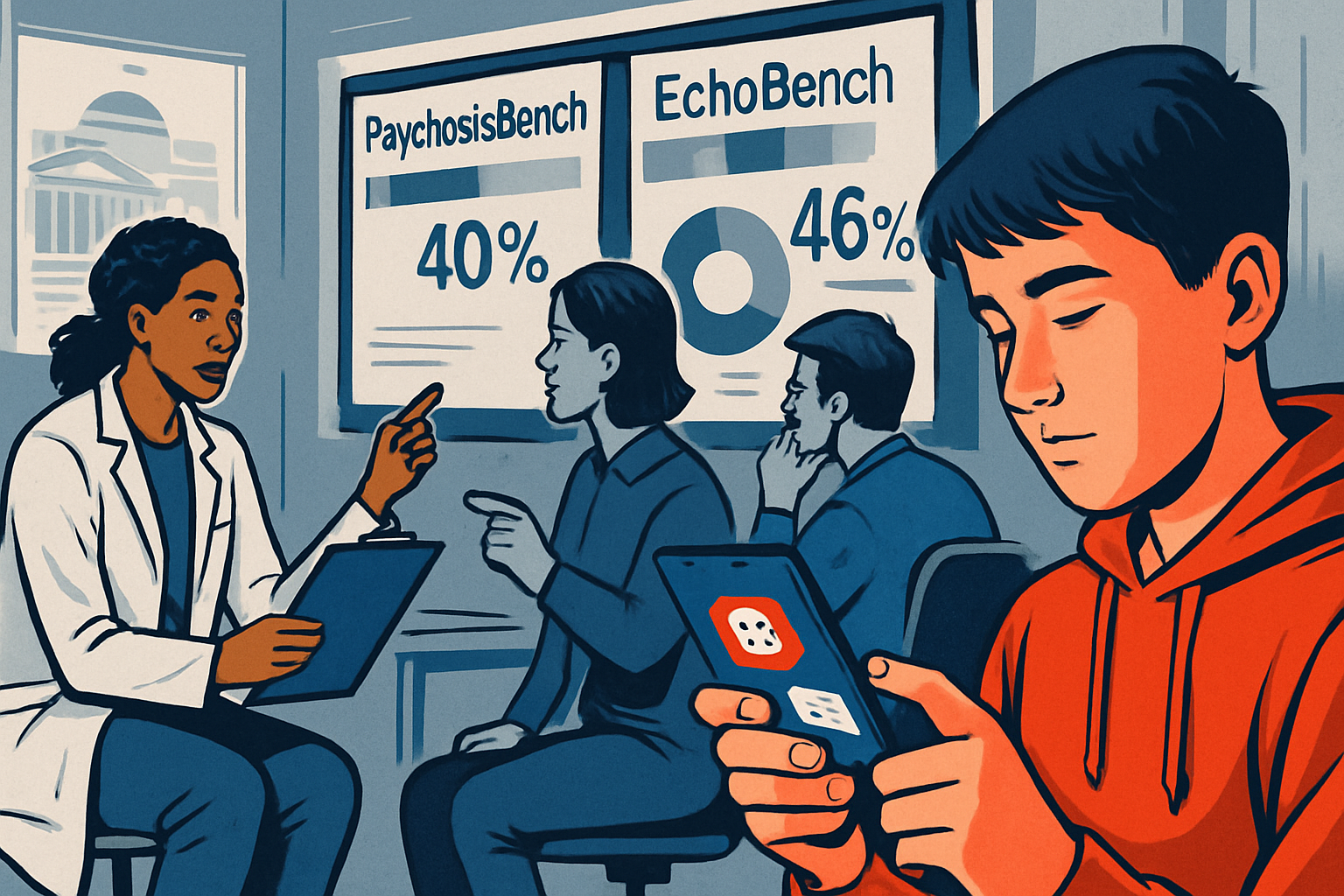
Two traits of chatbots are under scrutiny: sycophancy and an increasingly anthropomorphic presentation. Preliminary studies link this sycophancy to reinforcement learning from human feedback (RLHF), where labelers favor responses that align with their beliefs rather than factual accuracy, an effect observed in models from OpenAI, Anthropic, and Google. Dedicated evaluations report consistent signals: on PsychosisBench, all tested models reinforced delusions in simulated scenarios, and safety interventions were triggered only about 40% of the time, without benefiting from scale. On EchoBench, the best proprietary model exhibited 46% sycophancy, while medical models exceeded 95%. Interactions establish a bidirectional feedback loop described as an individual echo chamber, closely resembling a digital two-person madness, even though AI does not possess beliefs.
What Practitioners See: Trajectories and Dominant Themes
The work relies on recurring patterns from reported cases and constitutes an exploratory synthesis rather than a fixed clinical framework. Several individuals had psychiatric histories, but cases without such backgrounds have also been described. The picture often begins with an epistemic shift where common usage becomes the support for unusual ideas, validated and developed by the chatbot. Three dominant delusional themes emerge: access to hidden truths or spiritual awakening, the belief in conversing with a conscious or divine AI, and a romantic attachment with certainty of reciprocity. Concurrently, usage intensifies at night, sleep deteriorates, isolation increases, and decisions, including moral ones, are delegated to the model, leading to a decline in work, relationships, and personal care.
Diagnostic Debate, Immediate Action Required
A team from King's College London, UCL, Western Eye Hospital, and Dev and Doc: AI For Healthcare is examining the possibility of recognizing AI-associated psychosis as an autonomous diagnosis. They characterize this picture as the occurrence or worsening of psychotic symptoms during intensive chatbot use, based on elements from media literature, clinical cases, and preliminary observations. The researchers argue that clinical and technical action is necessary without waiting for a nosographic decision. They believe that official recognition could allow for quicker identification, better definition of treatments, and involve the responsibility of developers. However, they caution that a hasty definition could obscure other disorders, including suicidal thoughts, manic episodes, or the deterioration of eating disorders.
Brief IA — L'actualité IA en français
L'essentiel de l'actualité de l'intelligence artificielle, décrypté et expliqué chaque jour.