Sakana AI Bets on Nvidia Nemotron to Challenge AI Giants
Sakana AI Bets on Nvidia Nemotron to Challenge AI Giants
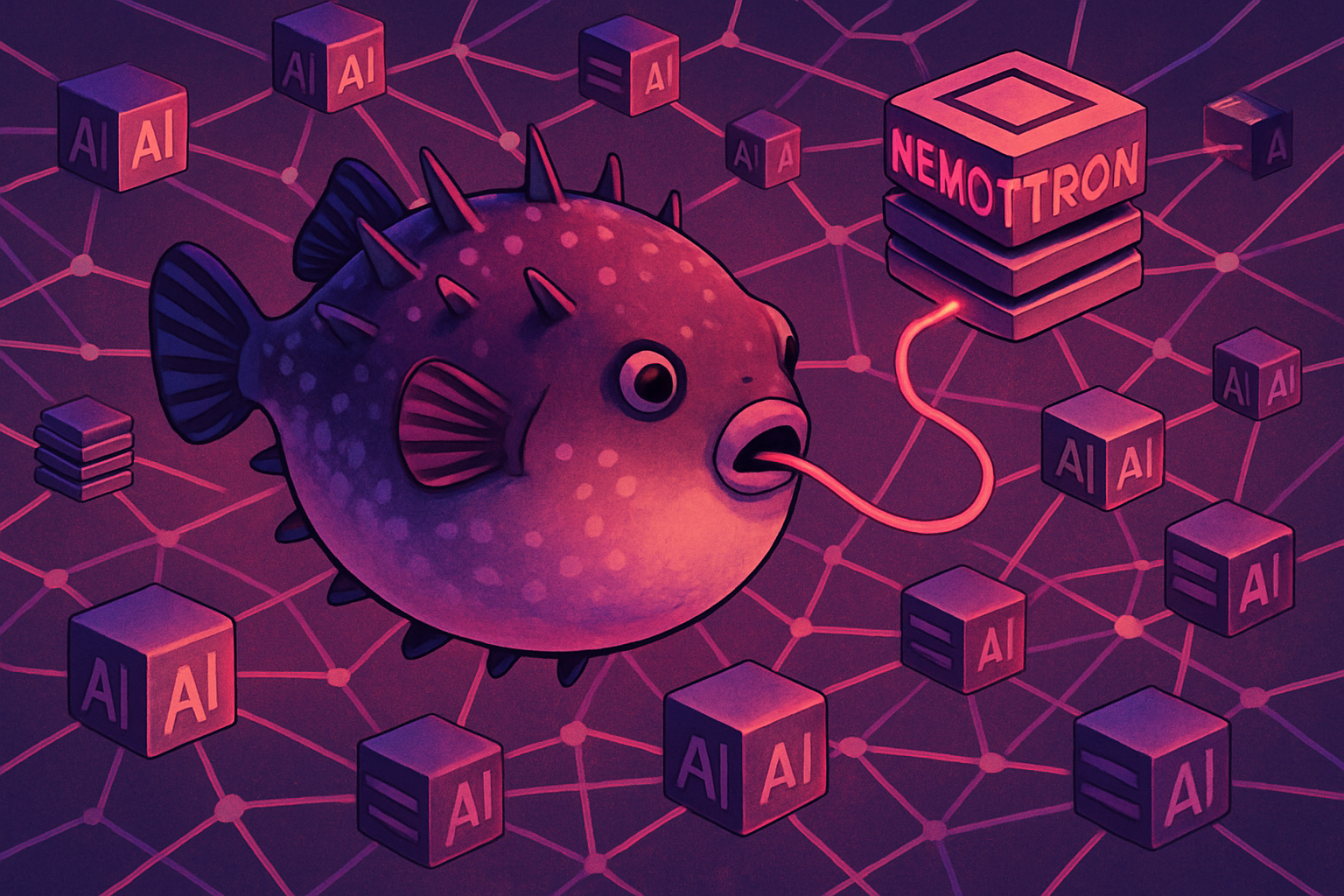
Sakana AI is expanding its AI orchestrator, Fugu, to include NVIDIA's open-source Nemotron models. Fugu dynamically selects the appropriate models for subtasks and aggregates their results.
Within this pool of agents, the Nemotron models act as specialists in programming, tool usage, and instruction following. They are intended to complement existing systems rather than replace them.
Sakana AI is based on the principle of collective intelligence. The company believes that the power of AI comes from the interaction of multiple models, which also reduces reliance on individual vendors.
The Tokyo-based startup Sakana AI is adding Nvidia's open Nemotron models to its Fugu orchestrator. This partnership aims to demonstrate that coordinated open models can compete with cutting-edge systems.
Sakana AI recently launched Fugu. The system itself is a language model trained to call other LLMs from a pool of agents that includes instances of itself. Behind a single API, Fugu dynamically chooses which models to combine for a given task, delegates subtasks, and synthesizes the results into a single response.
The setup is modular. New models can be added at any time, so the system is not tied to the strengths or failures of a single vendor, according to Sakana AI. In its own benchmarks, the company claimed that its more powerful variant, Fugu Ultra, performed at the same level as Fable 5 from Anthropic and Mythos Preview. However, preliminary independent tests have been less enthusiastic, criticizing speed and cost.
Nemotron Fulfills a Specialist Role in Fugu's Agent Pool
Nvidia's Nemotron family consists of open-weight models and tools. Sakana AI highlights their strengths in coding, tool calling, and instruction following. As specialized models, they are intended to complement cutting-edge models within Fugu's orchestration layer, rather than replace them. Open models become more useful when orchestrated in agentic systems rather than deployed in isolation, the company asserts.
Sakana Fugu dynamically orchestrates multiple language models from an interchangeable pool of agents to solve complex tasks. Externally, the system behaves like a single model with a single API.
Nvidia has rapidly expanded the Nemotron range. With Nemotron 3 Ultra, a model with approximately 550 billion parameters and 55 billion active parameters, the company has released what the benchmarking platform Artificial Analysis calls the highest-performing open model from the U.S. to date. It ranks ahead of Gemma 4 31B, gpt-oss-120b, and Nvidia's own Nemotron 3 Super, but still trails behind Chinese models like Kimi K2.6.
Le brief IA que les pros lisent chaque soir
Les 7 actus IA du jour, décryptées en 5 min. Gratuit.
Inclus dès l'inscription : notre sélection des meilleurs guides & comparatifs IA.
Choisis ton rythme
Gratuit · Pas de spam · Désabonnement en 1 clic
Nvidia has also launched Nemotron 3 Nano Omni, a multimodal model that handles text, images, video, and audio, aimed at agentic use cases such as document processing and computing agents. Together, the Nemotron family covers a wide range of capabilities that Fugu can leverage when selecting agents.
Sakana AI has not provided a specific date for the integration, only indicating that it will be included in an upcoming version of Fugu. After that, the teams from Sakana and Nemotron plan to continuously monitor and optimize Nemotron's performance within Fugu. Nvidia will provide technical guidance on the recipes and evaluation of Nemotron.
Orchestration as a Scalability Path for Open AI
Sakana AI presents the partnership as part of a broader trend. Advances in AI will increasingly depend on how models can be evaluated, combined, and integrated into real-world workflows, the company argues. No single model will be the leader in every task, language, modality, and business environment. This makes the orchestration layer essential for the next phase of open AI.
"The highest-performing AI will not come from a single model, but from many models working in concert," writes Sakana AI in its announcement. In early evaluations, the orchestration-based approach has shown solid performance alongside cutting-edge systems. However, the announcement does not include any new benchmark figures for the Nemotron combination. In practice, this agreement means that Sakana has access to a broader pool of specialized models while Nvidia collects data on Nemotron's performance in multi-agent workflows.
Sakana AI also positions the partnership in geopolitical terms. The startup describes its contribution as a Japanese approach to "collective intelligence" designed to give developers and businesses worldwide access to a growing ecosystem of open models. When it first unveiled Fugu, the company had already highlighted the risks of relying on a single AI vendor and proposed open and orchestratable models as a safeguard against regulatory access restrictions or foreign policy.
The startup was founded in Tokyo in 2023 by former Google researchers Llion Jones, co-author of the Transformer paper "Attention Is All You Need," and David Ha. From the outset, they placed collective intelligence, rather than increasingly larger single models, at the center of their scalability strategy. Before Fugu, Sakana AI had established the RSI Lab, a research group focused on recursive self-improvement aimed at automating the AI development process.
Brief IA — L'actualité IA en français
L'essentiel de l'actualité de l'intelligence artificielle, décrypté et expliqué chaque jour.