Siemens and AI in Physics: Humans Remain Essential
Le brief IA que les pros lisent chaque soir
Les 7 actus IA du jour, décryptées en 5 min. Gratuit.
Inclus dès l'inscription : notre sélection des meilleurs guides & comparatifs IA.
Choisis ton rythme
Gratuit · Pas de spam · Désabonnement en 1 clic
AI in Physics: A Rapid but Limited Advancement
In the field of applied physics, artificial intelligence has significantly accelerated the design process. Siemens, a leader in the sector, claims that its AI can explore up to 1,000 times more design variations than a traditional simulation in record time. However, this technology does not allow for the validation of critical safety components, a limitation that Sam Mahalingam, head of Siemens Digital Industries Software, clearly emphasizes.
At the Realize LIVE Asia-Pacific event in Bengaluru, Mahalingam stated, “Is it good for safety-critical applications? No, it is not.” This statement contradicts the trend of the past two years, where the industry has often touted the near-unlimited capabilities of AI. For engineers, the true value lies not in speed, but in understanding the safety limits of that speed.
Simcenter PhysicsAI: What AI Can and Cannot Do
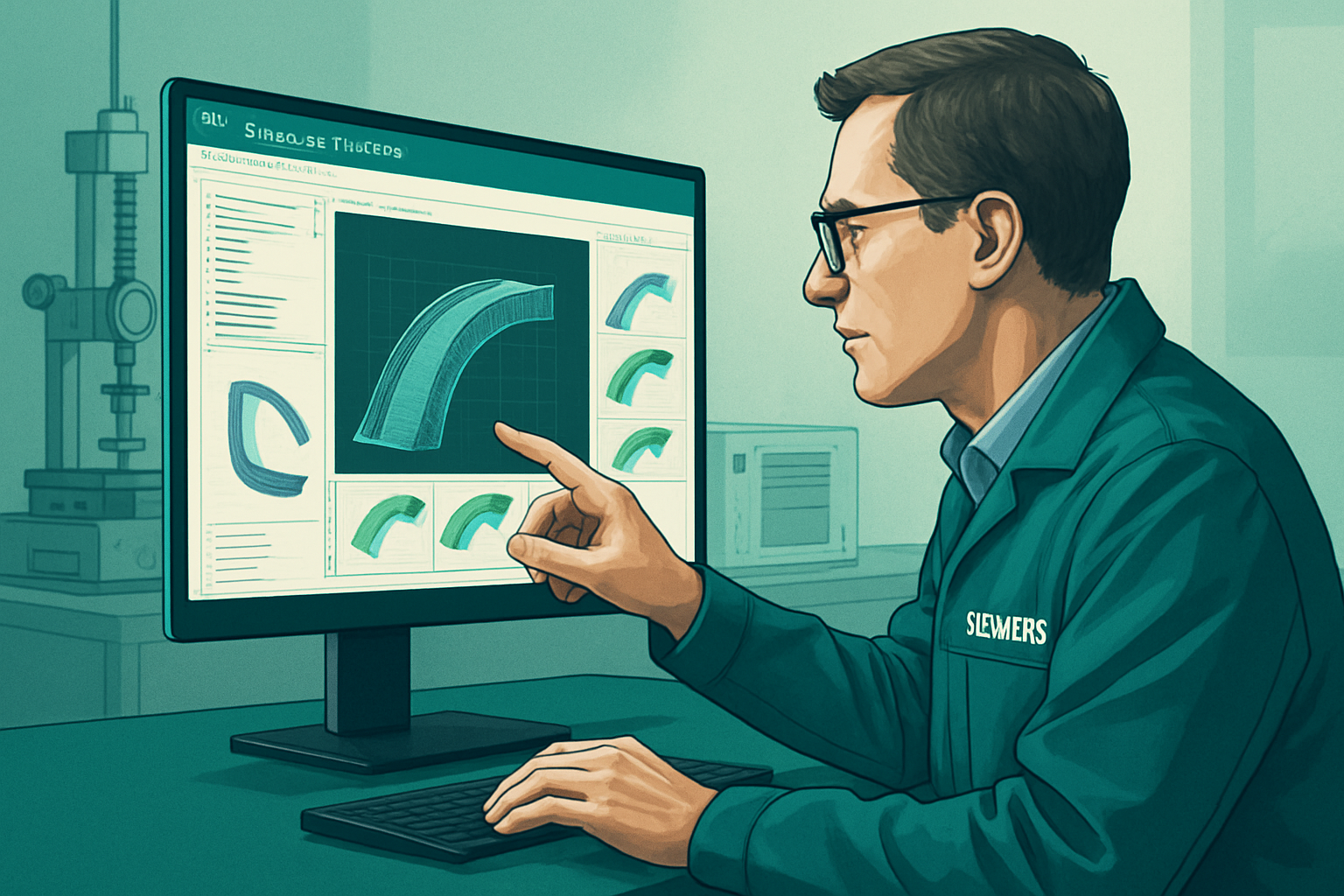
Siemens' Simcenter PhysicsAI software uses geometric deep learning to predict designs at an impressive speed. Unlike traditional methods that calculate physics from scratch, this software relies on surrogate models that learn from past simulation data to estimate the outcomes of new designs in just seconds. However, these rapid predictions do not replace a full calculation.
Mahalingam addressed the issue of accuracy by explaining that, historically, engineers have compared physics-based simulations to physical tests until a reliable correlation was achieved. Now, AI is evaluated against that same standard. Siemens has found that, with enough data, AI can come close to a physics-based solver with a variation of 1% to 3%. However, this level of precision is not sufficient to certify vital components.
The surrogate model serves as an initial filter, allowing for the rapid exploration of numerous design variations. Promising designs are then subjected to detailed physics-based simulations before being validated for manufacturing. Mahalingam clarified that even in exemplary cases, such as that of a Continental inflatable bag, AI is used only for initial exploration, not for final validation.
The Hidden Limits Behind Speed Figures
Another limitation of AI lies in how these models are trained. Siemens' flagship results, such as those involving Magna and Continental, often rely on synthetic data generated by Siemens' own solvers rather than real measurements. This raises the question of whether AI can ever surpass the simulation that trained it.
Mahalingam acknowledged this circularity. For instance, for Magna, the client used Simcenter HEEDS to explore numerous designs and quickly resolved variations with Simsolid, a solver that avoids the slow mesh-building step. These simulation outputs were then used to train the AI model. Thus, the surrogate model is never better than the underlying simulation.
To avoid pitfalls, Siemens has implemented safeguards. A surrogate model trained on certain variations will fail if it needs to predict a radically different shape, and it is designed to signal this. “We have put in place safeguards where it comes back and says, hey, I can’t predict that,” Mahalingam explained, ensuring that engineers do not go astray.
Transparency as a Trust Strategy
Siemens' transparency is not an admission of weakness but a positioning strategy. As every simulation provider seeks to integrate AI into its offering, the risk is that customers will lose trust if promises are not kept. By clearly defining the limits of its technology, Siemens hopes that engineers will trust more in a tool that acknowledges its own limitations.
This approach contrasts with that of chip design and enterprise AI providers, who often promise total autonomy. Siemens, whose clients model complex structures like jet engines, emphasizes the importance of human validation. AI serves to broaden initial research, but final validation remains in the hands of physics-based solvers.
Ultimately, Siemens offers a more realistic and sustainable vision of AI in physics. While it markets the speed of its AI, the most valuable aspect for engineers is understanding the limits of this technology.
Brief IA — L'actualité IA en français
L'essentiel de l'actualité de l'intelligence artificielle, décrypté et expliqué chaque jour.