Siobahn Day Grady Revolutionizes AI Education at HBCUs
Le brief IA que les pros lisent chaque soir
Les 7 actus IA du jour, décryptées en 5 min. Gratuit.
Inclus dès l'inscription : notre sélection des meilleurs guides & comparatifs IA.
Choisis ton rythme
Gratuit · Pas de spam · Désabonnement en 1 clic
A New Era for AI Education
Artificial intelligence is redefining the skills that employers seek in new graduates. In response to this evolution, universities are striving to establish new courses, research centers, and industrial partnerships to prepare students for the current job market. However, creating cutting-edge AI curricula requires funding and access to industrial networks—resources that are not evenly distributed across higher education. At North Carolina Central University (NCCU), Siobahn Day Grady is working to change this dynamic.
In January 2025, Grady, an associate professor at NCCU's School of Library and Information Sciences, inaugurated the first AI research institute at a historically black college or university (HBCU). The Institute for Artificial Intelligence and Emerging Research (IAIER) aims to help students and faculty acquire the skills necessary to thrive in a job market increasingly transformed by AI.
Grady emphasizes that there was a time when people could say, "I don't do technology" or "It's not for me." But today, possessing digital skills is essential, and this is evolving into AI literacy. This approach reflects a broader shift in how many universities view AI education. AI skills are no longer confined to computer science and engineering departments. At NCCU, where a computer science program is under development, integrating AI across all academic fields has become a priority.
The Financial Challenges of HBCUs
Historically black institutions, while representing about 3% of four-year colleges in the United States, receive less than 1% of federal funding for research and development. According to a 2025 report from the Center for American Progress and the Thurgood Marshall College Fund, 17 of the 43 federal agencies that distributed research funds to universities in 2023 provided no funding to HBCUs. Despite these challenges, the IAIER has emerged as a powerhouse for interdisciplinary AI education, supported by a $1 million grant from Google.org. Since its launch, the institute has engaged over 2,800 students, faculty members, and community residents through research initiatives and training. The challenge now is to maintain this momentum to meet the growing demand.
Grady asserts that the guiding principle of the institute is that AI is for everyone. This vision has driven the rapid expansion of the IAIER, which continues to grow to meet an ever-increasing demand.
A Technological Curiosity that Inspires
The mission to broaden AI literacy was born from Grady's curiosity about technology. "I was born at a time when the internet didn't exist," she says. Since the advent of the internet, our world has been transformed. Grady has been particularly drawn to the questions technology raises regarding privacy, identity, and human behavior. After earning her degree in computer science and master's degrees in AI and information science, Grady pursued a PhD in computer science at North Carolina Agricultural and Technical State University to delve deeper into these issues. Her dissertation focused on authorship attribution in social media, using machine learning and natural language processing to determine whether a person's writing style could reveal their identity.
"I've always been intrigued by the amount of data we give away for free," Grady says. This work allowed her to discover the power of AI systems to detect hidden patterns within vast datasets.
After earning her PhD in 2018, Grady joined NCCU as an assistant professor at the School of Library and Information Sciences. There, she studied the applications of machine learning for healthcare and autonomous vehicles. In 2020, she launched the Laboratory for Artificial Intelligence and Emerging Research at NCCU, providing students with opportunities to engage in hands-on projects and explore AI beyond the classroom.
Then, in 2024, an opportunity arose to apply for a Google grant, and Grady began to think beyond a single research group. Rather than creating another lab for faculty, she envisioned an institute that could serve the entire university during the AI boom. "We wanted to capitalize on the moment and make sure we weren't left behind," Grady says. Since receiving the million-dollar grant, Grady and her team have built a university-wide AI initiative, launched new academic programs, organized conferences, secured external support, and created research opportunities.
"We really operated like a startup," Grady states.
AI Beyond Computer Science
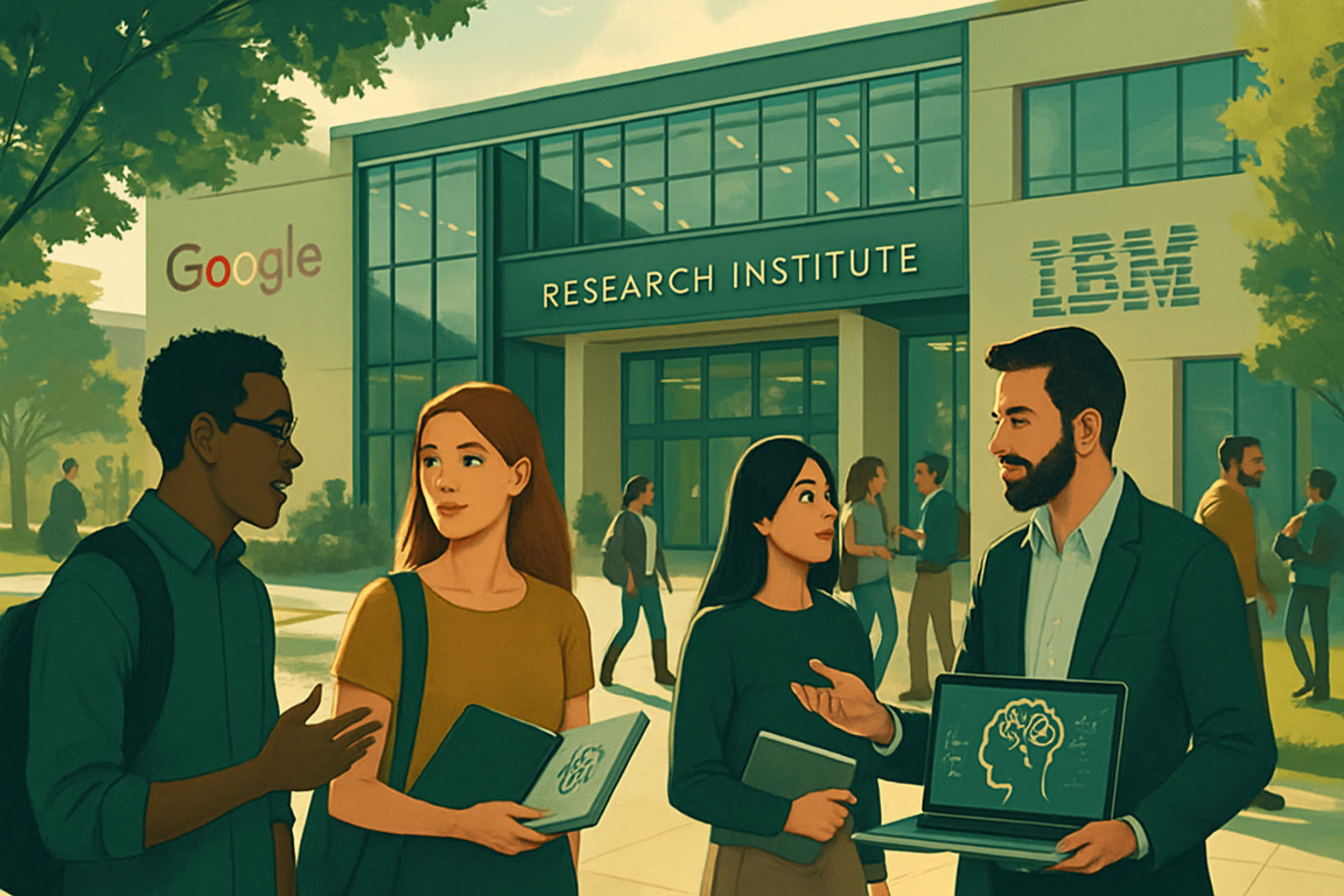
As part of the institute's goal to integrate AI education across all disciplines, all first-year students at NCCU are required to take an introductory AI course, designed in partnership with IBM, to develop foundational prompting skills. The institute has also worked with faculty development teams to help instructors integrate AI into their teaching.
Research is another component of the strategy. The IAIER has awarded startup grants of up to $10,000 to faculty members exploring AI applications in various disciplines. The first cohort funded 11 projects covering social work, digital archiving, healthcare, and information sciences. One project, for example, creates an AI lab where social work students can practice client interactions through simulations. "It's really interesting to see the perspective our researchers take in trying to solve complex problems and also to bring our students along with them," Grady says.
The growth of the institute has been fueled by a mix of professional training, interdisciplinary research, and, most importantly, industry engagement. "Industry is where advancements are really moving at a very rapid pace," Grady says, "not necessarily higher education."
To bridge this gap, the IAIER hosts events that connect students and faculty with researchers, employers, and tech leaders. It has held sessions with companies such as Deloitte, FICO, and Anthropic. Partnerships with Google and IBM allow students to earn recognized certificates and accreditations. And last year, the institute hosted the first OpenAI Academy Summit held at an HBCU, attracting 444 participants from over 40 institutions.
Maintaining the Vision
The rapid growth of the institute has created a new challenge: sustaining its momentum.
"Funding is currently the biggest obstacle for [IAIER] to remain sustainable," Grady states. As interest in the institute continues to grow, demand for its programs is beginning to exceed its capacity. "People just want more," she says.
This bottleneck reflects a broader tension in higher education. AI is evolving rapidly, while developing new academic programs, training teachers, and building research capacities takes time. The uncertainty is exacerbated by a shifting political landscape. Overall, American universities are facing proposals for cuts to federal research spending and increased scrutiny of diversity-focused initiatives under the Trump administration. However, in September 2025, the administration also announced a one-time investment of $500 million in HBCUs and tribal government-sponsored institutions of higher education.
Meanwhile, NCCU has continued to attract new investments. Last September, in collaboration with Howard University and two other institutions, the IAIER received a grant of nearly $500,000 through a National Science Foundation research coordination network program to help define emerging jobs in AI, identify in-demand skills, and inform future accreditations and curricula. This work will continue this fall when the IAIER opens its first dedicated physical space on campus, according to Grady.
In the coming years, Grady plans to expand academic programs, launch the university's computer science major and AI minor, increase research opportunities for faculty, and integrate AI more deeply into campus operations. She also aims to deepen the institute's collaborations with industrial partners.
Beyond expanding programs, Grady sees the long-term success of the institute as linked to creating a model that other universities can adapt. "We are creating a framework that can help not only HBCUs," she says, "but also any university looking to do similar work."
Brief IA — L'actualité IA en français
L'essentiel de l'actualité de l'intelligence artificielle, décrypté et expliqué chaque jour.