Thinking Machines Challenges Universal AI with Inkling
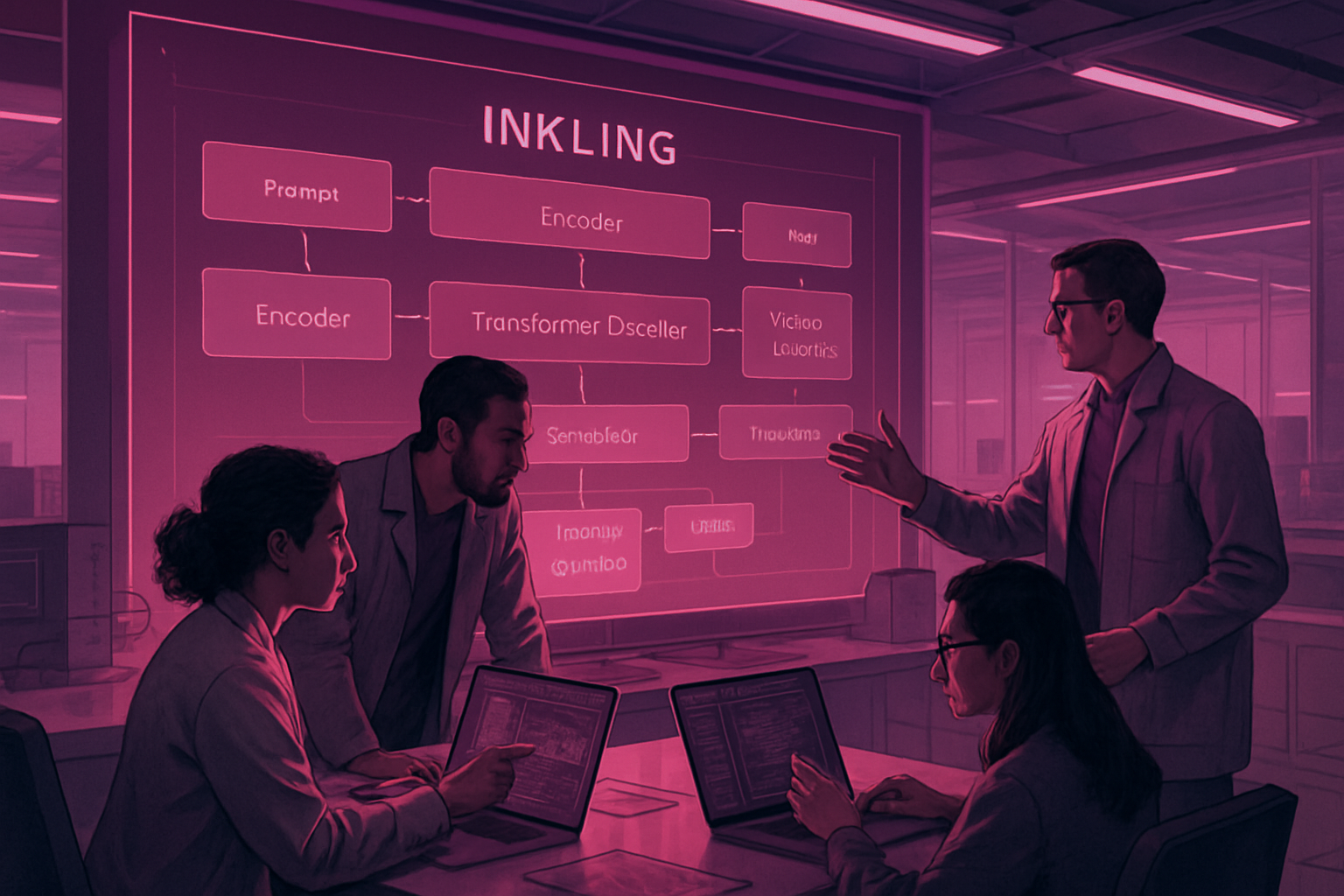
Thinking Machines Challenges Universal AI with Inkling, Its Innovative Open Model
Thinking Machines Lab, a startup specializing in artificial intelligence and founded by Mira Murati, former CTO of OpenAI, recently unveiled its first proprietary AI model, named Inkling. This model stands out for its openness, allowing developers and companies to download and modify it according to their needs, unlike the closed models from giants like OpenAI, Anthropic, or Google.
Inkling is based on a mixture of experts architecture, boasting an impressive total of 975 billion parameters. However, for each specific task, it only utilizes a fraction, approximately 41 billion parameters. This approach is common to make massive models more efficient and less costly to operate. The model was trained on 45 trillion tokens encompassing text, images, audio, and video, and it can natively reason across these four types of data. Currently, its capabilities focus on text production, including code, stylized artifacts, and structured data.
This launch marks the first public demonstration of Thinking Machines Labs' capabilities after a year and a half of behind-the-scenes development. Part of this work was revealed in May during a presentation on interaction models, an AI designed to engage in more fluid dialogue, capable of interrupting and reacting rather than passively waiting like traditional chatbots. This model also represents a test of the startup's central bet: that AI adaptable by organizations themselves will outperform universal models offered by major labs.
Inkling is distinguished by its ability to provide calibrated responses, signaling uncertainty rather than guessing, and allows users to adjust the thinking effort according to their needs, trading speed for accuracy. According to an internal benchmark, Inkling uses one-third of the tokens required by Nvidia's Nemotron 3 Ultra to achieve similar coding performance.
It is important to note that Thinking Machines does not claim that Inkling is the most powerful model on the market. The company's documents specify that Inkling is "not the most powerful model available today, whether closed or open." The goal is rather to offer balanced performance and increased customizability.
This raises the question: who is the target audience for this product? For now, Inkling is marketed as a starting point for businesses, rather than a finished product. Organizations can customize it via Tinker, Thinking Machines' model customization platform, although this requires expertise in machine learning to ensure the safety of the customizations.
In contrast, OpenAI, Anthropic, and Google have taken a different approach with their respective products ChatGPT, Claude, and Gemini, initially designed as versatile chatbots with autonomous features added later.
An article published by Thinking Machines last week seems to set the stage for this launch. The company argues that centralized AI, fixed by a single company, is less effective than AI that organizations can adapt themselves, as expertise is often specific to those who possess it. The idea is that centralized labs offer a one-size-fits-all product, while companies that customize their models can derive more value.
Le brief IA que les pros lisent chaque soir
Les 7 actus IA du jour, décryptées en 5 min. Gratuit.
Inclus dès l'inscription : notre sélection des meilleurs guides & comparatifs IA.
Choisis ton rythme
Gratuit · Pas de spam · Désabonnement en 1 clic
This argument is gaining traction. In a recent blog post, Microsoft CEO Satya Nadella warned that companies using proprietary AI models pay twice: first in subscription fees, then by sharing business knowledge embedded in their queries and corrections, which can be incorporated into future versions of the model.
Clem Delangue, CEO of Hugging Face, expressed a similar opinion, predicting that cutting-edge models will be reserved for experimentation and high-value tasks, while the majority of AI work in production will turn to private or open-source alternatives, aligning with Thinking Machines' strategy.
A concrete example of this approach is a recent project with Bridgewater Associates, the world's largest hedge fund. Researchers from both companies took an open-source model and adapted it to Bridgewater's financial expertise. The result achieved 84.7% on financial reasoning tests, surpassing the best proprietary AI models, while costing about one-fourteenth of the usual operating expenses — although these results stem from internal evaluations by both companies.
Thinking Machines also highlights its speed of development. While OpenAI took about five years to commercialize its technology, and Anthropic three, Thinking Machines claims to have reached a similar stage in just nine months.
Questions arise about Inkling's training method, particularly whether it used outputs from competing models, a practice known as distillation that raises concerns in the industry. According to the company's documents, Inkling was pre-trained independently but used other open models, such as Kimi K2.5 from Moonshot AI, to generate some initial data before embarking on large-scale reinforcement learning. The next model, the company promises, will use fully autonomous post-training.
Regarding costs, Thinking Machines remains tight-lipped. It established a strategic partnership with Nvidia in March to deploy a gigawatt of Vera Rubin computing capacity and claims that Inkling was fully trained on Nvidia's GB300 NVL72 systems. However, the company has not specified how it plans to balance this with revenues, which have not been a priority thus far. A $50 billion funding round was reportedly in the works but was blocked in January; the company has not commented on its financial situation since, although Nvidia mentioned a "significant investment" during the announcement of the partnership.
A related question is whether Thinking Machines' spending will ever reach the scale of OpenAI or Anthropic, or if its efficiency-focused approach means the economics are different. In other words, the company's bet could be that it does not need to spend as much as its rivals, as once the weights are public, there is no obligation for anyone to pay Thinking Machines to use them, unlike the measured access sold by OpenAI and Anthropic. It is Tinker, not the model itself, that must generate revenue, through training, fine-tuning, and now a share of the hosting ecosystem.
The number of employees at Thinking Machines appears stable, with around 200 people, up after a wave of departures earlier this year, including two co-founders who left for OpenAI in January.
Thinking Machines seems little interested in highlighting individual movements, preferring a culture of continuity rather than reliance on a single personality. This aligns with the idea that team changes are less disruptive if individuals are not put on a pedestal. This is notable for a company whose history is still strongly associated with its famous co-founder, whether it wants it to be or not.
Brief IA — L'actualité IA en français
L'essentiel de l'actualité de l'intelligence artificielle, décrypté et expliqué chaque jour.