Wall Street: Record AI Budgets and Restructurings
Le brief IA que les pros lisent chaque soir
Les 7 actus IA du jour, décryptées en 5 min. Gratuit.
Inclus dès l'inscription : notre sélection des meilleurs guides & comparatifs IA.
Choisis ton rythme
Gratuit · Pas de spam · Désabonnement en 1 clic
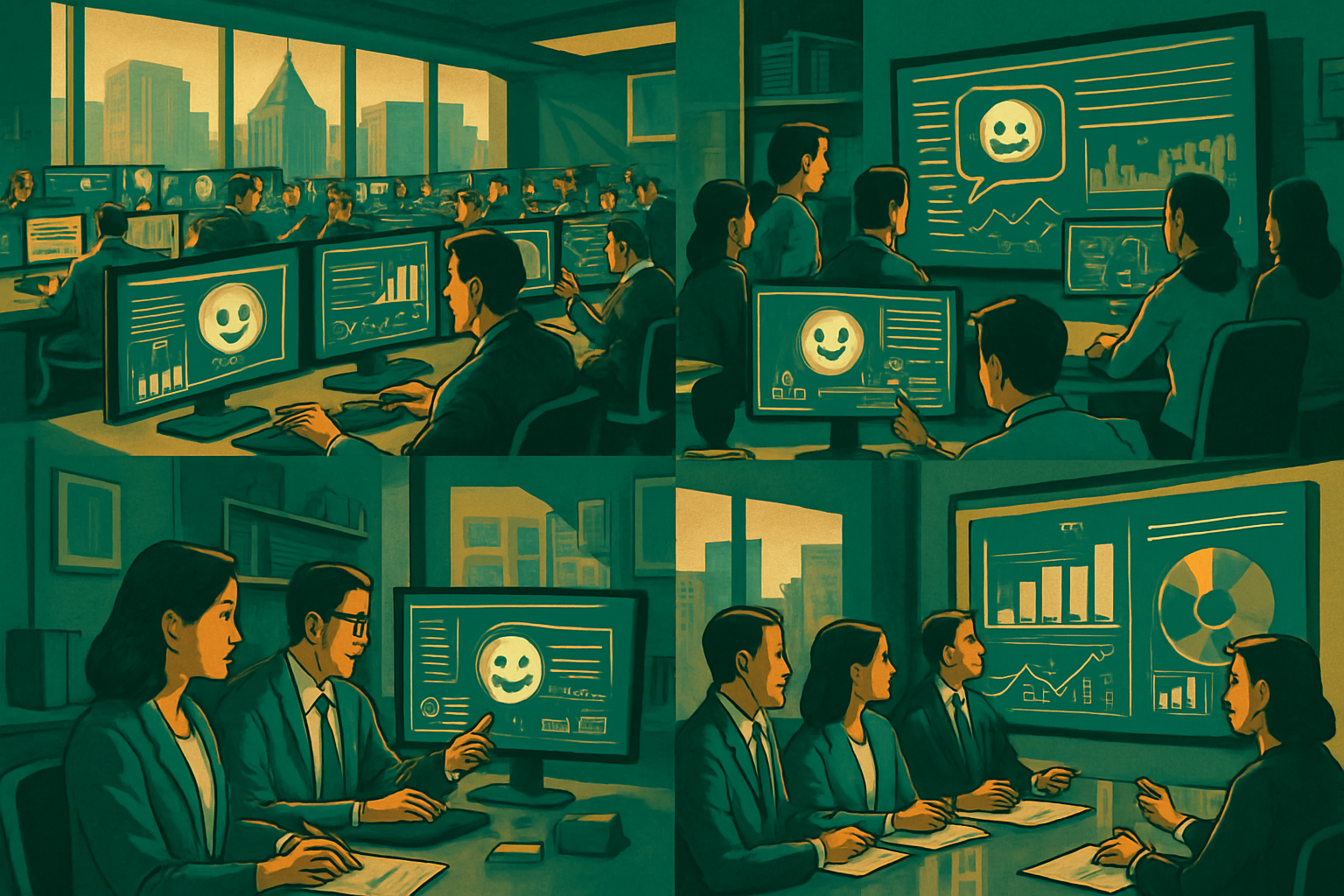
American banks are publishing figures on the impact of AI and reorganizing their structures. With budgets in the billions, hundreds of use cases, and assistants deployed at scale, AI integration affects both technical teams and financial advisors. Executives detail their trade-offs, from claimed savings at JPMorgan to slowed hiring at Goldman Sachs.
Tangible volumes already evident among several players
Bank of America reports over 300 approved AI and machine learning use cases and at least 34 fully deployed generative AI use cases, according to its July earnings presentation. The bank also stated in March that its virtual assistant Erica has surpassed 3.2 billion interactions since its launch. At Morgan Stanley, CFO Sharon Yeshaya highlights DevGen.AI, credited with saving over 280,000 hours, or 11,666 days, between January and June on the analysis of outdated code.
High budgets and public trade-offs on spending
JPMorgan, the largest bank in the country, allocates an annual technology budget close to $20 billion, and Jamie Dimon estimates that $2 billion invested in AI has already been offset by savings. Goldman Sachs has committed $6 billion in technology spending this year, while David Solomon indicated in October that he would aim for at least $8 billion if possible. Citi has a technology budget of $12 billion under the supervision of Tim Ryan, and Bank of America plans $13 billion by 2025.
The adoption of AI is described as essential, but analysts continue to question executives about returns and security, while concerns about justifying expenses are growing. Jamie Dimon emphasizes that JPMorgan does not uniquely benefit from AI, as all companies are now using it, although strategies remain differentiated.
Reorganizations and adjusted AI governance
At JPMorgan, the announced retirement in July of Teresa Heitsenrether, who has forty years in the bank, led to a reshuffling of the technology leadership. The institution says it is restructuring its data and analytics office to shift from infrastructure to business initiatives and had reorganized its commercial and investment division in February to maximize the impact of AI. Citi appointed new leadership in June 2025 to drive its technological transformation. Wells Fargo, for its part, hired Faraz Shafiq from Amazon Web Services at the beginning of 2026 to lead its AI products and solutions.
Culture, training, and monitoring of employee usage
JPMorgan closely monitors AI usage by its tens of thousands of engineers via a GitHub Copilot dashboard and has adjusted their objectives to encourage adoption. At Goldman Sachs, David Solomon invited interns to experiment with AI tools, while CIO Marco Argenti prioritizes measuring team speed rather than individual usage. The bank also announced in October, via an internal memo, that the OneGS initiative would leverage AI for efficiency gains, slow down hiring, and lead to a limited reduction in positions.
Citi is taking a bottom-up approach, with 4,000 trained AI "stewards" and nearly 90% of employees using AI tools according to Jane Fraser, while avoiding granular individual tracking and directing towards the least costly models that meet needs. Wells Fargo did not mandate AI usage for its employees as of March. A 2025 survey at Morgan Stanley indicates that 72% of interns use ChatGPT daily or several times a week. More broadly, generative AI is reshaping workflows, redefining the role of software engineers, how young bankers stand out, and certain managerial functions.
Agents and assistants for advisors and teams
Goldman Sachs is deploying tools, including an internal assistant, and has worked with Anthropic to create agents capable of automating several internal functions. Wells Fargo organizes its AI architecture in a hub and spoke model and, according to Saul Van Beurden, sees agents becoming central in major use cases; in July, the bank announced an "AI co-pilot" for its financial advisors, while Charles Scharf mentioned up to 35% increased productivity for engineers through generative AI.
Morgan Stanley, among the first to partner with OpenAI, equipped its advisors with generative tools as early as 2024 and highlights Parable for data analysis-summarization and LeadIQ for lead distribution among platforms and advisors.
Business use cases and client-side devices
Jamie Dimon mentions nearly 1,000 identified use cases at JPMorgan, with the bank having deployed its proprietary genAI platform to over 200,000 employees and aiming to reorganize workflows. Its asset management unit plans this year, in the U.S., to abandon external advisors for shareholder voting in favor of the internal Proxy IQ platform.
Citi unveiled an AI-based wealth advisor this year and has begun to expand the use of agents. At Bank of America, Brian Moynihan describes models producing a daily market report and others assisting in the drafting of pitch books; the virtual assistant Erica, launched in 2018, illustrates the presence of already established client tools.
Brief IA — L'actualité IA en français
L'essentiel de l'actualité de l'intelligence artificielle, décrypté et expliqué chaque jour.