WeatherNext: Google's AI Redefines Cyclone Forecasting
Le brief IA que les pros lisent chaque soir
Les 7 actus IA du jour, décryptées en 5 min. Gratuit.
Inclus dès l'inscription : notre sélection des meilleurs guides & comparatifs IA.
Choisis ton rythme
Gratuit · Pas de spam · Désabonnement en 1 clic
A Significant Meteorological Challenge
Forecasting cyclones, those devastating tropical storms, has long been a major challenge for meteorologists around the world. These phenomena, also known as hurricanes or typhoons depending on the region, are among the most destructive on Earth. Over the past fifty years, they have caused more than 700,000 deaths and generated economic losses exceeding $1.4 trillion globally. For meteorology experts, providing accurate and timely forecasts is crucial, as every hour of advance notice can potentially save lives and reduce property damage.
The WeatherNext Innovation
Recently, an article published in the scientific journal Nature highlighted a significant advancement in this field thanks to the WeatherNext artificial intelligence model. This model has demonstrated unparalleled accuracy in predicting the trajectory, intensity, and wind structure of cyclones. On average, WeatherNext provides forecasters with an additional day of accuracy compared to previous models. This advancement is equivalent to a decade of progress in meteorology, enabling three-day forecasts as reliable as the two-day forecasts from older models.
An International Collaboration
The development of WeatherNext is the result of a collaboration between researchers and engineers from Google DeepMind, Google Research, and experts from the National Hurricane Center (NHC), the Cooperative Institute for Research in the Atmosphere (CIRA), the UK Met Office, as well as other global meteorological agencies. This cooperation has allowed for the combination of diverse expertise to create a model capable of transforming how cyclones are forecasted.
A Concrete and Immediate Impact
During the 2025 hurricane season, WeatherNext enabled the NHC to accurately predict the rapid intensification of Hurricane Melissa and its arrival in Jamaica. Thanks to this forecast, an early warning could be issued, providing valuable time for on-the-ground preparations. Currently, the model explores 1,000 possible scenarios for each cyclone, helping forecasters make informed decisions and better anticipate potential impacts.
How WeatherNext Works
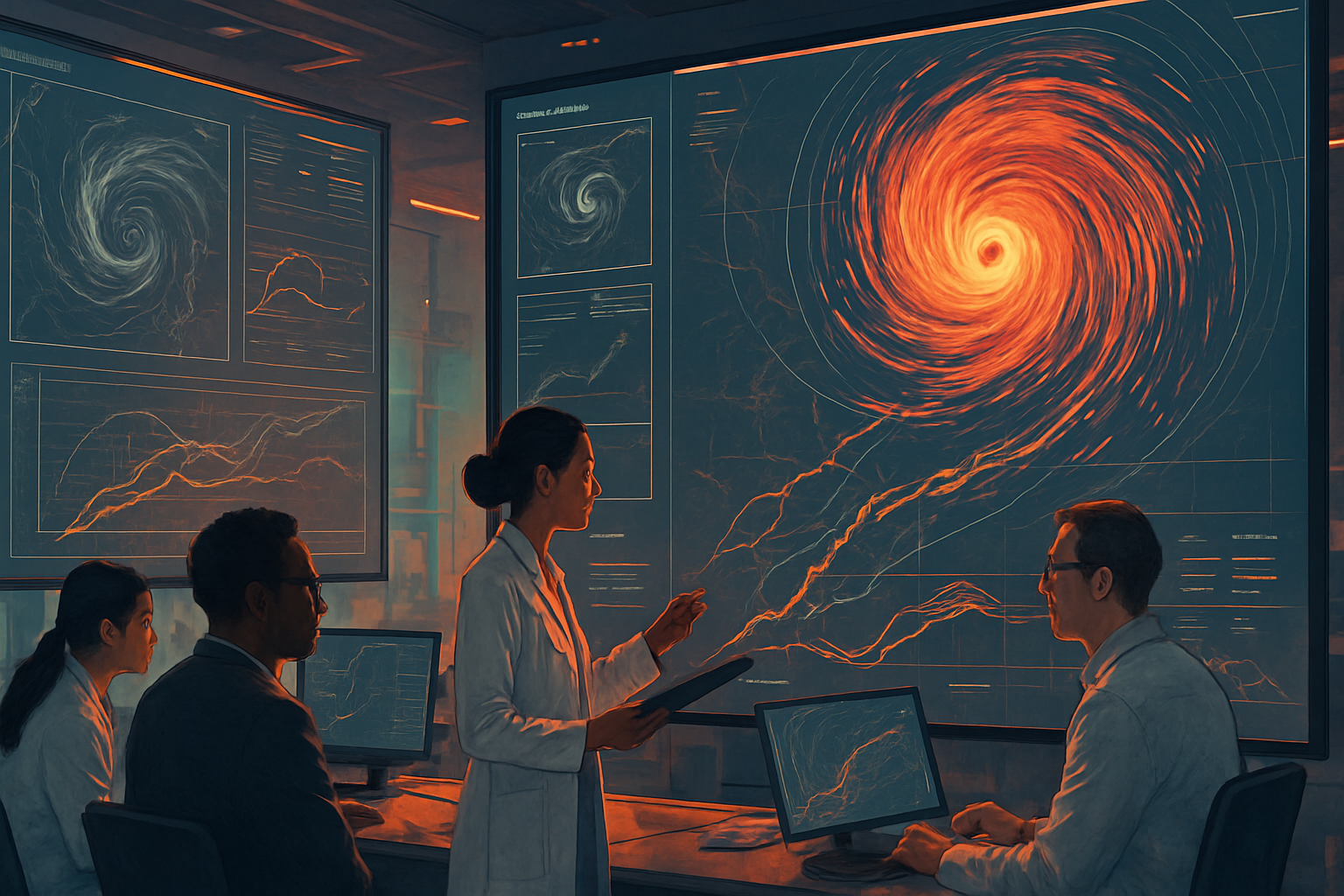
WeatherNext Cyclones operates by analyzing global atmospheric conditions, such as those observed during Hurricane Milton in October 2024. The model iteratively predicts global weather conditions and cyclone trajectories up to 15 days in advance. Using an ensemble of 1,000 members, it generates probability maps of winds, ranging from tropical storm strength to hurricane force. This long-range forecasting capability is crucial for regions vulnerable to cyclones.
A Unique and Innovative Approach
Traditionally, cyclone forecasting required choosing between two types of models: those that model global atmospheric currents and those that focus on local thermodynamic processes. WeatherNext successfully combines these two approaches, offering unprecedented accuracy in predicting the trajectory, intensity, and wind structure of tropical cyclones. This integration allows for a better understanding and anticipation of the complex behaviors of cyclones.
Model Evaluation and Training
The model has been evaluated on historical cyclones from 2023 to 2024, comparing its performance to other leading models. WeatherNext gains, on average, more than a full day of lead time in predicting cyclone trajectories and intensity. It has been co-trained on global weather data and historical cyclone observations, utilizing nearly 20 TB of data and the IBTrACS database. This vast dataset enables the model to learn complex atmospheric patterns and accurately model extreme weather events.
Advances in Forecasting Accuracy
Advances in cyclone forecasting accuracy have been consistent over the past decades. WeatherNext Cyclones marks a scale shift in forecasting precision, equivalent to a decade of progress according to trends observed over the last 20 years. Graphs show how WeatherNext improves the accuracy of three-day trajectory forecasts compared to existing models like ECMWF-ENS and HWRF.
Use of Functional Generative Networks
WeatherNext employs Functional Generative Networks (FGNs) to efficiently produce forecast ensembles, capturing the inherent uncertainty of weather. The model can generate a 15-day forecast in under a minute on a TPU, allowing for rapid assessment of potential extreme risks. This speed is essential for forecasters who need to respond quickly to changes in weather conditions.
Reduced Resolution Requirements
Unlike traditional models that require high resolution, WeatherNext Cyclones operates at a resolution of 28x28 km, which is 100 times less precise. A smaller version, WeatherNext 2-mini, also shows good performance at a resolution of 111x111 km. This efficiency at low resolution remains an open research topic, as it challenges traditional expectations regarding the necessity of high-resolution data for accurate forecasting.
Sharing and Collaboration with the Community
Alongside the publication in Nature, the code and weights of WeatherNext are being made open source, accessible to all for academic research or the development of specialized models. This initiative aims to accelerate progress within the global meteorological community, enabling researchers and agencies to develop new applications and improve weather forecasting worldwide.
Available Models and Weather Lab
We are also releasing WeatherNext Cyclones and WeatherNext 2, as well as WeatherNext 2-mini, accessible via a public Colab notebook. Forecasts can be explored on Weather Lab, which offers a refreshed interface for visualizing global weather forecasts. Weather Lab allows users to view forecasts for temperature, precipitation, wind speed, and more, all in a single integrated view.
Towards a Collaborative Future in Weather Forecasting
With this advancement, WeatherNext provides an additional day for predicting cyclones, a progress equivalent to a decade of development in meteorology. The goal is to create a collaborative ecosystem for weather forecasting, combining machine learning and human expertise, to save lives and help communities adapt to climate change. By inviting researchers and agencies to collaborate, Google hopes to enhance the global capacity to anticipate and respond to extreme weather events.
Brief IA — L'actualité IA en français
L'essentiel de l'actualité de l'intelligence artificielle, décrypté et expliqué chaque jour.