AI Agents in Business: The 2026 Reference Guide

According to OpenAI, the top 10% of AI-using companies produce 8.3 times more outputs per user than the average. The gap is not solely due to the chosen model; it stems from how to transform an agent into operational capability, with a responsible person, reliable data, validation thresholds, and indicators. AI agents do not replace processes; they necessitate redesigning them. This guide details the successful use cases, families of tools, rules to follow, pitfalls to avoid, and a plan to get started.
What AI Really Changes in the Agentic Enterprise
An AI agent is no longer limited to producing a response. It can search for information, classify a request, fill out a form, create a ticket, or trigger a step in a business tool. In our analysis on productivity agents, the strongest cases remain defined: meeting notes, data enrichment, responding to common requests, document extraction, or automating a repetitive flow. The gain comes less from total autonomy than from integration into a real work environment.
This capacity for action also transforms responsibility. An agent can consult a database, call an API, modify a record, or continue a task beyond the initial intent. Our analysis on the ambiguity of responsibilities highlights that CIOs, CTOs, CISOs, and AI teams often share decisions without a single owner. To go into production, it is essential to know who approves access, who monitors decisions, who corrects the agent, and who can stop it.
Reliability is not resolved by a longer prompt. Our analysis on reliability methods emphasizes adaptive flows, usable corporate memory, step evaluation, and human supervision on engaging decisions. The right architecture combines coded automation for stable sequences and model reasoning when multiple paths are possible. A more autonomous agent is not always more effective.
 Operations team validating the steps of an AI agent in the office
A useful agent remains attached to a process, a responsible person, and controls.
Use Cases That Work Today
The use cases below prioritize frequent, traceable tasks that are easy to compare with a starting situation. The right order is to automate first what is repetitive, then expand only after measurement.
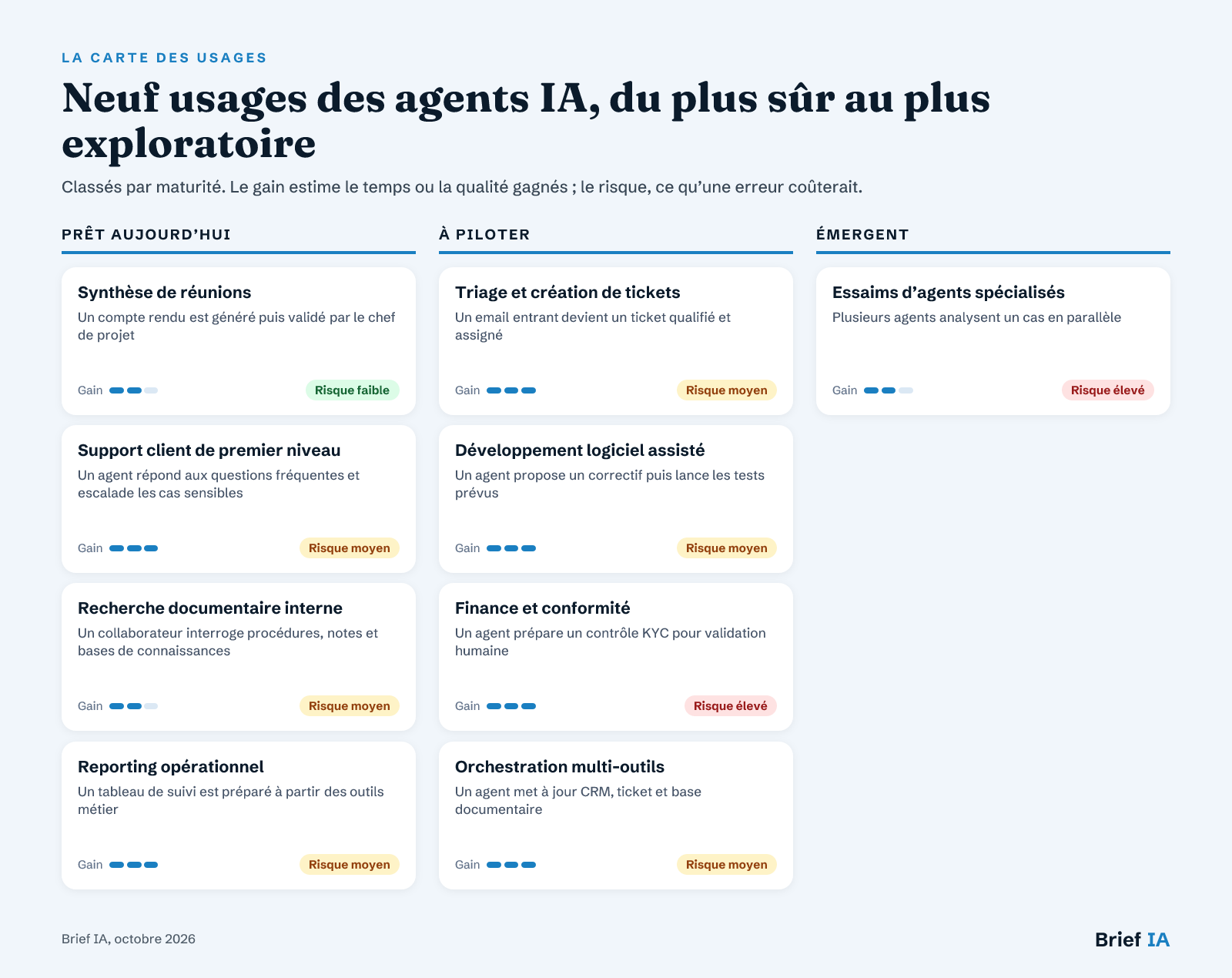 Map of AI use cases for teams deploying agents
Use cases ranked by maturity, with expected gains and risks in case of error.
Ready-to-Use Use Cases
Meeting Summaries. Agents can produce minutes, isolate decisions, identify actions, and prepare follow-ups in the work tool. The risk remains limited if the agent does not modify anything without validation. Quality mainly depends on the context provided: agenda, participants, expected decisions, and internal vocabulary. The use must remain assisted, with human proofreading before dissemination.
First-Level Customer Support. A support-oriented agent can respond to common requests, guide a conversation, filter leads, or resolve simple cases. Intercom Fin is presented as an example of an agent applied to customer support. Disputed cases, complaints, and requests with contractual impact must remain escalated. Sectors already automated show the shift of humans towards supervision.
Internal Document Search. Internal search becomes more useful when the agent can indicate the documents used, distinguish an official procedure from an outdated note, and limit its responses to the authorized scope. The use is ready if documents are classified, dated, and associated with a business owner. Agents must avoid turning old information into active rules. The main challenge is the quality of the corpus.
Operational Reporting. An agent can consolidate data, produce a follow-up summary, and report discrepancies. The interest increases when the same reporting recurs weekly with stable indicators. The business owner must define calculations, alert thresholds, and the expected format. Data must remain verifiable, as a file or period error can lead to poor decision-making.
Use Cases to Manage
Ticket Triage and Creation. Ticket triage is well-suited for agents, as priority, category, and escalation rules can be clearly defined. The agent reads the request, proposes a category, adds context, and directs it to the right team. Deployment should start with human validation on a sample, then confidence thresholds. Silent assignment errors are more costly than visible delays.
Assisted Software Development. According to HackerRank, 97% of developers use an AI assistant, and about one-third of code is generated by AI. Methods to ensure code agents' reliability emphasize specifications, persistent instructions, tests as contracts, and human review. The agent can write, refactor, and explore, but the team retains responsibility for architecture and maintainability.
Finance and Compliance. In finance, agents automate tasks such as KYC, "block/allow" decisions, and SAR report preparation. The gain comes from volume and standardization, but the risk is high as soon as an action affects a client or transaction. It is essential to separate preparation, recommendation, and decision, maintain records, and set human validation thresholds for sensitive cases.
Multi-Tool Orchestration. When a task spans multiple applications, the Model Context Protocol can reduce custom integrations. Our analysis on MCP recommends creating specialized servers by domain, applying the principle of least privilege, and validating arguments before execution. The use becomes cost-effective when multiple agents or teams reuse the same capabilities. It is not advisable to connect the entire information system at once.
Emerging Use Cases
Swarm of Specialized Agents. Anthropic offers dynamic workflows for its Managed Claude Agents, capable of orchestrating up to 1,000 agents in parallel. The company warns of high token consumption and recommends testing on its own loads. This use remains emerging: it is suitable for complex and evaluable tasks, not poorly defined processes. The bottleneck quickly becomes human validation.
Tools to Know
There is no universal ranking: the right choice depends on the process, data, action rights, and expected level of control.
- Integrated Assistants in Work Suites. They operate within the environment already used by teams. Microsoft Scout is presented as an agent integrated into Microsoft 365, functioning with Teams and Outlook under human control. Requirements: unique identity, activity log, role-based permissions, manual stop.
- No-Code and Low-Code Automation Platforms. They allow operational teams to describe or build flows without heavy development. Make, Zapier, and n8n connect agents, applications, and data in business automations. Requirements: execution limits, pre-production testing, cost tracking, manual recovery.
- MCP Orchestrators and Connectors. They standardize agents' access to tools, files, and data. MCP is useful when multiple agents need to reuse the same external capabilities, with specialized servers and limited rights. Requirements: least privilege, parameter validation, sandboxing, server versioning.
- Specialized Business Agents. They target a specific domain, such as customer support, HR, or software development. Intercom Fin illustrates the support agent; Leena.ai is described as an HR conversational agent. Requirements: clear business scope, human escalation, cited documents, quality indicators.
- Governance and Identity Consoles. They become necessary when agents multiply. Microsoft Agent 365 is presented as a centralized dashboard to track activity, manage permissions, and secure AI agents. Our analysis on agent governance details the expected controls. Requirements: inventory, owner, access revocation, alerts, audit trails.
Le brief IA que les pros lisent chaque soir
Les 7 actus IA du jour, décryptées en 5 min. Gratuit.
Inclus dès l'inscription : notre sélection des meilleurs guides & comparatifs IA.
Choisis ton rythme
Gratuit · Pas de spam · Désabonnement en 1 clic
The Framework: AI Act, GDPR, CSE, and Data
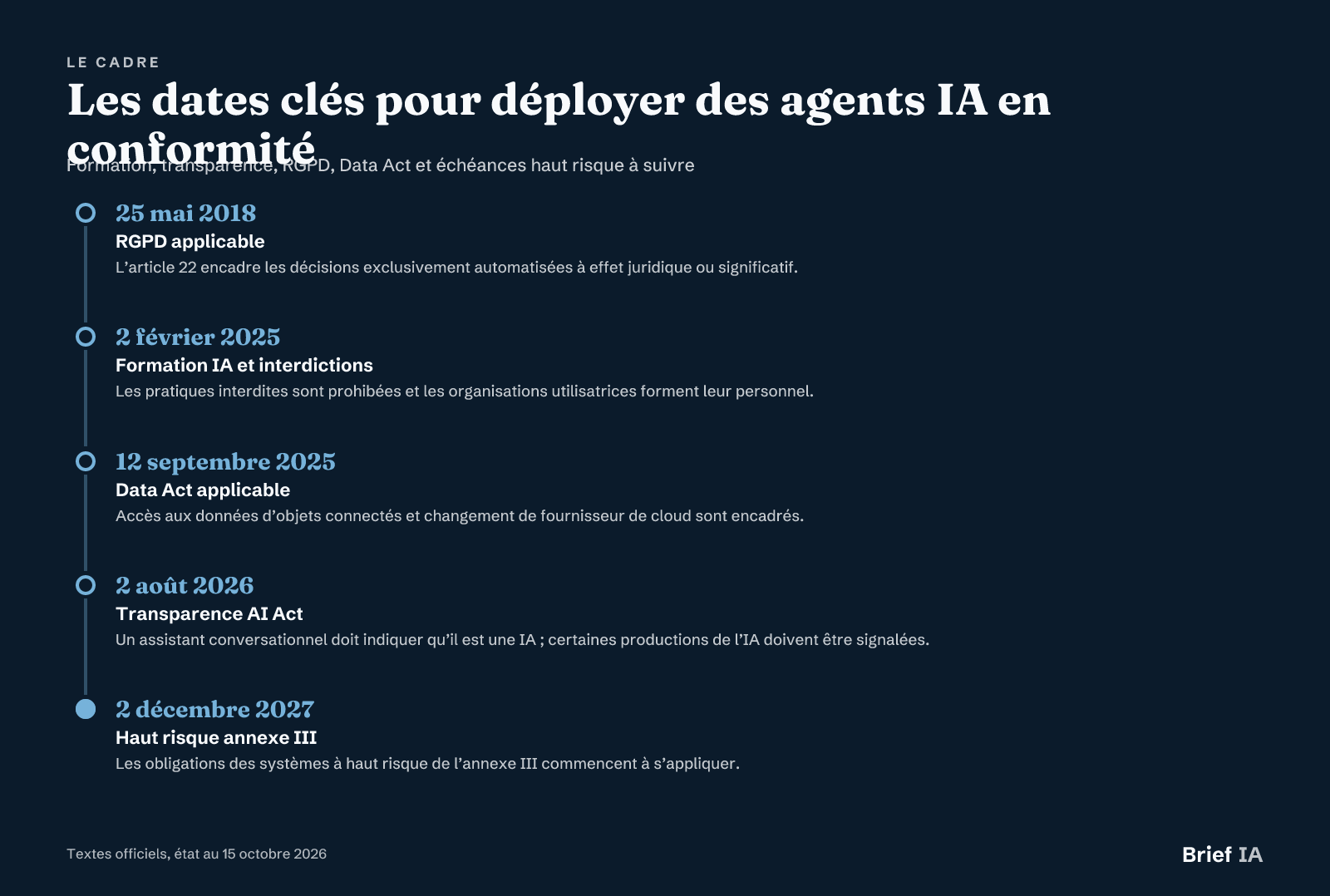 Key dates for deploying AI agents in compliance
Key dates, status as of October 15, 2026.
AI Act Already Applicable
Regulation (EU) 2024/1689 came into effect on August 1, 2024, and applies in phases. Since February 2, 2025, prohibited practices are banned, and any organization using AI systems must ensure a sufficient level of AI mastery among its staff. From August 2, 2026, transparency obligations apply: a conversational assistant must indicate that it is an AI, and certain AI outputs must be flagged as such.
Prohibited Practices
Prohibited practices include social scoring, manipulation exploiting vulnerabilities, and emotion recognition in the workplace and educational institutions, except for medical or safety reasons. Sanctions under the AI Act can reach €35 million or 7% of global annual revenue for prohibited practices. An agent deployed in the company must therefore exclude these uses from the design stage.
High Risk, Not Yet Obligations
The AI Act classifies certain uses in employment, education, critical infrastructure, essential services, policing, migration, justice, and democratic processes as high-risk autonomous systems. For employment, this includes recruitment, selection, promotion, termination, task allocation, evaluation, and employee monitoring. Following the Digital Omnibus, the obligations for high-risk systems in Annex III will apply from December 2, 2027. They do not apply yet, but relevant projects must be prepared.
GDPR, CSE, and Data
The GDPR has been in effect since May 25, 2018. Its Article 22 regulates decisions based solely on automated processing that produce legal or significant effects on a person. The Labor Code mandates informing and consulting the CSE when introducing new technologies in the company. The Data Act, applicable since September 12, 2025, organizes access to data produced by connected objects and facilitates changing cloud providers.
Pitfalls to Avoid
Diluted Responsibility. An agent connected to multiple tools cannot have multiple vague owners. Designate a business owner, a technical lead, and a shutdown procedure. Without this, no one knows who corrects, suspends, or declares the incident.
Too Broad Permissions. An effective agent does not need general access to the information system. Grant only the rights necessary for its mission, for a defined duration and scope. Write actions should be more strictly controlled than read actions.
Data Without Context. Agents become weak when procedures are outdated, documents undated, or rules contradictory. Every useful document must have an owner, a version, and a validity date. Business context is worth more than a large volume of content.
Premature Scaling. Multiplying agents before proving a flow creates additional costs and validations. OpenAI describes the performance gap between pioneers and followers around measured, governed, and replicated flows, not around scattered trials.
Sensitive Automated Decision-Making. Recruitment, employee evaluation, access to essential services, or financial decisions require particular vigilance. The GDPR regulates exclusively automated decisions with legal or significant effects. Separate decision support, recommendation, and final decision.
Taking Action: The 90-Day Plan
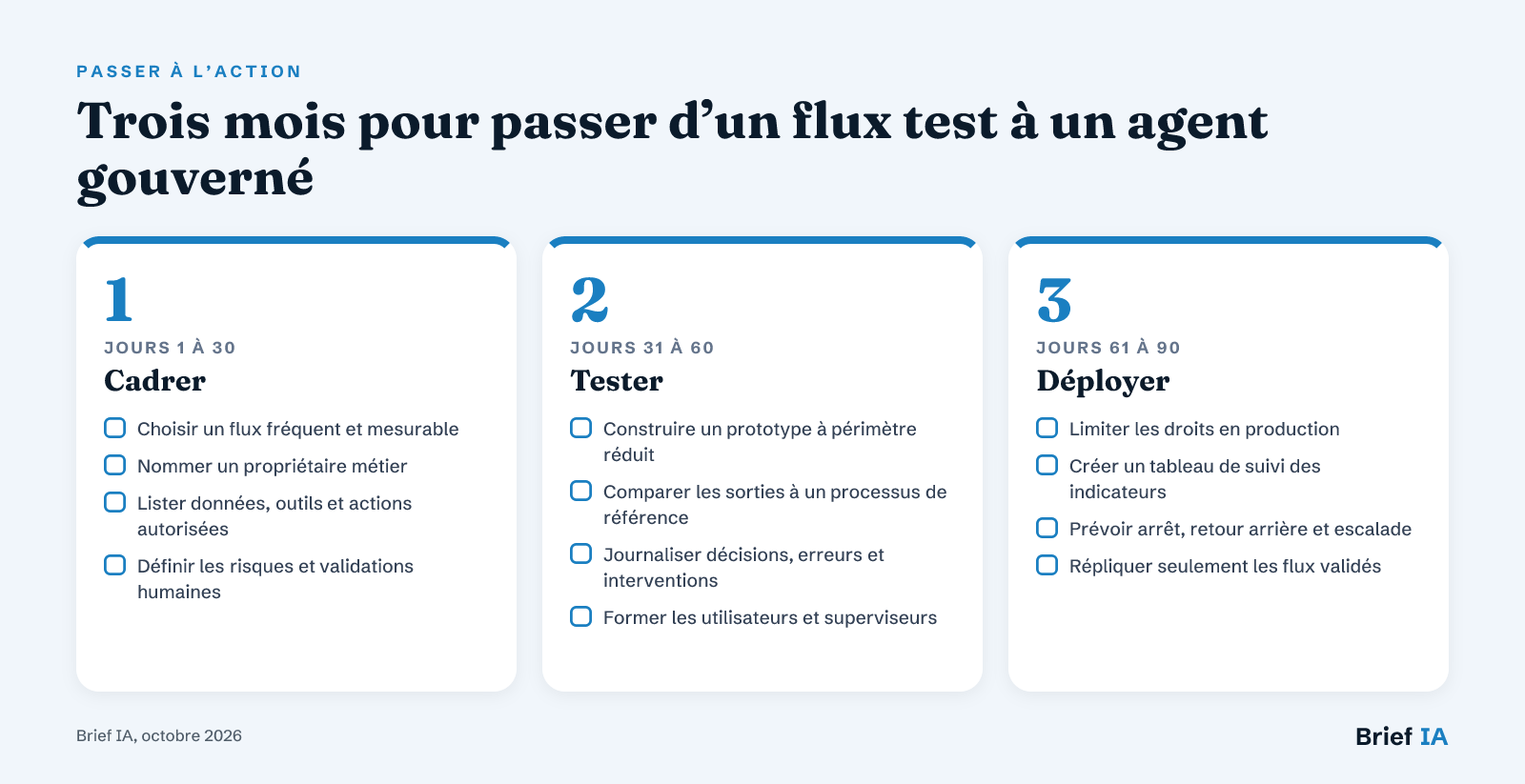 Three months to move from a test flow to a governed agent
Three steps: frame, test, deploy.
Start with a frequent, costly, and measurable flow, with a single responsible person. In the first month, map data, rights, steps, and risks. In the second month, test an agent on a narrow scope, with human validation and simple indicators. In the third month, decide: stop, correct, or deploy. The selected flows should become reusable templates, with documentation, training, and incident tracking.
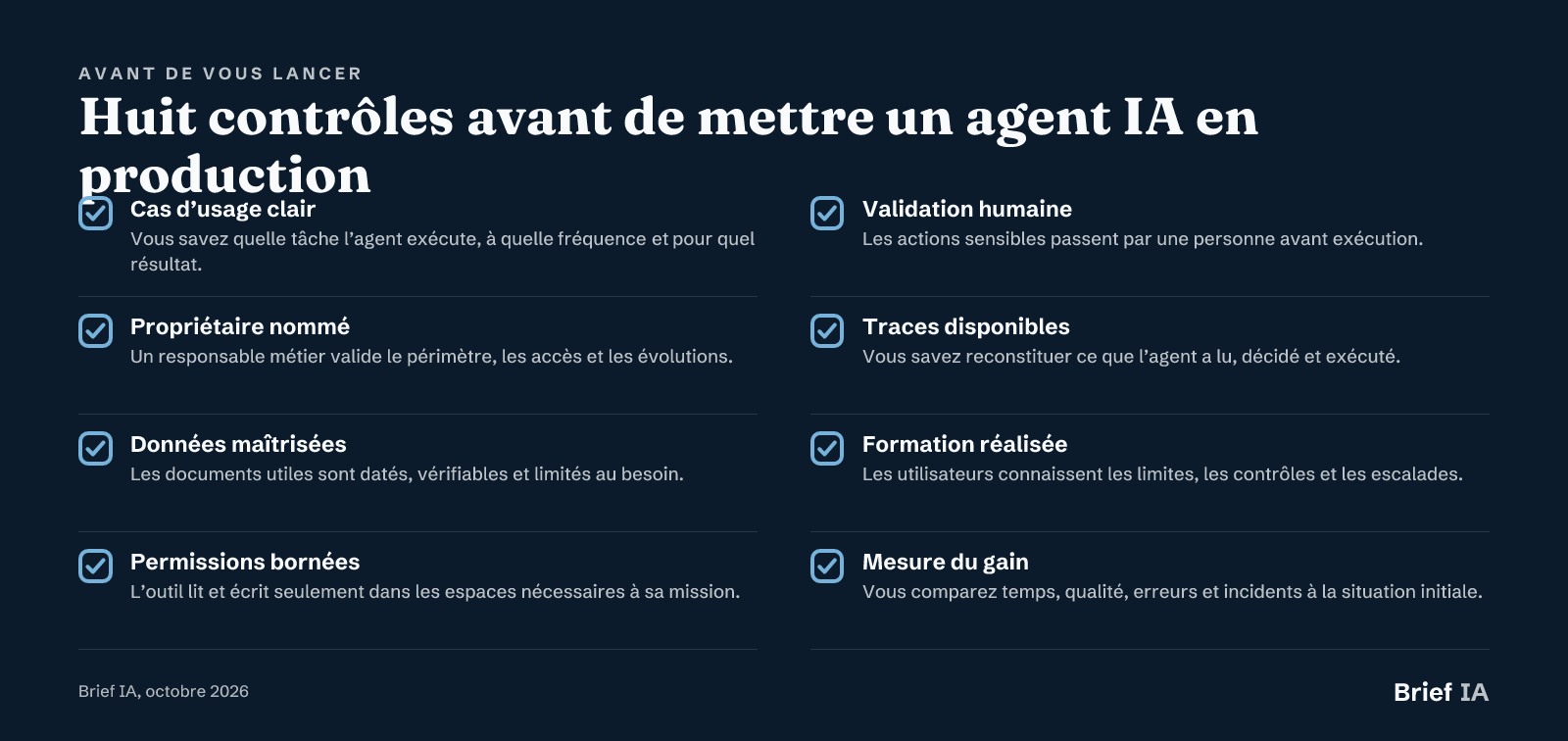 Eight checks before putting an AI agent into production
Eight verifications to perform before each new use.
Further Reading
Our analyses for teams deploying agents
- Five useful AI agents for business productivity. Overview of agents for documentation, support, writing, reporting, and workflows, with their limitations.
- Five methods to ensure AI agents' reliability. Memory, adaptive flows, evaluation, and human supervision to avoid production failures.
- Optimize your agents with MCP. Method to connect agents to business tools without multiplying fragile integrations.
- Why responsibility hinders AI deployments. What changes when moving from co-pilot to an agent capable of acting within the information system.
- Governing AI agents in the enterprise. A method to map, control, train, and supervise agents before scaling.
Key News to Remember
- OpenAI measures an 8.3 times gap between the best AI users and the average
- Five functions already automated by AI agents in business
- AI code agents: tests, permissions, and human review to ensure reliable results
- Microsoft introduces Scout, an AI agent integrated into Microsoft 365
- Microsoft Agent 365 centralizes management and security of AI agents
- Anthropic allows Claude to orchestrate up to 1,000 agents in parallel
Do you provide a solution for deploying AI agents in business?
This guide is read by executives, CIOs, business leaders, operations teams, data, security, and transformation teams. Brief IA offers solution providers in automation, AI governance, and business agents dedicated articles, evening brief inserts, and promotion in the directory. Formats and rates at briefia.fr/partenaires.
The Essentials in Questions
What is an AI agent in business?
An AI agent is a system capable of using tools, data, and rules to achieve a defined objective. In business, it can classify a request, prepare an analysis, trigger an action, or update a tool. The difference from a chatbot lies in execution: the agent acts within an authorized scope.
What are the safest AI agent use cases to start with?
The safest use cases are those that produce verifiable assistance without irreversible decisions: meeting summaries, document searches, reporting preparation, ticket triage, or draft responses. They must remain bounded, logged, and reviewed. Write actions in a business tool require more controls.
Can an AI agent make HR decisions?
Caution is advised. The AI Act classifies several employment-related uses as high-risk, including recruitment, selection, promotion, termination, task allocation, evaluation, and employee monitoring. Obligations for these systems will begin on December 2, 2027. The GDPR already regulates exclusively automated decisions with significant effects.
Should MCP be used to deploy AI agents?
MCP is useful when multiple agents need access to the same tools or data, or when a task spans multiple applications. It is not necessary for a simple initial use of writing or summarizing. The safest approach is to stabilize the use case, then standardize useful connections with limited rights.
How to measure the success of an AI agent?
Measure an agent like a process: time saved, error rate, number of human interventions, output quality, incidents, execution cost, and user satisfaction. Monitoring should compare the situation before and after. An agent that produces faster but increases corrections or risks is not ready for industrialization.
Brief IA — L'actualité IA en français
L'essentiel de l'actualité de l'intelligence artificielle, décrypté et expliqué chaque jour.