AI and Customer Service: The 2026 Reference Guide

Le brief IA que les pros lisent chaque soir
Les 7 actus IA du jour, décryptées en 5 min. Gratuit.
Inclus dès l'inscription : notre sélection des meilleurs guides & comparatifs IA.
Choisis ton rythme
Gratuit · Pas de spam · Désabonnement en 1 clic
According to Norrsken VC, Vocca's voice assistant resolves an average of 70% of end-to-end conversations without human intervention, and over 85% among its most mature clients. This shift summarizes the new challenge in customer service: AI is no longer just about responding faster; it operates within tools, creates appointments, qualifies, synthesizes, and escalates. This guide presents effective use cases, tool families, applicable rules, operational pitfalls, and a simple plan to get started.
What AI Really Changes in Customer Service
The main leap is not in the channel but in resolution. A classic chatbot responds; an AI agent can check a status, qualify an intent, propose an action, and create a ticket. In our analysis on optimizing customer support, the best deployments of AI agents achieve deflection rates between 70% and 87% for simple requests, with an average satisfaction rating around 4.1/5. These results assume a well-maintained knowledge base, stable integrations, and clear limits.
Customer service also receives errors produced by clients' AIs. In our analysis on AI agents and hallucinations, professionals in hospitality, parks, education, and commerce face erroneous bookings, impractical routes, or requests based on non-existent rules. The contact center then becomes a verification point: it must distinguish between software promises, commercial information, and real commitments.
Performance is no longer judged solely by response time. It is essential to verify that AI does not create operational debt: misclassified conversations, wrongly reserved slots, data copied to the wrong place, clients convinced that an exception has been granted. The right model combines automation of frequent cases, visible escalation to an advisor, and regular analysis of failed conversations, especially when the agent acts within the CRM, calendar, or payment tool.
 Customer advisors with headsets examining an escalation in a bright contact center.
AI handles simple requests, while the team manages sensitive cases.
Effective Use Cases Today
The best use cases stem from the most frequent and well-documented contact reasons. The more AI operates within systems, the stricter the management must be.
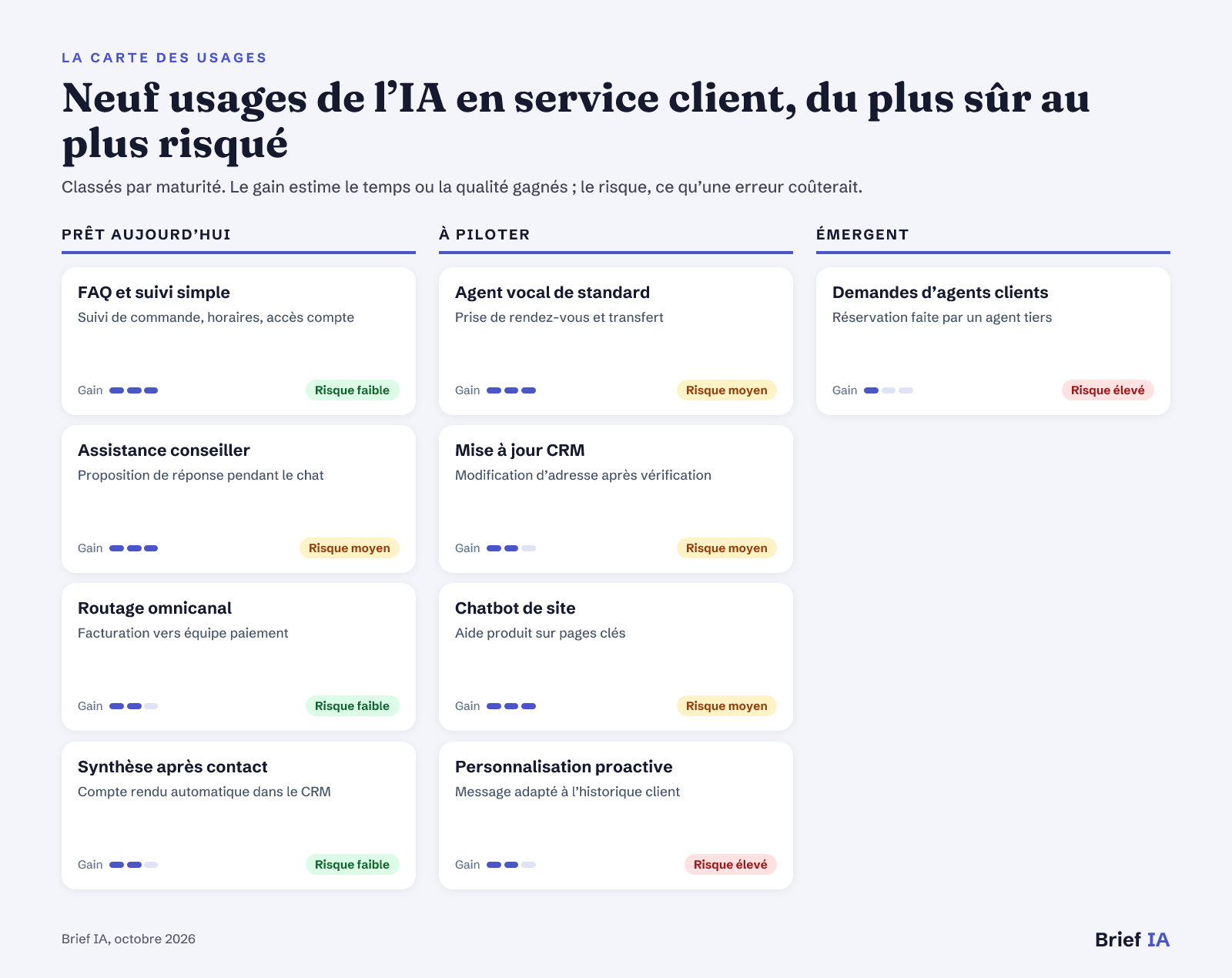 Map of AI use cases for customer relationship managers
Use cases classified by maturity, with expected gains and risks in case of error.
Ready-to-Use Use Cases
FAQ and simple follow-up. Start with questions that have stable and verifiable answers: hours, return policy, order tracking, account access, required documents. AI should cite the correct internal rule and propose escalation if the information is lacking. This case works if the knowledge base is cleaned, versioned, and linked to actual contact reasons.
Advisor assistance. The advisor remains the decision-maker, but AI prepares the work: case summary, useful history, draft response, suggestion for the next action. This format reduces cognitive load without giving the tool the power to conclude on its own. It suits teams looking to improve response consistency before automating entire exchanges.
Omnichannel routing. AI classifies intent, identifies urgency, and directs the contact to the right team, regardless of the channel. The gain comes less from the generated response than from reducing misrouting errors. Start with simple categories, test frequent confusions, and plan a control queue for new or ambiguous reasons.
Post-contact synthesis. After a call, chat, or lengthy email, AI produces a summary, extracts commitments made, and prepares the case update. This case limits manual entry and improves continuity between advisors. The rule must remain strict: no synthesis replaces the recording of actions actually validated by the team.
Use Cases to Manage
Standard voice agent. Reception desks become agents capable of understanding an oral request, checking a schedule, creating a ticket, or transferring to the right service. Our analysis on AI telephone receptionists describes uses such as call qualification, appointment scheduling, and follow-ups. The manager must monitor drop-offs, transfers, and cases where the client explicitly requests a human.
CRM updates. An agent connected to the CRM can update an address, create a task, complete a record, or associate a document with the correct file. The scope must be narrow: allowed fields, identity verification, logging, and possible cancellation. Start with reversible changes, then expand only when residual errors are understood.
Website chatbot. A website chatbot helps visitors find information, choose an offer, or resolve a blockage before human contact. Our guide on creating a corporate AI chatbot emphasizes choosing a simple case, importing reliable documents, and tracking conversations. The main risk is a plausible but non-compliant response to your commercial rules.
Proactive personalization. AI can adapt tone, explanations, and proposals to the client's history. The use becomes sensitive as soon as it mobilizes personal data, behavioral signals, or commercial segmentation. Personalization must remain explainable, proportionate, and controlled by business rules, especially if it influences discounts, prioritization, or differentiated treatment.
Emerging Use Cases
Client agent requests. Clients may arrive with actions prepared by their own AI agents: booking, comparison, purchase, exception request. Customer service must learn to verify these requests without blaming the client. Create clarification scripts: what is confirmed, what is not, and what evidence or steps are missing before execution.
Tools to Know
There is no universal ranking: the right choice depends on the channel, accessible data, the level of action permitted, and expected controls.
- Support platforms with integrated AI. They add automatic responses, advisor assistance, sorting, synthesis, and dashboards within the ticket environment. Intercom Fin, mentioned in our analysis on corporate AI agents, illustrates the support-oriented and qualification-focused agent. Requirements: versioned knowledge base; human escalation; analytics by reason; response log.
- No-code chatbots for websites and messaging. They allow for quickly launching an assistant on a website, FAQ, or messaging channel, without heavy development. They are suitable if the use case is limited and training documents are controlled. Requirements: testing in a closed environment; source control; visible human button; refusal of uncertain responses.
- Voice agents for telephone reception. They respond, qualify, transfer, and can act on a schedule or business tool. According to Norrsken VC, Vocca resolves an average of 70% of end-to-end conversations, with over 85% among its most mature clients. Requirements: immediate transfer; recording of decisions; measurement of drop-offs; emergency scenarios.
- Connected productivity agents. They automate coordination tasks around customer service: preparing responses, consolidating follow-ups, extracting information, and updating documents. Our guide on ChatGPT Work advises connecting only necessary applications. Requirements: minimal rights; test copies; action approval; simple access revocation.
- Regulated sector-specific assistants. In banking, Hello bank launched HelloïZ 2.0 with Mistral AI models, capable of recognizing 25 transactional intents, according to our article on HelloïZ 2.0. These tools require controls adapted to the sector. Requirements: sector compliance; traceability; legal validation; transactional limits.
The Framework: AI Act, GDPR, CSE, and Sector Rules
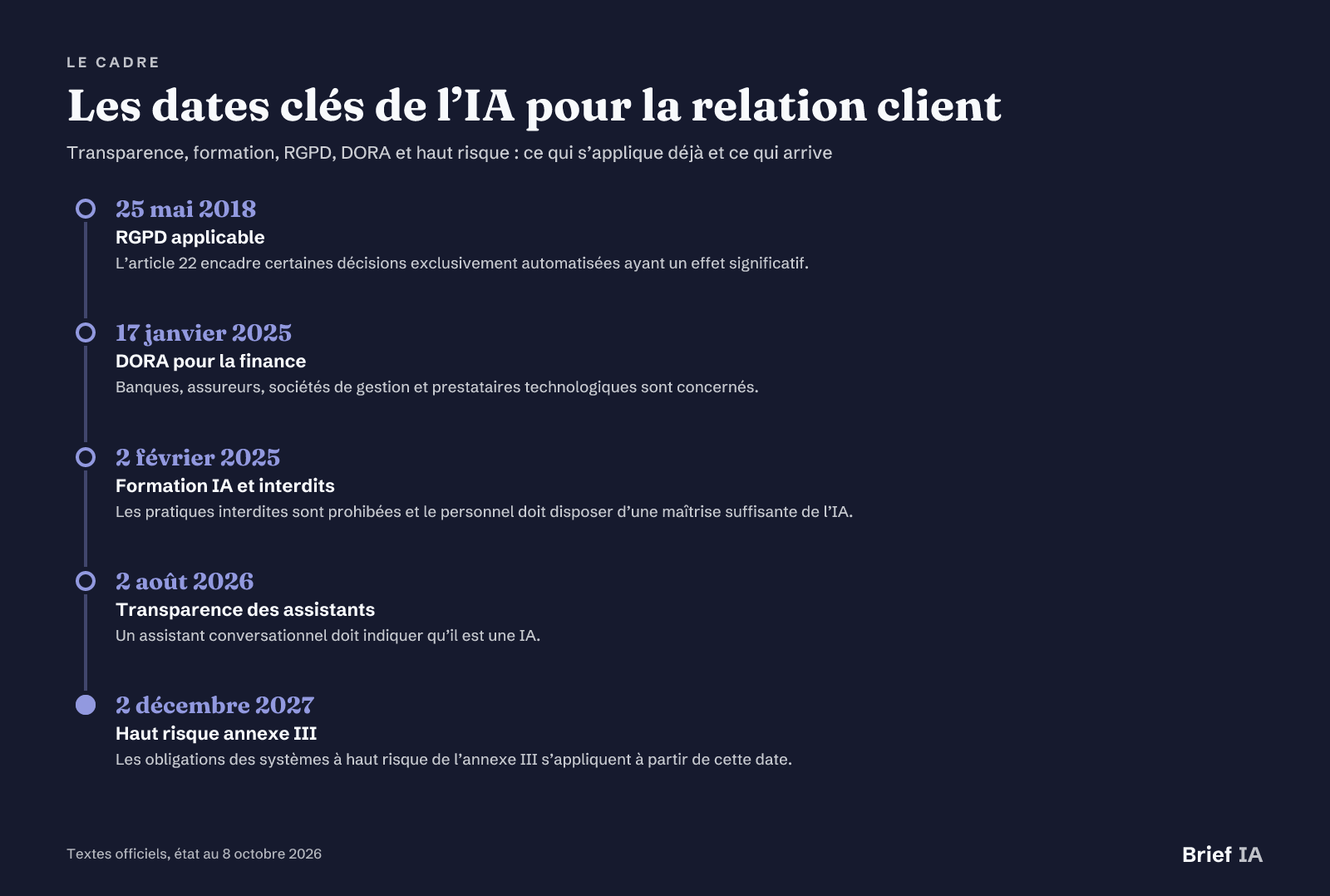 Key dates for AI in customer relations
Key dates, status as of October 8, 2026.
Transparency and Training
The AI Act came into effect on August 1, 2024, and applies in phases. Since February 2, 2025, any organization using AI systems must ensure a sufficient level of AI mastery among its staff. From August 2, 2026, transparency obligations apply: a conversational assistant must indicate that it is an AI, and certain generated content must be flagged as such.
Prohibited Practices
Since February 2, 2025, practices prohibited by the AI Act are banned. Customer service must especially note the prohibition of manipulation that exploits vulnerabilities and the recognition of emotions in the workplace, except for medical or safety reasons. In a contact center, emotional analysis of employees is therefore a territory to avoid, even if presented as a quality management tool.
Automated Decisions
The GDPR has been in effect since May 25, 2018. Its Article 22 regulates decisions based solely on automated processing that produce legal or significant effects on a person. A customer service that automates this type of decision must provide for specific analysis, appropriate human intervention, and the ability to contest.
CSE and Sensitive Sectors
The labor code requires informing and consulting the CSE when introducing new technologies in the company. For banks, insurers, and management companies, DORA has applied since January 17, 2025, to digital operational resilience requirements, including technology providers. High-risk systems in Annex III, for example, certain uses related to essential services, only enter their specific obligations starting December 2, 2027.
Pitfalls to Avoid
Automating chaos. If contact reasons, business rules, and the knowledge base are unstable, AI accelerates inconsistencies. Before the pilot, clean the items, remove duplicates, and assign a responsible person for each rule used in responses.
Confusing response and resolution. A quick response can degrade the experience if it opens a second contact. Measure reopens, transfers, and manual corrections, not just the volume of conversations handled by AI or the first response time.
Letting it act without safeguards. An agent that can book a slot, change an address, or alter a status must have limited permissions. Sensitive actions require approval, a consultable log, and a simple cancellation procedure.
Hiding AI from the client. Since August 2, 2026, a conversational assistant must indicate that it is an AI. This information should not be buried in a legal page: it must be visible in the experience, with readable access to an advisor.
Ignoring client agents. Clients may arrive with information generated by their own assistants. Prepare teams to calmly correct a false promise, distinguish quotes, bookings, and confirmations, and then trace the source of confusion.
Taking Action: The 90-Day Plan
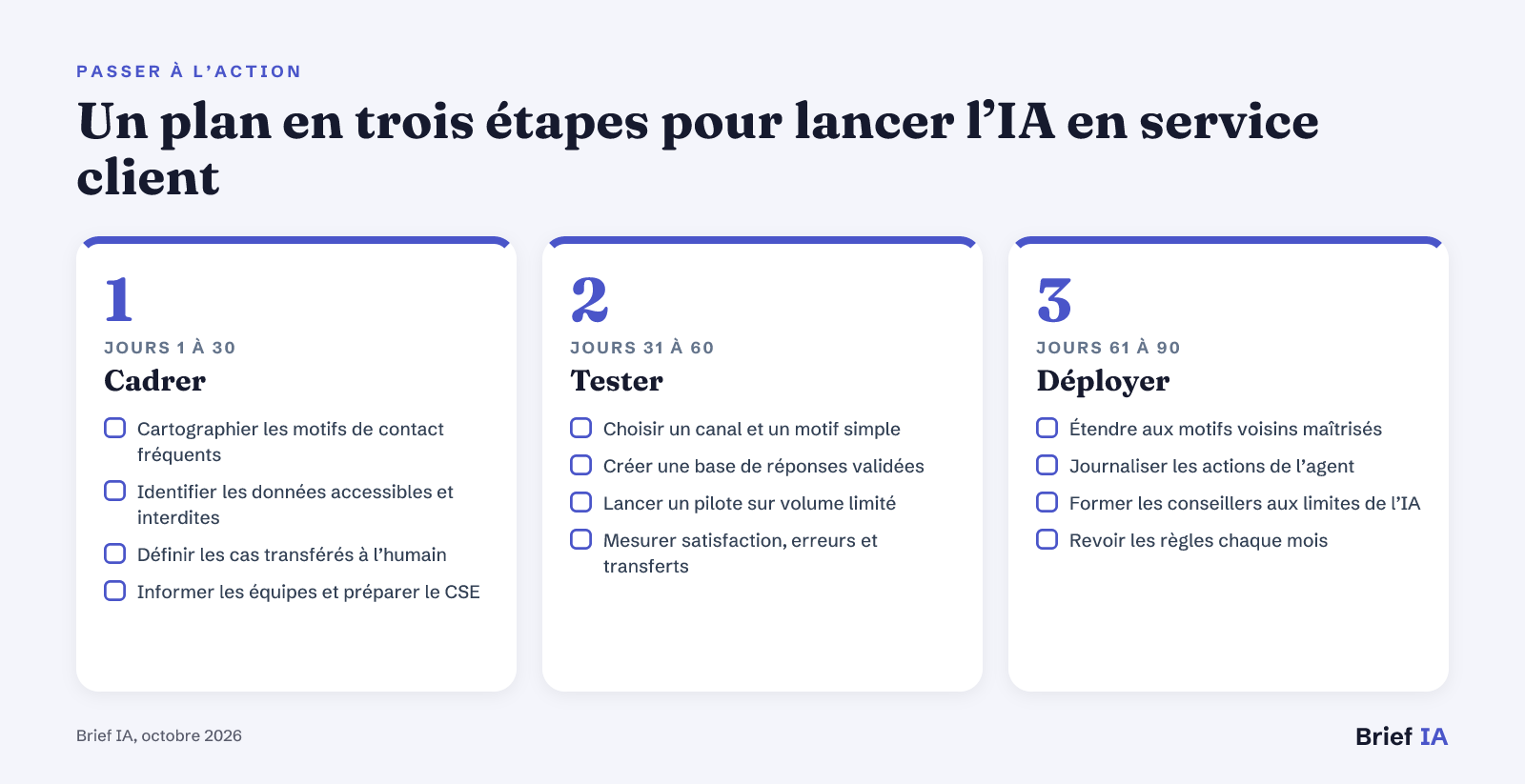 A three-step plan to launch AI in customer service
Three steps: frame, test, deploy.
Start with a three-month mapping of contacts: reasons, volumes, channels, costs, satisfaction, and escalations. Choose a simple case, without sensitive decisions, then test on a limited population. During the next three months, improve the knowledge base, measure failures, formalize escalation rules, and secure access. Peripheral tasks can also be tested with agents like those described in our article on Le Den and ChatGPT Work.
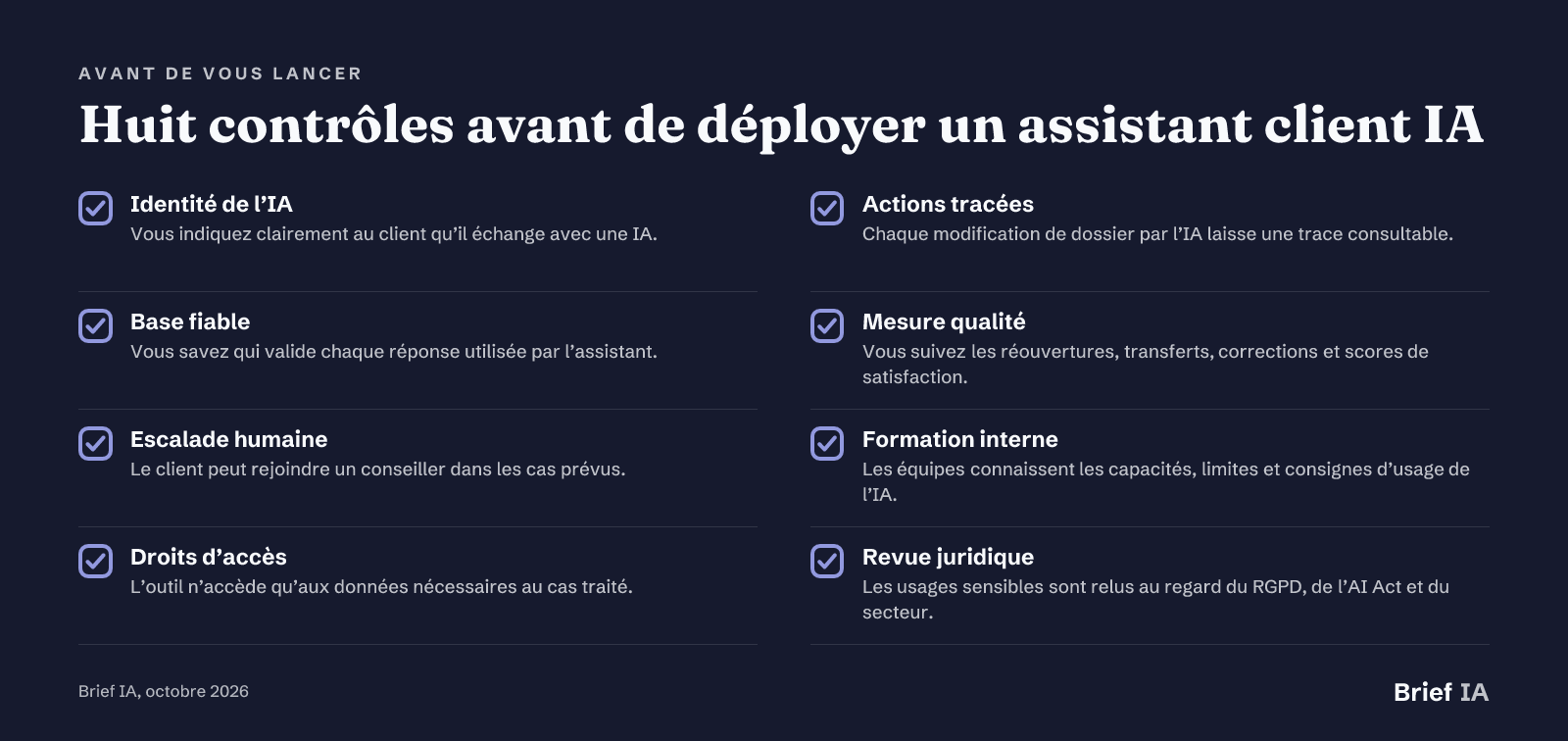 Eight checks before deploying an AI customer assistant
Eight verifications to perform before each new use case.
Further Reading
Our analyses for customer relationship managers
- Optimizing customer support with AI in 2026. The method for moving from a decorative chatbot to a resolution measured by reasons, costs, and satisfaction.
- Why AI agents are already complicating customer service. The hallucinations of customer agents create impossible requests that teams must correct.
- When the telephone reception becomes an AI agent. The main uses of AI voice: qualification, appointments, transfers, and multichannel synchronization.
- Creating a corporate AI chatbot without coding. The steps for framing, tool selection, training, and testing for an operational first assistant.
- Five useful AI agents in business. Examples of agents connected to work tools, including customer support-oriented uses.
- Automating repetitive tasks with ChatGPT Work. How to frame productivity agents connected to documents, messages, and business applications.
Key News to Note
- Le Den claims to save 10 to 15 hours per week with ChatGPT Work
- Hello bank launches HelloïZ 2.0 with Mistral AI models
- Mistral presents Vibe, a multitasking AI agent for businesses
- Copilot and ChatGPT highlight the importance of precise instructions
- Circuit Breaker Labs tests AIs against psychological risks
Do you provide a solution for customer service?
This guide is read by customer relationship directors, contact center managers, customer experience managers, and operations teams. Brief IA offers solution providers in customer relationship management, helpdesk, voice agents, chatbots, and CRM automation dedicated articles, evening brief inserts, and promotion in the directory. Formats and rates at briefia.fr/partenaires.
The Essentials in Questions
How to use AI in customer service?
Start with repetitive, well-documented, and low-sensitivity requests: tracking, access, hours, case status, appointments. Link AI to a validated knowledge base, plan for human escalation, and measure actual resolution. Actions within business tools should come later, with limited permissions and logging.
Should a chatbot disclose that it is an AI?
Yes. Since August 2, 2026, the transparency obligations of the AI Act apply. A conversational assistant must indicate that it is an AI. In a customer journey, this information must be readable at the time of interaction, and the client must understand how to obtain human intervention when it is expected.
What KPIs to track for a support AI agent?
Track the rate of resolution without human involvement, but also transfers, reopens, manual corrections, customer satisfaction, first response time, and resolution time. The right indicator is not just the automated volume: it is the share of requests actually resolved without degrading trust or creating a second contact.
Can AI replace customer advisors?
AI automates part of simple requests and assists advisors with more complex cases. It does not replace situations that require judgment, empathy, negotiation, or arbitration. The safest model is to remove repetitive tasks from the queue while making human escalation quick and visible.
What legal risks are associated with AI in customer relations?
The main risks come from transparency, personal data, automated decisions, and prohibited practices. The GDPR regulates certain exclusively automated decisions that have a significant effect. The AI Act already imposes training and transparency, prohibits certain practices, and provides for high penalties. Financial sectors must also consider DORA.
Brief IA — L'actualité IA en français
L'essentiel de l'actualité de l'intelligence artificielle, décrypté et expliqué chaque jour.