AI and GDPR: The 2026 Reference Guide to Protecting Personal Data

According to PwC, 79% of companies are already using AI agents capable of planning and executing tasks without solicitation. For a DPO or a lawyer, the issue is no longer just whether a chatbot is allowed or prohibited, but the actual circulation of personal data in tools that read, summarize, classify, and sometimes act. The GDPR remains the foundation, while the AI Act adds obligations for training and transparency. This guide details the effective uses, tools, rules, pitfalls, and a plan to get started.
What AI Really Changes for DPOs and Lawyers
AI shifts GDPR risk towards ordinary actions: copying a contract into an assistant, summarizing a client file, analyzing support tickets, connecting a tool to messaging. A request may contain personal data, identifiers, or contractually confidential information. Our analysis on securing data against AI shows that a service presented as a single assistant can call a third-party API or forward a request to a subcontractor. Therefore, control must cover the visible tool, logs, connectors, and models called.
The second change concerns agents. According to PwC, 79% of companies are already using AI agents capable of planning and executing tasks without solicitation. Our article on AI agents and data origin reminds us that the junction between generation and action is progressing faster than safeguards. For a DPO, the challenge is to distinguish between drafting assistance, recommendations, and actions triggered within a business system, as the expected level of human control is not the same.
The third change is regulatory. Since August 2, 2026, the transparency obligations of the AI Act apply: a conversational assistant must indicate that it is an AI, and certain generated content must be labeled as such. However, the obligations for high-risk systems listed in Annex III, including employment, education, or access to certain essential services, will apply starting December 2, 2027. Projects must therefore be prepared without assuming that everything is already required.
 DPO and lawyer annotating impact analyses in an office in Lyon
AI compliance starts with visible, documented, and verifiable uses.
Effective Uses Today
The best uses are not always the most spectacular. To protect personal data, start with tasks that make flows visible, verifiable, and reversible.
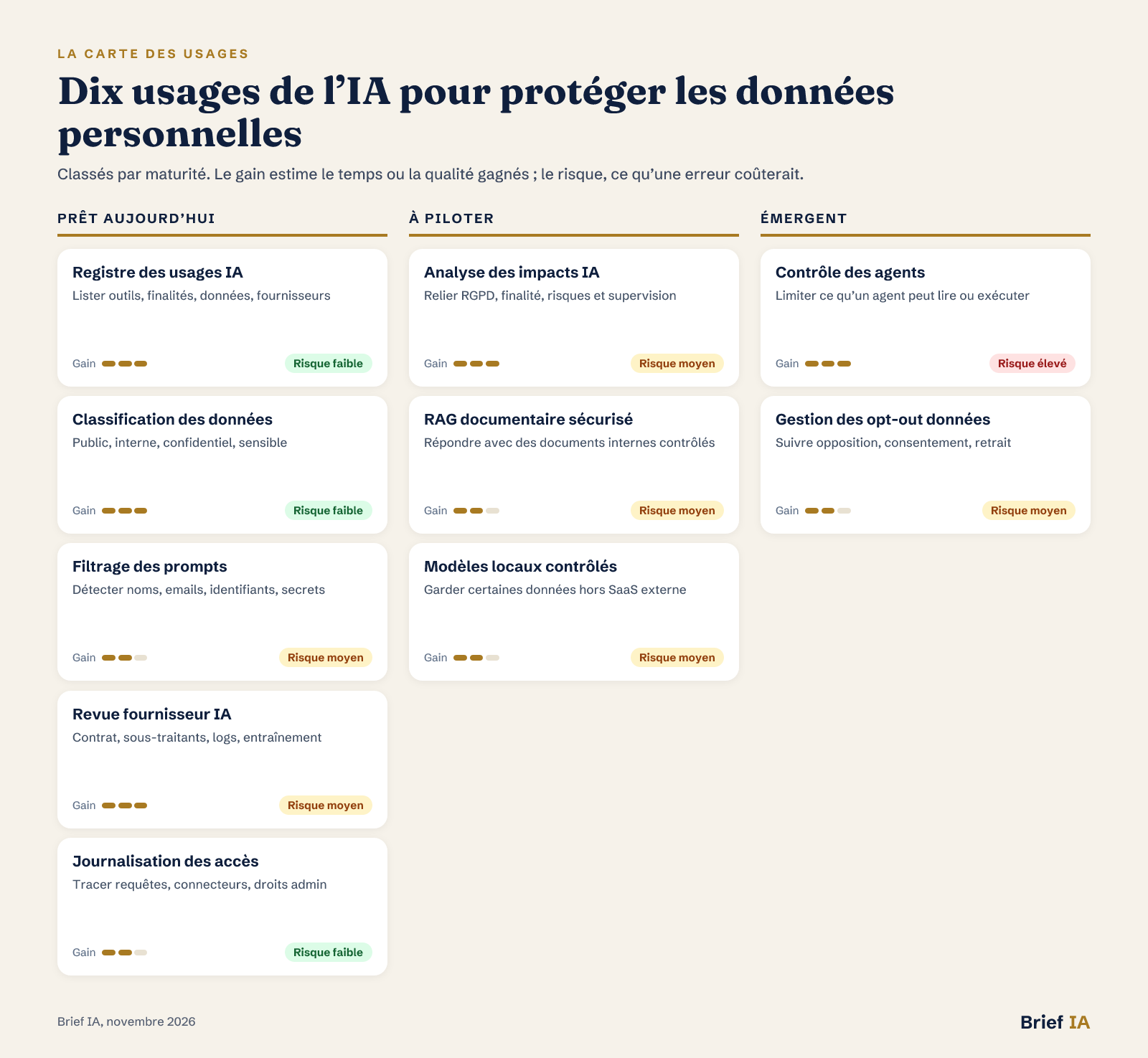 Map of AI uses for DPOs and lawyers
Uses classified by maturity, with expected gains and risks in case of error.
Ready-to-Use Applications
AI Usage Register. Inventory each actual use before drafting a policy. The register should indicate the tool, purpose, data categories, users, connectors, provider, and retention period for logs. Our analysis on the 2026 method for securing data recommends mapping public chatbots, AI functions in office suites, CRMs, and unvalidated experimental uses.
Data Classification. Classify data according to its actual sensitivity, not according to the application that hosts it. A simple grid distinguishes public, internal, confidential, and sensitive content. It triggers concrete rules: blocking health data in public assistants, distinct encryption for sensitive datasets, separate accounts for AI projects, and prohibiting identifiers or technical secrets in prompts.
Prompt Filtering. Control what goes to a model before sending. The filter should identify personal data, contact details, identifiers, technical keys, client information, and health elements. It does not replace a usage rule, as pseudonymization reduces risk without always erasing it. The right reflex is to block, replace with a fictitious example, or request human validation depending on sensitivity.
AI Supplier Review. Contractually verify the supplier's promises. The review should cover the non-use of data to train models, subcontractors, hosting, logs, retention periods, auditing, reversibility, and incidents. A commercial confidentiality mention is not enough: the DPO must obtain an actionable description of data flows and enforceable guarantees.
Access Logging. Trace accesses, modifications, additions, deletions, and administrative uses. Logs should allow tracking who used which tool, with what categories of data and which connectors. They serve to detect abnormal uses, document risk analysis, and respond in case of incidents. The logs themselves must be protected, as they may contain sensitive excerpts.
Uses to Manage
AI Impact Analysis. Analyze impacts when AI processing may affect individuals, especially if it influences a significant decision. The work must connect legal basis, minimization, rights of individuals, security, possible biases, human supervision, and contestation modalities. For uses that will fall under high risk according to the AI Act, prepare documentation already, without prematurely applying obligations that only start from December 2, 2027.
Secure Document RAG. Frame systems that search within a document base before responding. Retrieved documents should be treated as unreliable data, as they may contain hidden instructions or errors. Our analysis on AI security by design recommends controlling provenance, writing rights, versions, metadata, and filtering rules.
Controlled Local Models. Running an open-weight model locally can reduce data outputs to an external service, but it does not eliminate GDPR obligations. Our article on open-weight AI models reminds us that licenses, security, and hardware requirements vary by model. It is also necessary to plan for updates, safeguards, and usage traceability.
Emerging Uses
Agent Control. Frame agents capable of acting within business tools. Rights should be minimal, sensitive actions subject to human validation, and outputs logged. The risk increases when the agent can read emails, modify a database, trigger a send, or access personal files. Each action capability must be described, tested, and revocable.
Data Opt-Out Management. Implement tracking for objections, consents, and withdrawal requests when data is used for AI projects. In healthcare, our analysis on Doctolib, Pippa, and health data illustrates the sensitivity of a default inclusion mechanism. The register should show which data is concerned, what purpose is pursued, and what rights remain open to individuals.
Tools to Know
There is no universal ranking: choose tool families based on your flows, your data, your hosting, and your auditing capacity.
- Enterprise Generative Assistants. They are used for drafting, summarizing, and searching, but their level of protection depends on the contract, settings, and logs. Our analysis on OpenAI's lock mode reminds us that non-use for training does not mean total absence of storage. Requirements: non-training by default, controlled logs, listed subcontractors, retention period, audit.
- Sensitive Data Filters. They detect and mask names, emails, identifiers, payment data, or technical secrets before sending to a model. They should complement, not replace, a minimization policy and clear prohibitions on sensitive categories. Requirements: configurable blocking, tracked false positives, proof of testing, API integration, alert log.
- Governance and Logging Platforms. They centralize uses, rights, connectors, and activity traces. For a DPO, they transform an AI policy into verifiable elements: who accesses what, from which tool, for what purpose. Requirements: exportable register, fine roles, rights review, alerts, limited retention.
- Local or Open-Weight Models. They can help keep certain processing within the company's infrastructure. Openness does not guarantee complete transparency or superiority: licenses, security, and safeguards must be evaluated before deployment. Requirements: readable license, isolated environment, updates, security tests, traceability.
- Tools for Managing Individual Rights. They track access, rectification, objection, and withdrawal requests related to AI projects. Their importance increases as multiple teams reuse datasets or models exploit internal document bases. Requirements: link to register, request status, timestamp, proof of response, data scope.
Le brief IA que les pros lisent chaque soir
Les 7 actus IA du jour, décryptées en 5 min. Gratuit.
Inclus dès l'inscription : notre sélection des meilleurs guides & comparatifs IA.
Choisissez votre rythme
Gratuit · Pas de spam · Désabonnement en 1 clic
The Framework: GDPR, AI Act, and Data Regulations to Follow
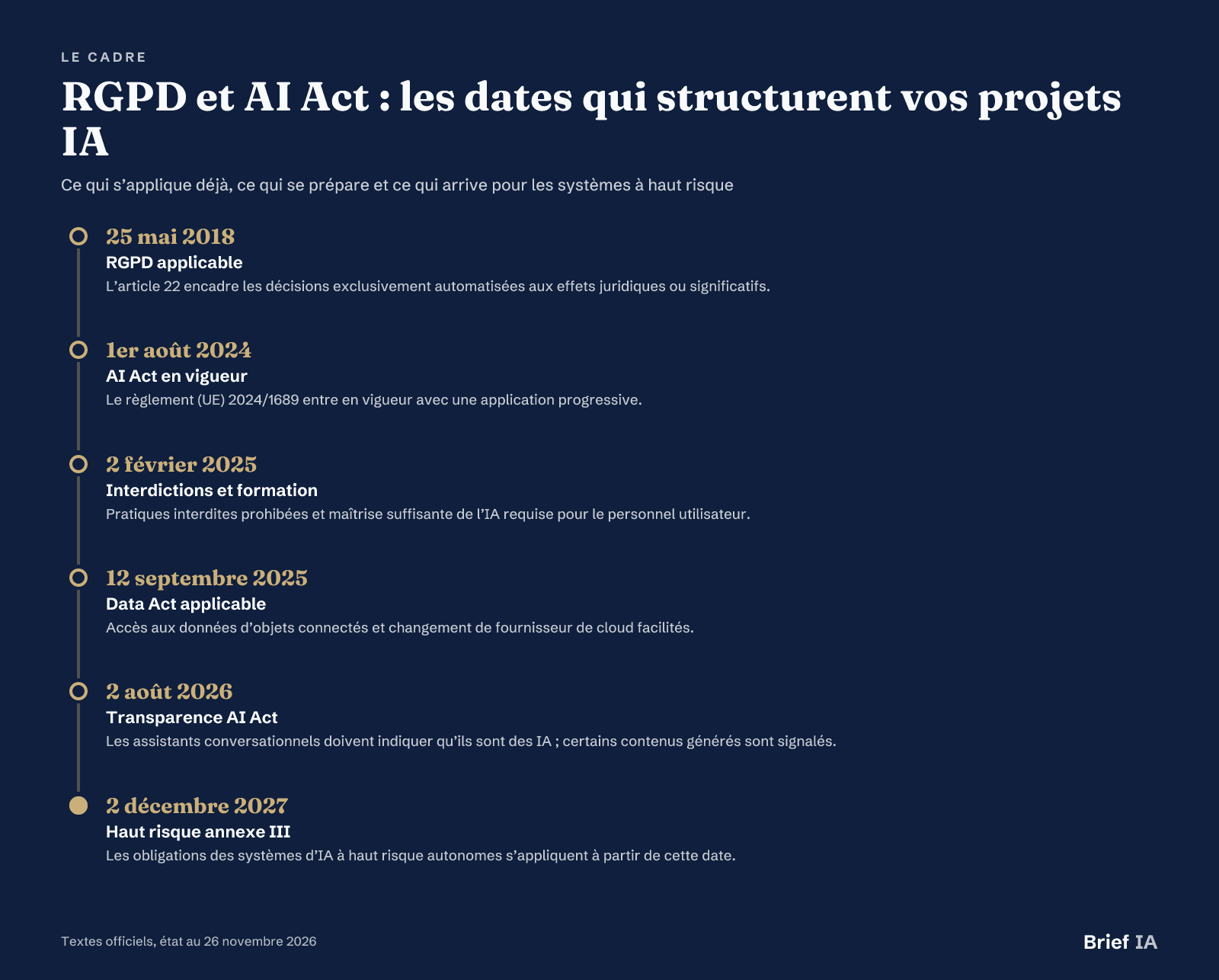 GDPR and AI Act: key dates structuring your AI projects
Key dates, status as of November 26, 2026.
GDPR and Automated Decisions
The GDPR has been in effect since May 25, 2018. For AI, its Article 22 remains central: it regulates decisions based solely on automated processing that produce legal or significant effects on an individual. Projects involving sorting, scoring, recommending, or prioritizing must therefore be analyzed according to their actual effect on individuals, not just based on the tool's name. Legal basis, minimization, information, security, and rights of individuals remain the DPO's control points.
AI Act: Already General Obligations
The AI Act came into force on August 1, 2024, and applies in phases. Since February 2, 2025, prohibited practices are banned, and any organization using AI systems must ensure, through training, a sufficient level of AI mastery among its staff. Notably prohibited are social scoring, manipulation exploiting vulnerabilities, and emotion recognition in the workplace or educational institutions, except for medical or security reasons.
Transparency and High Risk
Since August 2, 2026, transparency obligations apply: a conversational assistant must indicate that it is an AI, and certain generated content must be labeled as such. High-risk autonomous systems in Annex III cover employment, education, access to certain essential services, policing, migration, justice, and democratic processes. Following the Digital Omnibus, their obligations will apply starting December 2, 2027.
Data, Cloud, and Sensitive Sectors
The Data Act has been applicable since September 12, 2025: it organizes access to data produced by connected objects and facilitates changing cloud providers. Health data in France requires hosting by a certified HDS provider. In the company, the social and economic committee must be informed and consulted when introducing new technologies. These rules impose treating AI as a data, contractual, and social project, not just as a software subscription.
Pitfalls to Avoid
Confusing non-training with deletion. A provider may promise that data is not used to train its models while retaining logs for security, billing, or auditing. The DPO must verify what is stored, where, for how long, and who can access it.
Treating the prompt as a draft. A prompt may contain a name, address, identifier, client file, contract excerpt, or technical secret. The rule should be simple: no personal or sensitive data in an unvalidated tool, except in a documented and controlled framework.
Applying high risk too early. Uses in Annex III must be prepared, but obligations for high-risk systems only apply from December 2, 2027. Mixing preparation and enforceability blurs priorities and weakens dialogue with business units.
Forgetting connectors. The risk does not only come from the model. An assistant connected to messaging, CRM, files, or support tickets can read much more data than expected. Each connector must have a purpose, limited rights, and logs.
Underestimating health data. Health data remains among the most sensitive categories. In France, their hosting requires a certified HDS provider. AI projects that mobilize them must document the purpose, inform individuals, ensure enhanced security, and clarify open rights.
Taking Action: The 90-Day Plan
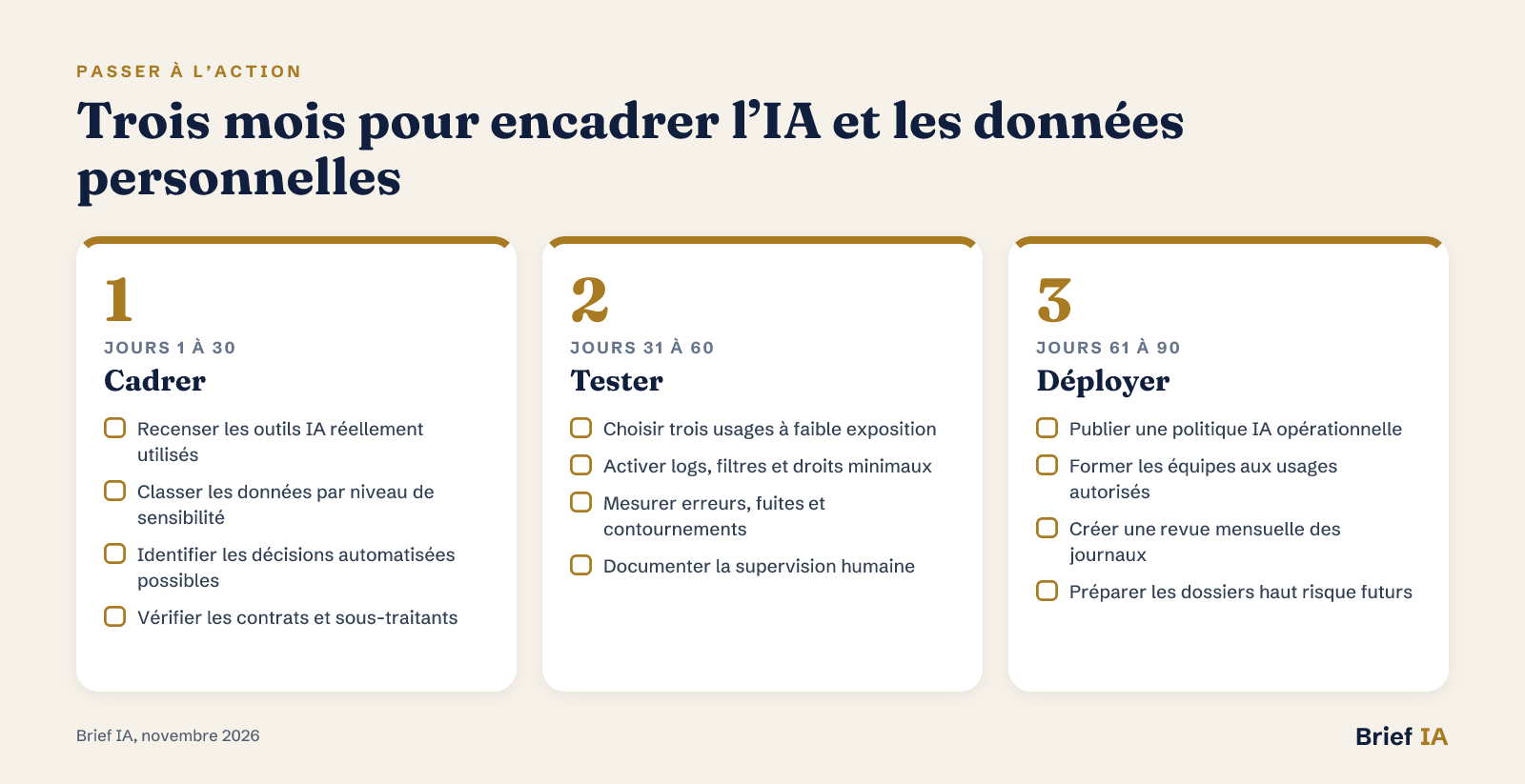 Three months to frame AI and personal data
Three steps: frame, test, deploy.
Start by making actual uses visible: authorized tools, tolerated tools, connectors, and manipulated data. The first month is for classifying processes and blocking the riskiest transmissions. The second month tests a few useful cases with contracts, logs, and access rules. The third month formalizes the doctrine, trains teams, and prepares projects that may fall under high risk starting December 2, 2027.
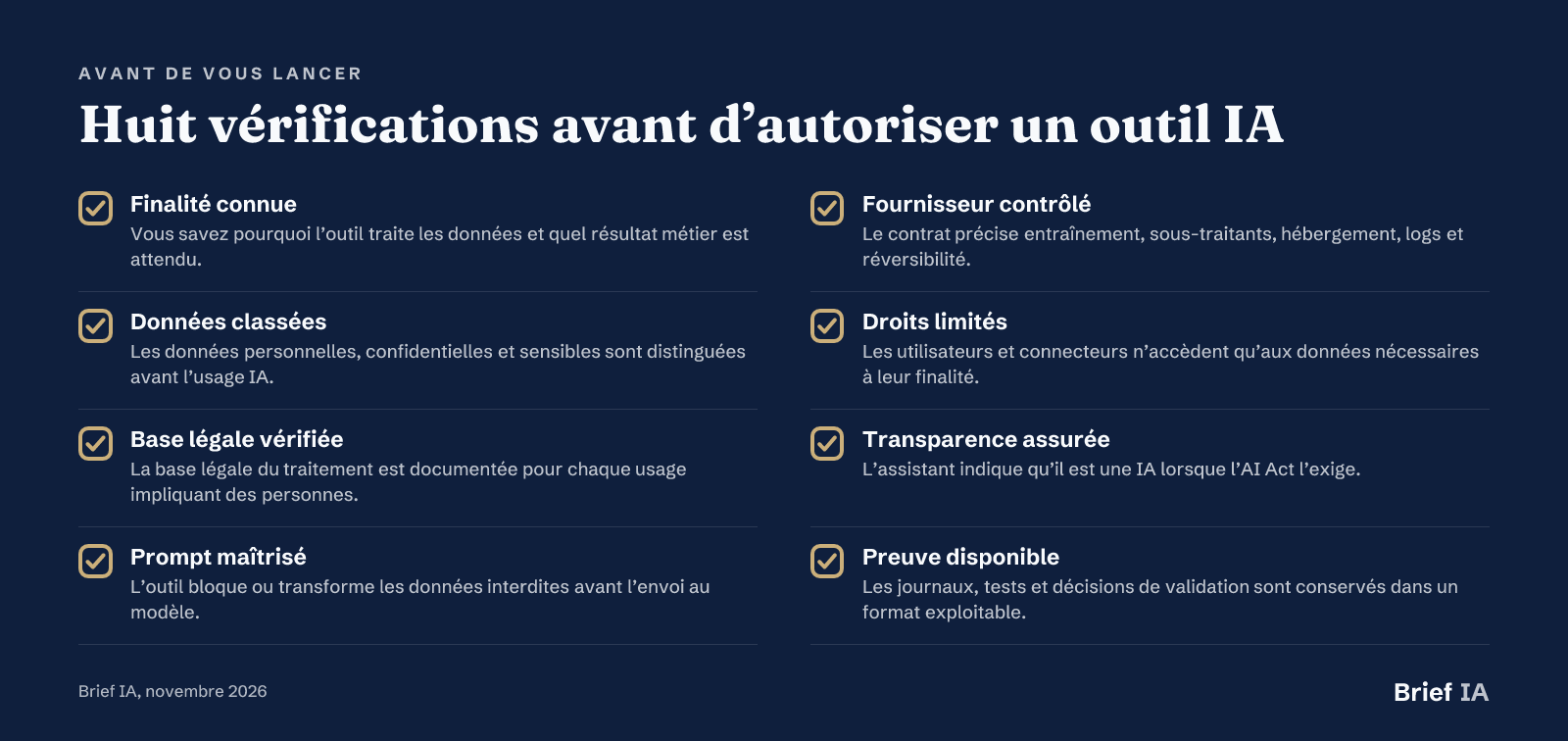 Eight checks before authorizing an AI tool
Eight checks to perform before each new use.
Further Reading
Our analyses for DPOs and lawyers
- Securing data sent to AIs. Controls to implement when an assistant can forward requests to other models or subcontractors.
- 2026 Method for Protecting Data with AI. An approach to mapping, classification, encryption, access, and logging tailored to AI uses.
- Understanding Lock Mode and Its Limits. What the promise of non-use of data for training entails, and what it does not resolve regarding logs.
- AI Security by Design. Controls to integrate before deployment: data, permissions, RAG, testing, and monitoring.
- Health Data and AI: Guarantees to Compare. The stakes of pseudonymization, opt-out, hosting, and use of health data for AI.
- Training an AI on Protected Content. Legal reflexes on licenses, opt-out, training data, and obligations of generalist models.
Key News to Note
- According to PwC, 79% of companies are already using AI agents
- Google expands the use of personal data to train its AI
- Open-weight models require technical, legal, and security evaluation
- Mistral highlights European demand for sovereign models
- American schools: lawsuits and moratoriums requested against Google’s AI
- Carissa Véliz warns about the influence of predictive AIs in decision-making
Do you provide a solution for personal data protection?
This guide is read by DPOs, lawyers, CISOs, and compliance officers. Brief IA offers solution providers in compliance, cybersecurity, and data governance dedicated articles, placements in the evening brief, and promotion in the directory. Formats and rates at briefia.fr/partenaires.
The Essentials in Questions
Does the GDPR apply to generative AI tools?
Yes, as soon as an AI tool processes personal data. The GDPR imposes a determined purpose, a legal basis, minimization, security, and respect for individuals' rights. Article 22 must be examined if the system produces an exclusively automated decision with legal or significant effects.
Can I send personal data to ChatGPT or another assistant?
Only if the use is authorized, documented, and framed. You must check the contract, hosting, subcontractors, logs, retention period, and any potential use of data for training. Otherwise, use fictitious, anonymized, or blocked data by a filter before sending.
Does the AI Act already impose rules for high-risk systems?
No. The obligations for high-risk AI systems in Annex III apply starting December 2, 2027. However, since February 2, 2025, prohibited practices are banned, and user organizations must ensure a sufficient level of AI mastery among their staff.
What is the difference between pseudonymization and anonymization for AI?
Pseudonymization replaces direct identifiers with codes, but re-identification may still be possible. The data remains personal data subject to the GDPR. Anonymization means that a person can no longer be identified. For AI projects, this distinction conditions the legal basis, individuals' rights, and security measures.
Does a local model resolve GDPR issues?
No. A locally executed model can limit transfers to an external service, but the GDPR continues to apply if personal data is processed. It is necessary to document the purpose, limit access, secure the environment, verify the license, trace uses, and plan for deletion or retention rules.
Brief IA — L'actualité IA en français
L'essentiel de l'actualité de l'intelligence artificielle, décrypté et expliqué chaque jour.