AI for Retail and E-commerce: The 2026 Reference Guide

According to Adobe, traffic generated by AI to U.S. retail sites surged by 393% in the first quarter of 2026 compared to the previous year, and visitors using AI generated 37% higher revenue per visit than non-AI traffic. The signal is clear for commerce: AI is no longer limited to customer service or marketing texts; it is transforming search, advice, payment, and customer loyalty. This guide sorts through the effective uses, tools, rules, pitfalls, and a plan to get started.
What AI Really Changes for Commerce and E-commerce
The first change relates to acquisition. According to Adobe, in the United States, AI traffic to retail sites increased by 269% in March 2026 year-over-year, and by 393% overall in the first quarter. American consumers using AI for their purchases generated 37% higher revenue per visit than non-AI traffic. Our article on AI traffic to American retailers documents this American progression, though it cannot be directly transposed to other markets.
The second change concerns customer experience. Personalization is no longer limited to segmenting a customer base: it adapts recommendations, content, email subjects, channels, and timing. According to Salesforce, campaigns triggered by predictive scoring convert 3 to 5 times better than manually scheduled campaigns. Our analysis on personalizing customer experience in e-commerce recommends systematically comparing the AI version to a classic version to measure open rates, clicks, revenue, and unsubscribes.
The third change comes from agents. Shopify already allows AI agents operating in the browser to finalize purchases on eligible stores, including Shop Pay, via WebMCP. Stripe observed a 38-fold increase in AI agent transactions via Link in September, with nearly 200 active agents and an average cart value of around $100, without publishing absolute volumes. Agent-based commerce is still young, but it already requires making catalogs, delivery rules, and payments understandable by machines.
 E-commerce team preparing returns and packages in a warehouse office.
AI assists commerce when data, roles, and controls are clear.
Effective Uses Today
The most robust uses are those that enhance a specific step in the journey: finding, choosing, buying, receiving, returning, or coming back. More autonomous cases should remain supervised until order and payment errors are under control.
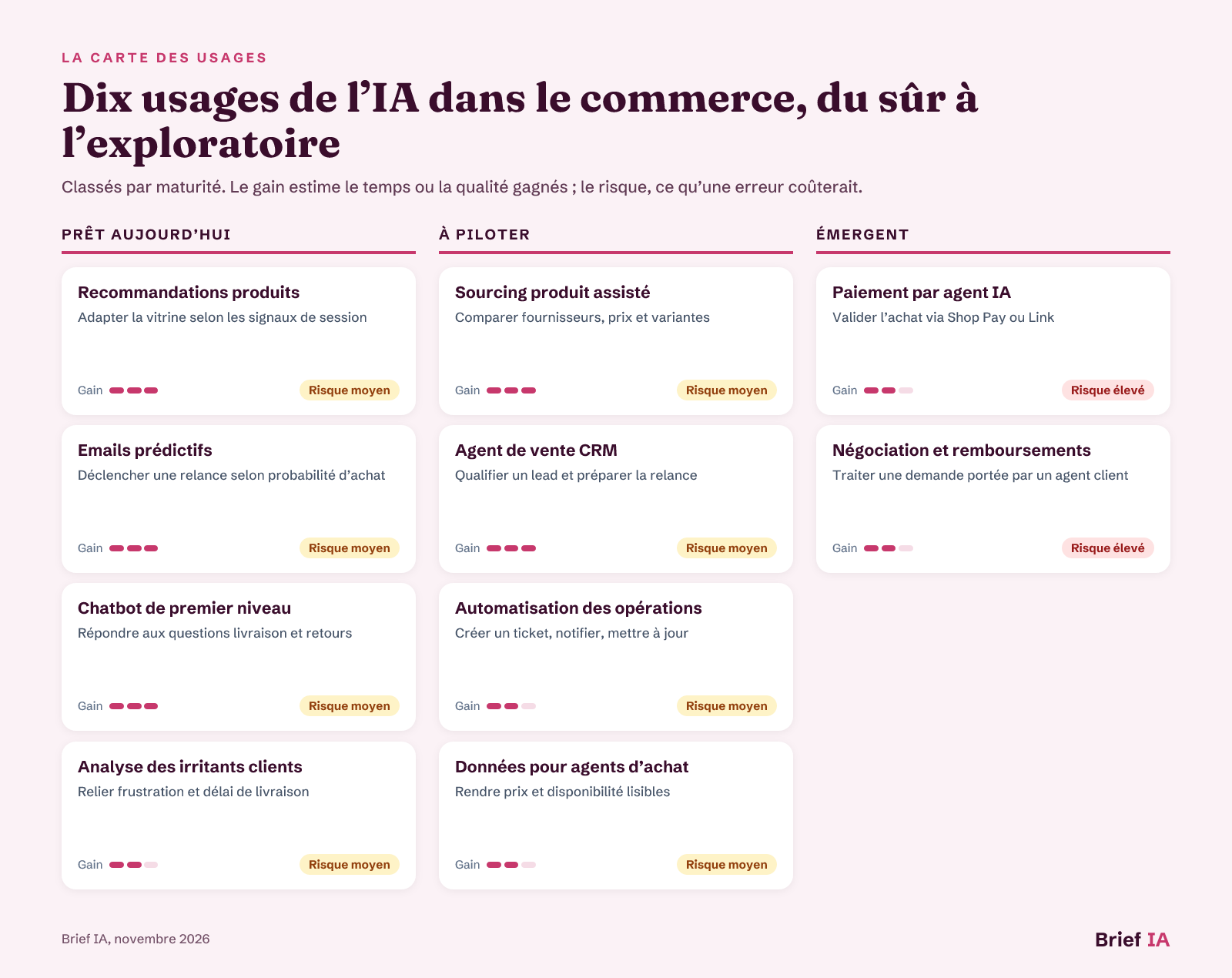 Map of AI uses for commerce professionals
Uses classified by maturity, with expected gain and risk in case of error.
Ready-to-Use Applications
Product Recommendations. Recommendation engines leverage browsing, past purchases, and context to suggest more relevant products. The interest is maximized when the tool acts on the order of categories, banners, recommendations, and messages, then measures the impact against a control journey. The priority is not to personalize everywhere but to identify areas that significantly affect conversion and cart size.
Predictive Emails. Campaigns can be triggered by a score rather than a fixed schedule: abandoned cart, likely repurchase, decreased interest, or product affinity. According to Salesforce, campaigns triggered by predictive scoring convert 3 to 5 times better than manually scheduled campaigns. It is essential to measure open rates, clicks, revenue per email, and unsubscribes without multiplying messages at the risk of damaging the relationship.
First-Level Chatbot. A well-framed chatbot handles frequent questions about order tracking, returns, sizes, availability, or warranties. Our analysis on creating an AI chatbot for a website emphasizes that training on the knowledge base and monitoring conversations are as important as choosing the platform. Escalation to a human advisor should remain simple and visible.
Analysis of Customer Frustrations. Semantic analysis of reviews, chats, emails, surveys, and transcribed calls helps identify causes of frustration, hesitation, or disappointment. Our analysis on customer emotions in e-commerce recommends linking each emotion to a business theme: delivery, product sheet, return, price, or customer service. Sentiment analysis should not become an emotional surveillance of employees.
Uses to Manage
Assisted Product Sourcing. AI sourcing tools accelerate the search for suppliers, comparison of variants, and cost estimation. Our article on Alibaba and Accio reports that the tool helped Mike McClary relaunch a Guardian lamp with production costs dropping from $17 to $2.50. The final decision remains human: quality, compliance, deadlines, and commercial conditions must be verified.
CRM Sales Agent. An agent connected to the CRM can qualify leads, summarize exchanges, enrich records, and prepare follow-ups. Our analysis on integrating an AI sales agent advises starting with a measurable case: conversion rate of leads to opportunities, qualification time, or acquisition cost. The CRM database must be cleaned before any pilot; otherwise, the agent amplifies inconsistencies.
Operations Automation. Workflow agents connect forms, CRM, customer service, spreadsheets, and messaging to execute sequences of actions. They are suitable for repetitive but variable tasks: sorting requests, creating tasks, updating statuses, or reporting. The right framing is to keep humans on exceptions, sensitive refunds, disputes, and decisions that significantly impact the customer.
Data for Purchasing Agents. Purchasing agents need accurate data on prices, stock, variants, fees, deadlines, return conditions, and reviews. Google has enriched its Universal Commerce Protocol with cart functions, real-time catalog, and loyalty for AI agents. For a retailer, the challenge is to prepare structured and coherent data to avoid the agent favoring a more readable competitor.
Emerging Uses
AI Agent Payment. Automated payment is advancing quickly but remains sensitive. Shopify allows AI agents to finalize purchases on eligible stores, including Shop Pay, via WebMCP, as explained in our article on agent-finalized purchases on Shopify. Merchants must plan for limits, validations, action logs, accurate information, and dispute procedures before allowing an agent to act in the purchase funnel.
Negotiation and Refunds. Personal agents are already helping some users reduce bills, recover refunds, or track travel credits. For merchants, this means more structured, persistent, and sometimes automated requests. Clear processing rules must be prepared: proof of purchase, identity, negotiation limits, authorized or unauthorized access for agents, and escalation to a human as soon as a dispute falls outside the framework.
Tools to Know
There is no universal ranking: the right choice depends on the channel, data, volume, level of autonomy, and accepted risk.
- E-commerce Personalization Engines. Nosto, AB Tasty, and Insider are mentioned for adapting recommendations, banners, category order, or messages based on browsing signals and customer data. They must be connected to e-commerce platforms and evaluated through controlled testing. Requirements: A/B testing, revenue measurement, unsubscribe control, consent management.
- Conversational Assistants for Websites and Customer Service. Tidio, Crisp, Zendesk AI, eesel AI, and Freshservice AI are included in our analysis of chatbots for websites. The choice should start from the requests to automate, languages, escalation to an advisor, and the data used to respond. Requirements: mastered knowledge base, human escalation, response log, indication of AI.
- Sales and Customer Relationship Agents. These tools qualify leads, prepare follow-ups, summarize exchanges, and feed the CRM. HubSpot, Salesforce, or an equivalent are cited as possible prerequisites when an agent needs to work on structured commercial data. Requirements: clean CRM, human validation, limited rights, conversion indicators.
- Workflow Orchestrators and Internal Agents. Make, Zapier, n8n, Pipedream, or Tray.ai serve to connect applications, data, and actions. They are suitable for recurring flows, but sensitive business decisions must remain supervised, especially for refunds, pricing, and payments. Requirements: flow mapping, minimal rights, sandbox testing, manual recovery.
- Cost Tracking and Governance Tools. The cost of an agent adds up API, hosting, maintenance, and supervision. Our analysis on optimizing AI agent costs recommends tracking the cost per useful task rather than just the calls to the model. Requirements: cost center, usage cap, cost per task, monthly review.
Le brief IA que les pros lisent chaque soir
Les 7 actus IA du jour, décryptées en 5 min. Gratuit.
Inclus dès l'inscription : notre sélection des meilleurs guides & comparatifs IA.
Choisissez votre rythme
Gratuit · Pas de spam · Désabonnement en 1 clic
The Framework: AI Act, GDPR, Invoicing, and Work Organization
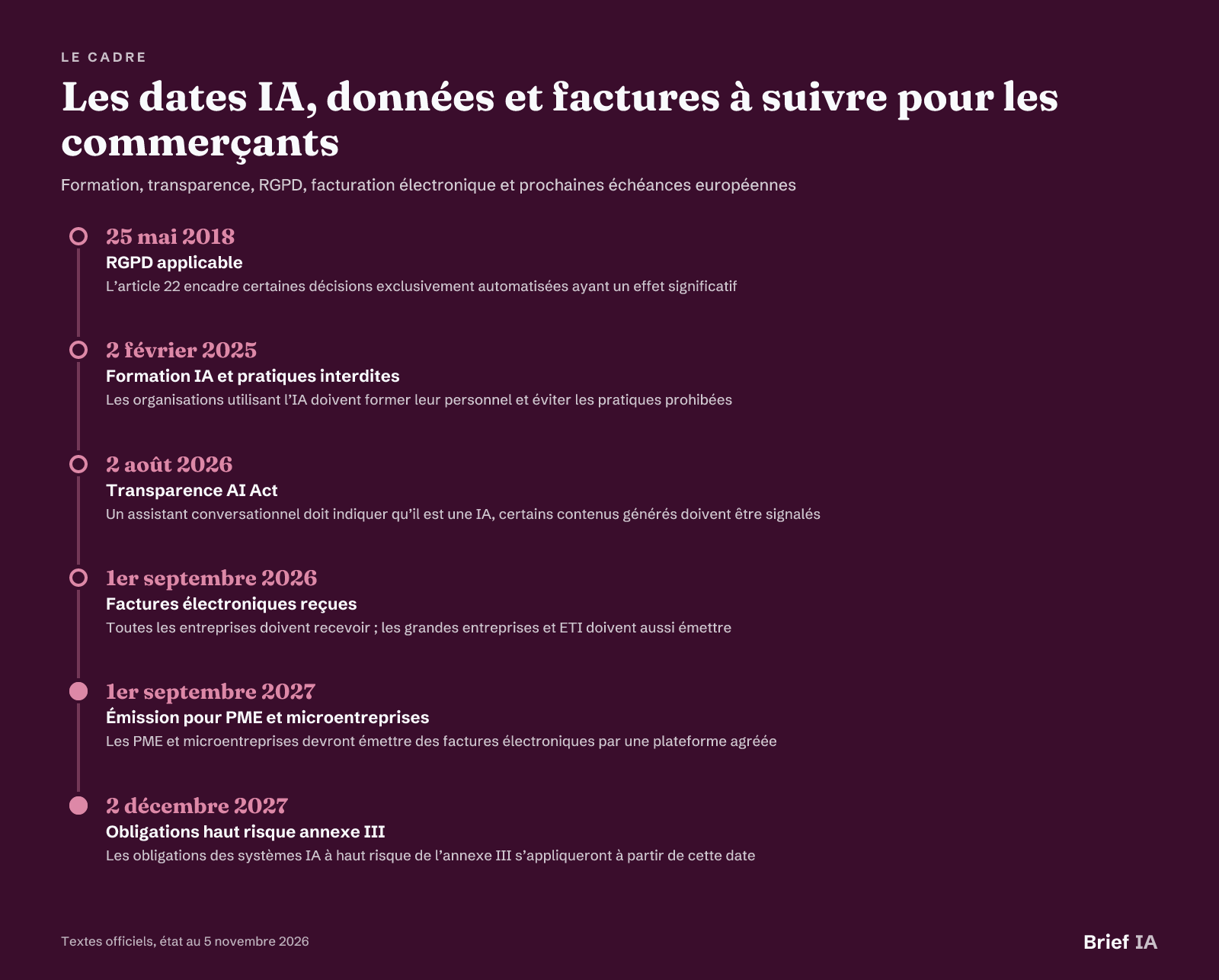 Key dates for AI, data, and invoicing to follow for merchants
Key dates, status as of November 5, 2026.
AI Act
The European AI regulation came into effect on August 1, 2024, and is being implemented in phases. Since February 2, 2025, prohibited practices are banned, and any organization using AI systems must ensure a sufficient level of AI mastery among its staff. From August 2, 2026, transparency obligations apply: a conversational assistant must indicate that it is an AI, and certain generated content must be labeled as such.
Prohibited and High-Risk Uses
Prohibited practices include social scoring, manipulation exploiting vulnerabilities, and emotion recognition in the workplace, except for medical or safety reasons. For commerce, customer sentiment analysis must therefore be separated from any emotional surveillance of employees. High-risk systems listed in Annex III include employment practices such as recruitment, promotion, dismissal, task allocation, evaluation, and monitoring of employees; their obligations apply from December 2, 2027.
Personal Data
The GDPR has been in effect since May 25, 2018. Its Article 22 regulates decisions based solely on automated processing that produce legal or significant effects on a person. For e-commerce, this requires framing automated decisions that may lead to a refusal, significant limitation, or significant consequence for a customer.
Invoicing and Internal Consultation
Since September 1, 2026, all companies must be able to receive electronic invoices, and large enterprises and SMEs must issue them through an approved platform. SMEs and micro-enterprises will have to issue them starting September 1, 2027. The Labor Code also stipulates that the CSE must be informed and consulted when introducing new technologies in the company, which includes AI deployments in stores, warehouses, customer service, or headquarters.
Pitfalls to Avoid
Automating Without Reliable Data. A sales or customer service agent reading a false catalog, incomplete stock, or poorly filled CRM will respond quickly but inaccurately. Before the pilot, check key fields: price, availability, deadlines, returns, order status, customer history, and discount rules.
Confusing Customer Sentiment with Surveillance. Analyzing reviews, tickets, and conversations helps reduce irritants. It should not shift towards recognizing employee emotions, which is prohibited in the workplace except for medical or safety reasons. Separating customer data from internal data avoids unnecessary drift.
Allowing the Agent to Pay Too Early. News about Instinct, Muse, Stripe, Shopify, and American Express shows that agent-based payment is advancing, but cautiously. Our article on American Express's intention token illustrates the necessity of linking each transaction to explicit authorization.
Measuring Only Volume. A chatbot can handle many conversations while degrading the experience if it responds poorly to complex cases. Track escalation rates, human corrections, avoided refunds, satisfaction, incremental revenue, and cost per useful task.
Forgetting the Teams. In stores, warehouses, customer service, or marketing, AI changes tasks. The CSE must be informed and consulted when introducing new technologies. Training teams, documenting authorized uses, and planning for manual recovery reduces operational bottlenecks.
Taking Action: The 90-Day Plan
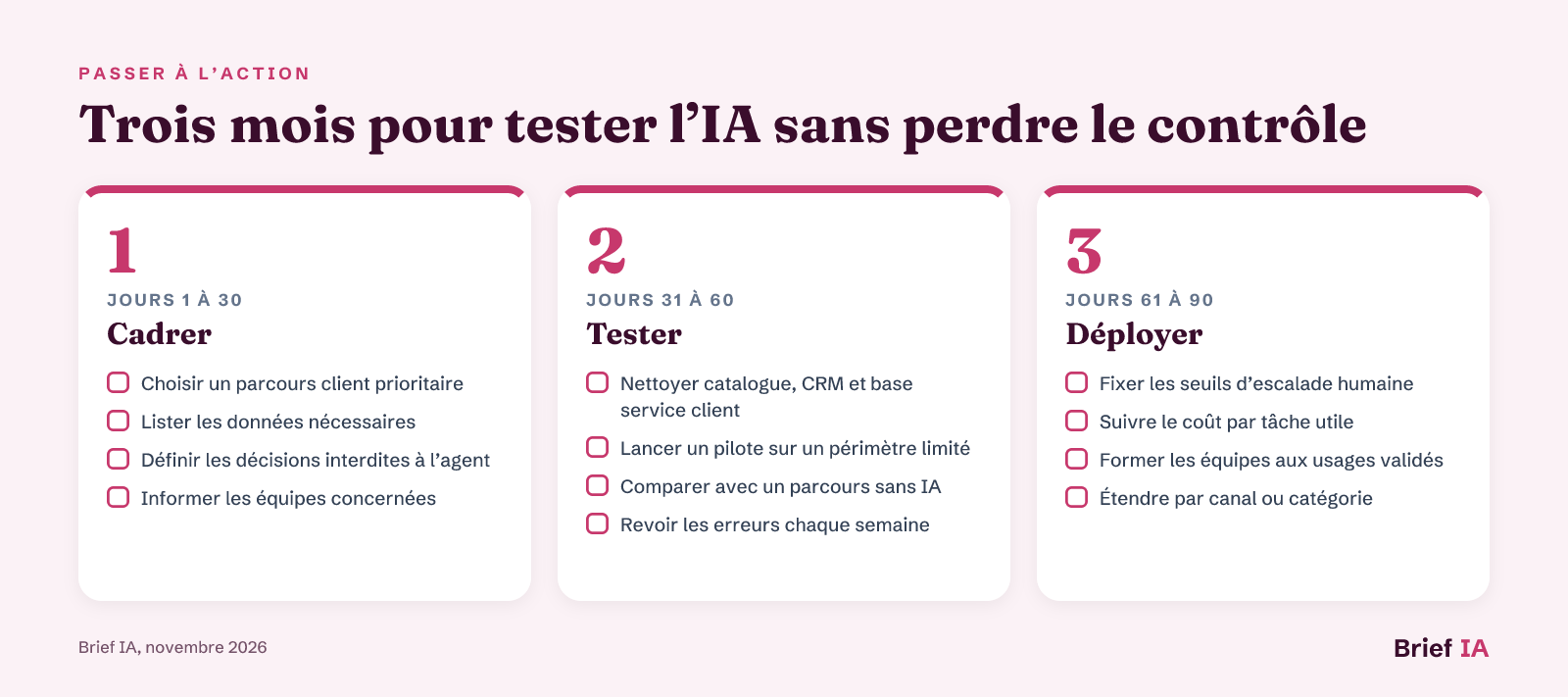 Three months to test AI without losing control
Three steps: frame, test, deploy.
Start with a short and measurable journey: a product category, a customer segment, or a customer service flow. During the first month, clean the data and set escalation rules. In the second month, test an AI version against a classic version, with a small volume. In the third month, expand only if gains, errors, costs, and team feedback are documented.
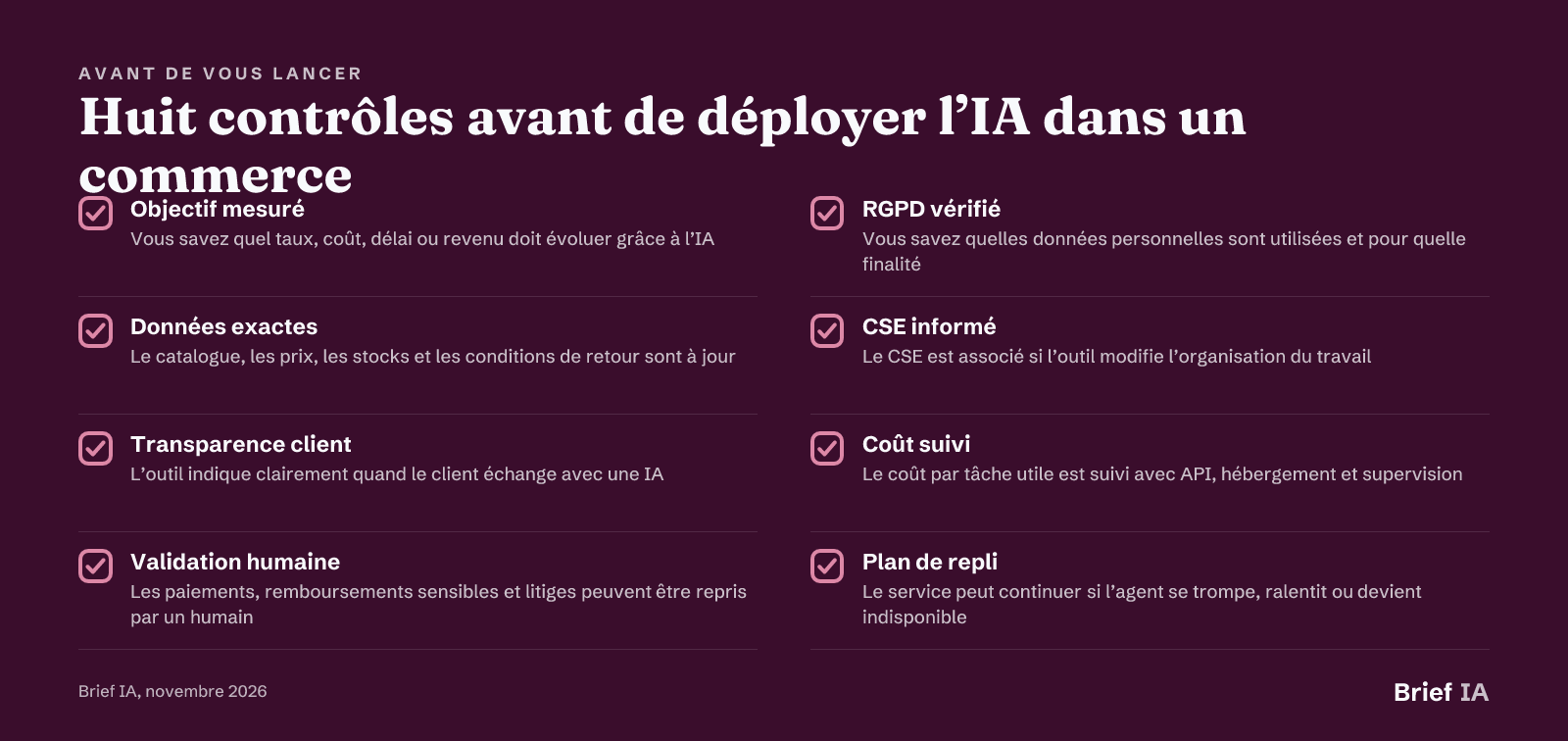 Eight checks before deploying AI in commerce
Eight verifications to perform before each new use.
Further Reading
Our analyses for commerce professionals
- Personalizing customer experience in e-commerce with AI. Method for recommendations, emails, chatbots, and performance testing on a commercial site.
- Analyzing customer emotions without drift. How to leverage reviews, chats, and tickets to reduce irritants without monitoring employees.
- Creating an AI chatbot for a website. Steps for framing, platform choice, training, and monitoring customer conversations.
- Integrating an AI sales agent. Use cases, CRM prerequisites, limits, and pilot methods for qualifying and following up.
- Mastering the costs of AI agents. A method for tracking API, hosting, maintenance, supervision, and cost per useful task.
- Meta Business Agent and customer relations. What integrated agents in WhatsApp, Instagram, and Messenger change for sales and customer service.
Key News to Remember
- Adobe measures a significant increase in AI traffic to American retailers
- Shopify opens payment for eligible stores to AI agents
- Stripe observes a strong increase in agent payments via Link
- American Express links agent purchases to an intention token
- Blocked platforms or dedicated queues: agent access is negotiable
- Alibaba Accio accelerates sourcing for small online sellers
Do you provide a solution for commerce and e-commerce?
This guide is read by commerce leaders, e-commerce managers, marketing directors, customer relations teams, and operations managers. Brief IA offers e-commerce solution providers, CRM, payment, customer relations, personalization, and automation dedicated articles, evening brief inserts, and promotion in the directory. Formats and rates at briefia.fr/partenaires.
The Essentials in Questions
How to Use AI in an E-commerce Site?
Start with a measurable use: product recommendation, customer service chatbot, cart recovery, review analysis, or lead qualification. The tool should rely on clean data and be compared to a non-AI version. Payments, refunds, and disputes should remain supervised at the beginning.
Should an AI chatbot indicate that it is an AI?
Yes. Since August 2, 2026, the transparency obligations of the AI Act apply. A conversational assistant must indicate that it is an AI. For a commercial site, this information should be clear in the customer journey, especially if the tool responds to customer service, advises a product, or collects information.
Can AI agents buy on behalf of customers?
Some solutions already allow this in certain environments, notably with Shopify, Stripe Link, or payment systems tested by major networks. The market is still young. The dominant safeguards are human validation, limits, dedicated cards or identifiers, and action logs.
What data should be prepared to be visible to AI agents?
Agents need accurate, structured, and up-to-date data: product name, variants, price, availability, fees, deadlines, return conditions, and reviews. An attractive sheet for a human is not enough. The information must also be readable by systems that compare and fill carts.
Can AI analyze customer emotions?
It can analyze sentiments expressed in reviews, tickets, chats, or emails to identify frustration, hesitation, or satisfaction. These signals should be linked to business causes, such as delivery or product sheet. However, emotion recognition in the workplace is prohibited except for medical or safety reasons.
Brief IA — L'actualité IA en français
L'essentiel de l'actualité de l'intelligence artificielle, décrypté et expliqué chaque jour.