AstraZeneca: AI Revolutionizes Drug Design
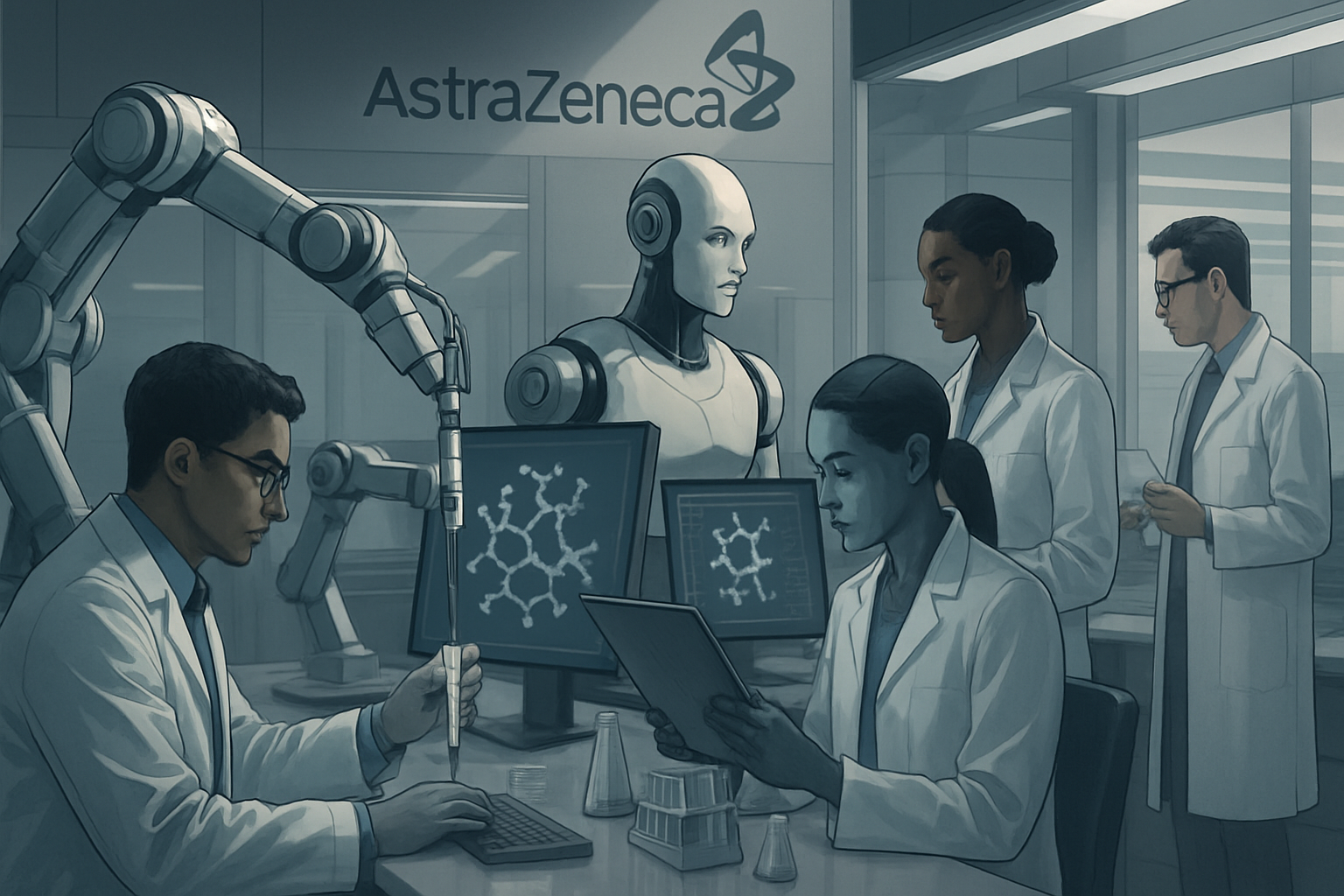
AI: A Major Asset for Drug Design
The development of new drugs is a lengthy, costly process often fraught with challenges. In particular, biologics, which are treatments developed from designed proteins, present additional complexity compared to synthetic drugs. These treatments are essential for many acute and chronic diseases, but their development poses a significant scientific challenge.
Researchers must explore a vast array of potential molecules to identify those that will bind effectively to a specific target, remain stable in the human body, and can be produced at scale. Artificial intelligence (AI) now plays a central role in accelerating these processes, becoming a cornerstone of research and development infrastructure in the pharmaceutical industry.
AI and Biologics: A New Era
AI is increasingly establishing itself in the design of biologics. Companies like AstraZeneca are investing heavily in their engineering teams to leverage these technologies. Puja Sapra, Senior Vice President and Head of Biologics Engineering and Targeted Oncology Discovery at AstraZeneca, emphasizes that every step of the process, from design to analysis, is now optimized by computing. This allows for shorter development cycles while increasing productivity and innovation.
AstraZeneca employs an iterative build-measure-learn approach. AI is used to generate and prioritize candidate molecules, predicting which ones are most likely to succeed. Laboratory resources are then focused on these promising candidates, reducing dead ends and accelerating iteration. This method also allows for targeting diseases once considered untreatable, leveraging AI's ability to explore a number of molecular combinations far beyond what a human team could achieve.
Solving Complex Challenges with AI
AI not only accelerates drug development; it also paves the way for the discovery of new classes of treatments. Traditional biologics typically target a single disease mechanism. However, the next generation of treatments could target multiple targets simultaneously or deliver therapies precisely to specific cells. This requires complex optimization across many variables.
Puja Sapra explains that AI models could help design these increasingly complex multispecific drugs. For instance, these models could identify which targets to prioritize based on underlying biology and optimize various parameters to balance potency, stability, manufacturability, and safety. These technological advancements make it possible to consider treating previously inaccessible targets, with potentially significant benefits for patients.
The Crucial Importance of Data
According to McKinsey, generative AI, combined with other computational tools, could halve drug discovery timelines. However, the effectiveness of these models depends on the quality of training data. In drug discovery, this means having vast amounts of high-quality biological data.
Le brief IA que les pros lisent chaque soir
Les 7 actus IA du jour, décryptées en 5 min. Gratuit.
Inclus dès l'inscription : notre sélection des meilleurs guides & comparatifs IA.
Choisissez votre rythme
Gratuit · Pas de spam · Désabonnement en 1 clic
Every experiment, whether successful or not, provides valuable insights into what works and what doesn't. Sapra highlights that data is a key differentiating factor for AstraZeneca. The company has proprietary, multimodal datasets, including molecular structures, binding measurements, safety profiles, and manufacturing outcomes. These data are intentionally diversified across multiple disease areas and drug types, allowing for the refinement of AI models with rich and representative training sets.
Towards a Laboratory of the Future
To centralize this data, AstraZeneca is building a laboratory of the future in Kendall Square, Cambridge, Massachusetts. This lab will integrate AI and robotic automation to form a closed-loop discovery system. Much like an autonomous car, this system will use AI to make predictions, robots to execute experiments, and instruments to generate data, thereby accelerating each subsequent cycle.
Scientists will remain at the heart of this process, providing their oversight, judgment, and strategic direction to ensure that the results are explainable, tolerable, and oriented toward potential patient benefits.
De Novo Design: A Vision for the Future
The ultimate goal of AI in biologics discovery is "de novo" design, where AI generates entirely new protein sequences that match the desired properties of a drug. This includes designing the structure, predicting safety, behavior in the body, and manufacturability.
Sapra asserts that the field is rapidly progressing toward an AI-generated biologic, designed from scratch to a clinical candidate. To achieve this goal, richer and standardized training data, robust evaluation benchmarks, and teams skilled at the intersection of machine learning and biology are needed. Predicting safety is a major challenge, and AstraZeneca is addressing this with virtual clinical trials, using advanced cellular systems and micro-scale organ models that function as physical test beds.
The Crucial Role of Human Talent
The ongoing transformation in the field of biologics does not rely solely on technology. Human oversight remains essential to ensure explainable and ethical AI. Scientists collaborate with these systems, testing AI-designed molecules and gathering data to continuously improve the models.
For engineers, designing effective systems for human-AI collaboration involves ensuring high levels of transparency and explainability of the models. AstraZeneca's engineering teams, composed of data scientists, automation specialists, and AI engineers, are developing systems that act as "thinking partners" rather than black boxes. These systems are designed to generate, validate, and learn quickly, tackling challenges such as merging multimodal data, closed-loop optimization, quantifying uncertainty, and interpretability at the point of clinical decision-making.
By addressing these demanding technical challenges, engineers and scientists contribute to the research and development of potentially revolutionary treatments for many diseases. The biologics we can develop today, and those we will design tomorrow, depend on the combination of AI and world-class engineering talent with deep scientific expertise.
Brief IA — L'actualité IA en français
L'essentiel de l'actualité de l'intelligence artificielle, décrypté et expliqué chaque jour.