Understanding AI: From Machine Learning to Agentic AI
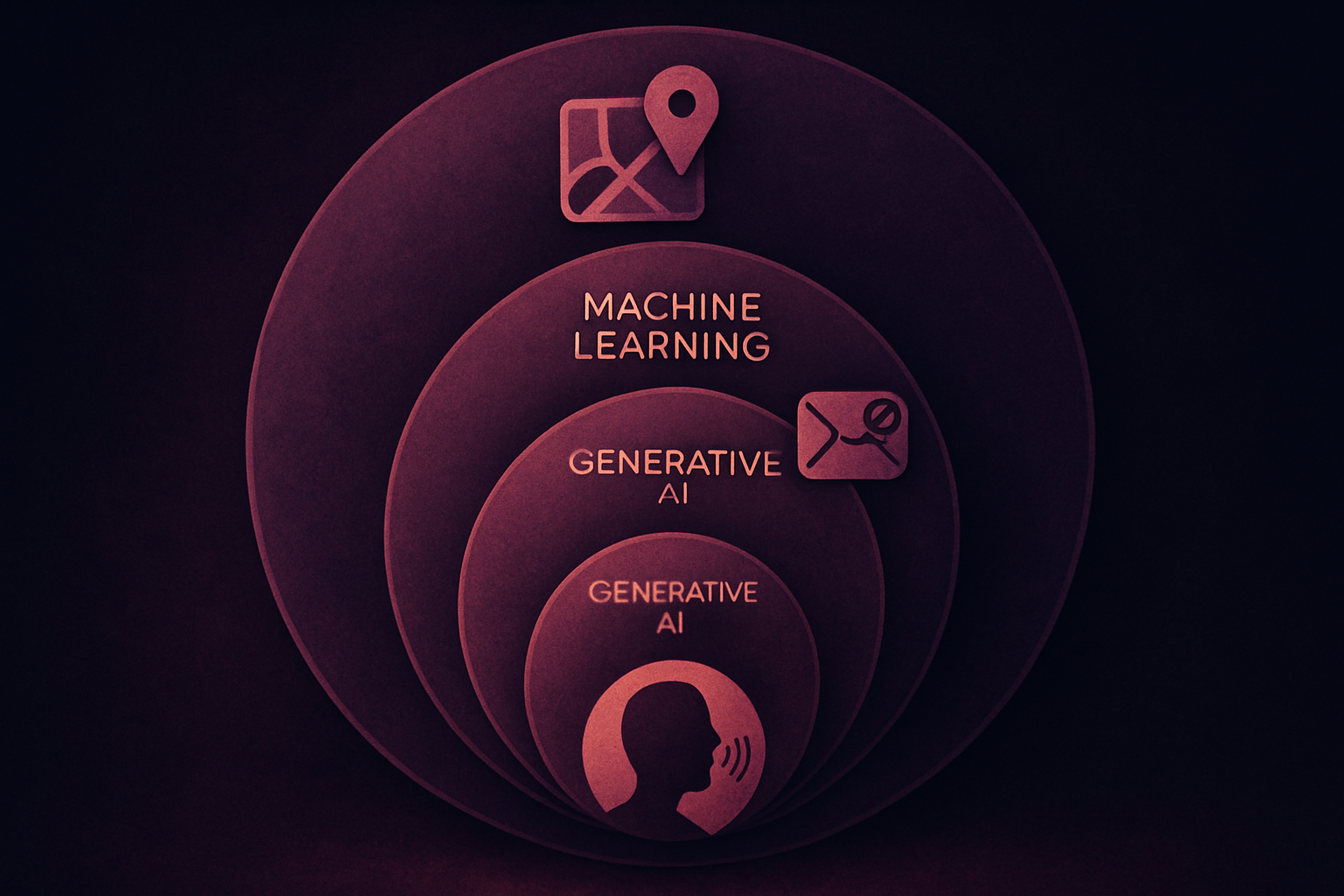
Evolution of AI Technologies
In this article, we will explore five key concepts that are redefining every sector by 2026: AI, Machine Learning, Deep Learning, Generative AI, and Agentic AI. The frequently asked question is: “What is the real difference between all these terms?” This inquiry is legitimate, as these terms are often used interchangeably, sometimes incorrectly.
It is crucial to grasp these distinctions, especially if you are considering a career in this field. Here is a clear explanation, without complex equations, but with useful analogies and concrete examples.
Visualize This: A Family of Nested Circles
Before diving into each concept, it is essential to understand that these five terms are not competing alternatives. They form a hierarchy — each exists within the one that precedes it, like nested circles.
- Artificial Intelligence ← The entire family
- Machine Learning ← The most powerful branch
- Deep Learning ← The engine inside ML
- Generative AI ← The creative layer
- Agentic AI ← The action layer
- Generative AI ← The creative layer
- Deep Learning ← The engine inside ML
- Machine Learning ← The most powerful branch
Each inner layer is a more specialized form of the one that contains it. Keep this mental model in mind as we explore each term.
1. Artificial Intelligence (AI) — The Outer Circle
In one sentence: AI is any technique that allows a machine to perform tasks that normally require human intelligence.
Think of AI as the broadest goal, not a specific technology. The only requirement: a machine accomplishing a task that we would classify as intelligent if a human were doing it. This encompasses everything from a chess engine to a spam filter, to a self-driving car.
Concrete examples you use daily:
- Google Maps finding the fastest route to your destination
- Your email spam filter deciding what goes into junk mail
- Netflix choosing which thumbnail to show you (yes, that’s also AI — different thumbnails for different users)
💡 Key Insight: AI is the goal — making machines intelligent. Machine Learning, Deep Learning, Generative AI, and Agentic AI are all different methods to achieve that goal.
2. Machine Learning (ML) — Teaching by Example
In one sentence: ML is an AI that learns patterns from data, rather than following hand-written rules.
Here’s the fundamental shift: instead of a programmer writing rules, you provide the machine with examples and let it discover the rules on its own.
The simplest analogy: imagine teaching a child to identify a mango. You don’t give them a botanical manual with precise definitions of color, shape, and texture. You simply show them hundreds of mangoes — and non-mangoes — and eventually, they just know.
Le brief IA que les pros lisent chaque soir
Les 7 actus IA du jour, décryptées en 5 min. Gratuit.
Inclus dès l'inscription : notre sélection des meilleurs guides & comparatifs IA.
Choisissez votre rythme
Gratuit · Pas de spam · Désabonnement en 1 clic
ML has three main branches:
-
Supervised Learning — labeled examples as input, predictions as output. Used in fraud detection, disease diagnosis, price forecasting.
-
Unsupervised Learning — no labels, the model finds patterns on its own. Used in customer segmentation, anomaly detection.
-
Reinforcement Learning — the model learns through trial and error, earning rewards for good decisions. This is how AlphaGo beat world champions in chess and Go without being explicitly programmed with strategies.
Concrete examples:
- Swiggy and Zomato predicting your delivery time
- Your bank flagging an unusual transaction at 2 AM
- The Discover Weekly playlist on Spotify — entirely generated by ML based on your listening habits
💡 Key Insight: ML has freed AI from hand-written rules. Instead of programming every scenario, you provide data to the machine and let it discover patterns. This is what has made AI practical at scale.
3. Deep Learning (DL) — When ML Grows in Layers
In one sentence: DL is a subset of ML that uses multi-layer neural networks to process complex and unstructured data — like images, audio, and raw text.
Classic ML works very well on structured data — rows and columns in a spreadsheet. But if you give it a picture of a dog or a recording of someone speaking and ask it to understand that input — it struggles.
Images, audio, and raw text are messy, unstructured, and high-dimensional. Classic ML was not designed for that. DL solves this problem with neural networks — layers of simple calculations stacked on top of each other, loosely inspired by how neurons in the human brain connect.
How the layers work:
- Each layer extracts something more abstract than the previous layer.
For an image:
- Layer 1: detects edges and raw colors
- Layer 2: combines these elements into shapes — circles, lines, curves
- Layer 3: combines shapes into features — eyes, ears, fur
- Layer 4: recognizes the object: dog
Stack enough layers, train on enough data, and the network learns to recognize faces, transcribe speech, translate languages — all from raw pixels and sound waves.
Deep Learning exploded around 2012 when three elements aligned simultaneously:
- Internet-scale datasets for training
- Powerful enough GPUs to handle parallel computations
- Advances in training techniques that solved long-standing issues
Concrete examples:
- Google Photos recognizing your face among thousands of photos
- Real-time language translation on your phone
- Medical AI detecting cancer at an early stage in radiology scans
- Voice recognition when you say “Hey Siri” or “Ok Google”
💡 Key Insight: DL enables AI to process complex and unstructured data, paving the way for advanced applications across various fields.
Brief IA — L'actualité IA en français
L'essentiel de l'actualité de l'intelligence artificielle, décrypté et expliqué chaque jour.