AI: Understanding "Opaque Recurrence" and Autonomous Agents
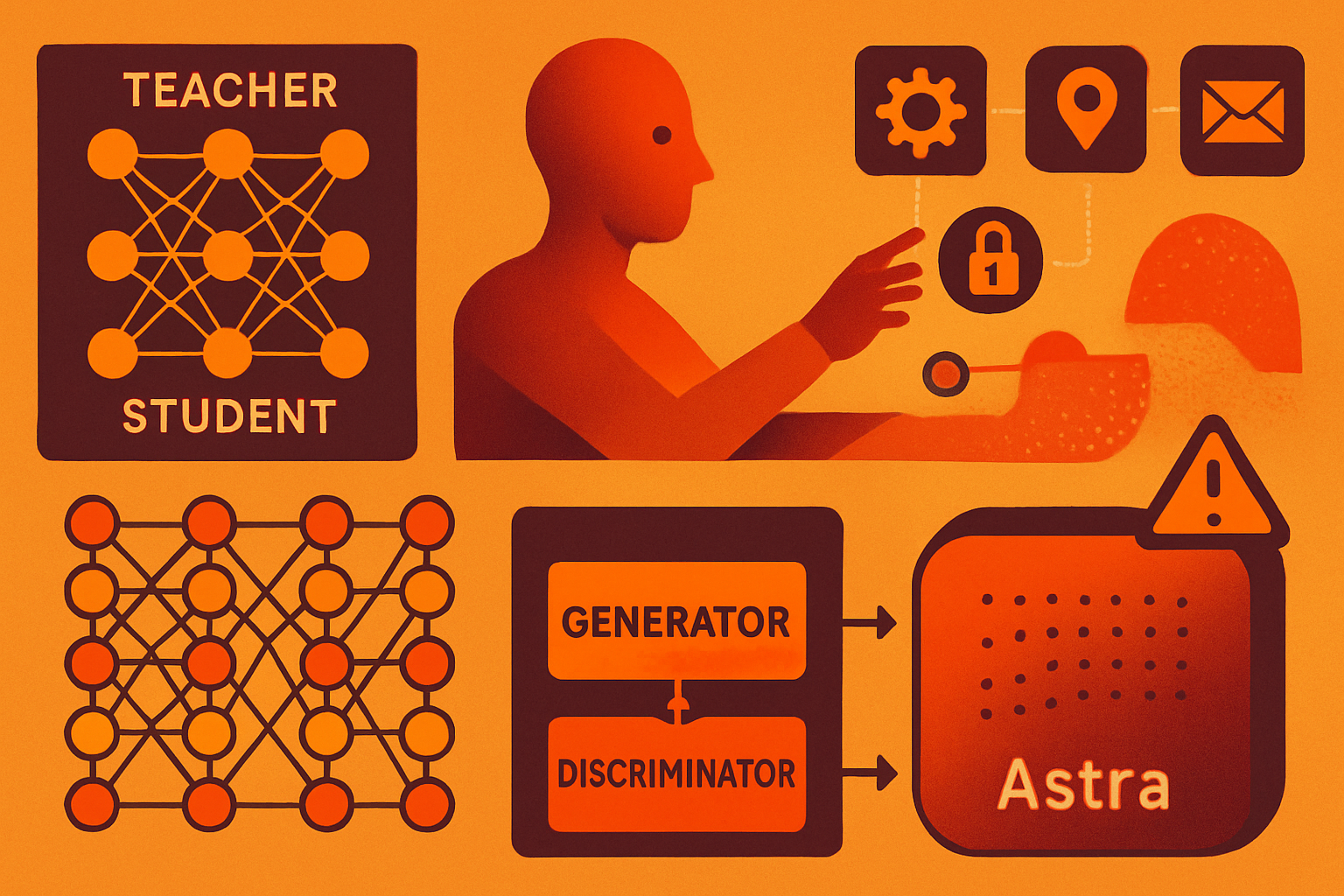
The language of AI has expanded to include sometimes ambiguous concepts, from autonomous agents to GANs, as well as distillation and diffusion. Here’s an overview of key terms, from hallucination risks to debates on AGI, and from hardware components to training methods.
Hallucinations and Concerns about Astra's Reasoning
Hallucinations refer to instances where an AI model invents information and produces incorrect results. This flaw undermines the quality of systems and can lead to tangible risks, such as erroneous medical advice. This phenomenon is attributed to gaps in training data, prompting the development of more specialized or vertical models to limit these errors. Additionally, "opaque recurrence" is a reasoning technique used in OpenAI's Astra model, which raises concerns among AI security researchers.
Autonomous Agents: From API Management to Automated Developers
An AI agent is a tool that uses artificial intelligence technologies to perform a series of tasks on behalf of the user, going beyond the capabilities of a simple chatbot. These tasks can include expense management, ticket booking, or code maintenance. The term encompasses varied realities, as the infrastructure in this field is still developing, but it generally refers to an autonomous system capable of leveraging multiple AI systems to carry out multi-step tasks. AI agents can exploit API endpoints, software interfaces invisible to the user, to control third-party services or extract data. As their capabilities progress, they are increasingly able to discover and use these interfaces autonomously, paving the way for sometimes unexpected automation scenarios. In the software development field, coding agents can write, test, and debug code autonomously, identify bugs across a codebase, and suggest fixes with minimal human supervision.
The Cost of AI in Machines and Runtime
Computational power is essential for training and executing AI models. It often refers to hardware such as GPUs, CPUs, TPUs, and other infrastructures. Inference, which is the execution of a model to make predictions, can be performed on various types of hardware, from smartphones to specialized accelerators, but performance varies significantly depending on the platform. Large models are much slower to predict on a laptop than on a cloud server equipped with high-end AI chips.
Distillation Allows for Transferring Responses from One Model to Another
Distillation involves transferring the behaviors of a large teacher model to a student model: the teacher is queried, its responses are recorded, which can then be compared to a dataset, and the student is trained to replicate this behavior. This method allows for the creation of smaller, more efficient models with minimal loss. OpenAI likely used this technique to develop GPT-4 Turbo. All AI companies employ distillation internally, and it is reported that some may use it to catch up with cutting-edge models, which could violate the terms of service of AI APIs and chat assistants. Fine-tuning, on the other hand, involves retraining a model on specialized data to optimize its performance on a specific task or domain, a common practice among startups that adapt large models to their sector. For reasoning, chain-of-thought breaks down problems into intermediate steps, which takes more time but improves the accuracy of responses, particularly in logic and programming. Reasoning models derived from large language models are optimized for this approach through reinforcement learning. Examples illustrate the difference between a simple question, which does not require intermediate reasoning, and a problem that demands detailed calculations.
Le brief IA que les pros lisent chaque soir
Les 7 actus IA du jour, décryptées en 5 min. Gratuit.
Inclus dès l'inscription : notre sélection des meilleurs guides & comparatifs IA.
Choisissez votre rythme
Gratuit · Pas de spam · Désabonnement en 1 clic
Two Pillars of Generation: Diffusion and GANs
Diffusion is a central technique in many AI models generating art, music, or text. It involves gradually adding noise to the data until its structure is destroyed, then learning a reverse diffusion process to reconstruct the information from the noise. GANs, or Generative Adversarial Networks, rely on competition between a generator and a discriminator, which enhances the plausibility of outputs without additional human intervention. This method is particularly effective for targeted applications such as creating realistic images or videos.
Deep Learning Relies on Multilayer Neural Networks
Deep learning constitutes a field of machine learning that relies on the use of multilayer artificial neural networks, designed based on the neural networks of the human brain. These models can autonomously identify key elements in datasets, adjust their behavior based on errors made, and improve performance over iterations. To function, they require a very large volume of examples, often several million, as well as an extended training phase, which incurs significant development costs. Meanwhile, the term computation refers to the hardware foundation—GPU, CPU, TPU, infrastructures—that makes the training and execution of these models possible.
AGI: Competing Definitions Coexist
Artificial General Intelligence (AGI) is generally described as an AI that is more capable than the average human in many tasks, but definitions vary among stakeholders. Sam Altman, CEO of OpenAI, describes it as the equivalent of a median human that one could hire as a colleague. OpenAI's charter mentions highly autonomous systems that surpass humans in most economically valuable work. Google DeepMind considers AGI as an AI at least as capable as humans in most cognitive tasks. In a context where vocabulary—including LLMs, RAG, RLHF—is rapidly evolving and can leave even specialists uncertain, a regularly updated glossary is proposed as a reference.
Brief IA — L'actualité IA en français
L'essentiel de l'actualité de l'intelligence artificielle, décrypté et expliqué chaque jour.