Free AI: 5 Key Courses to Become an Expert by 2026
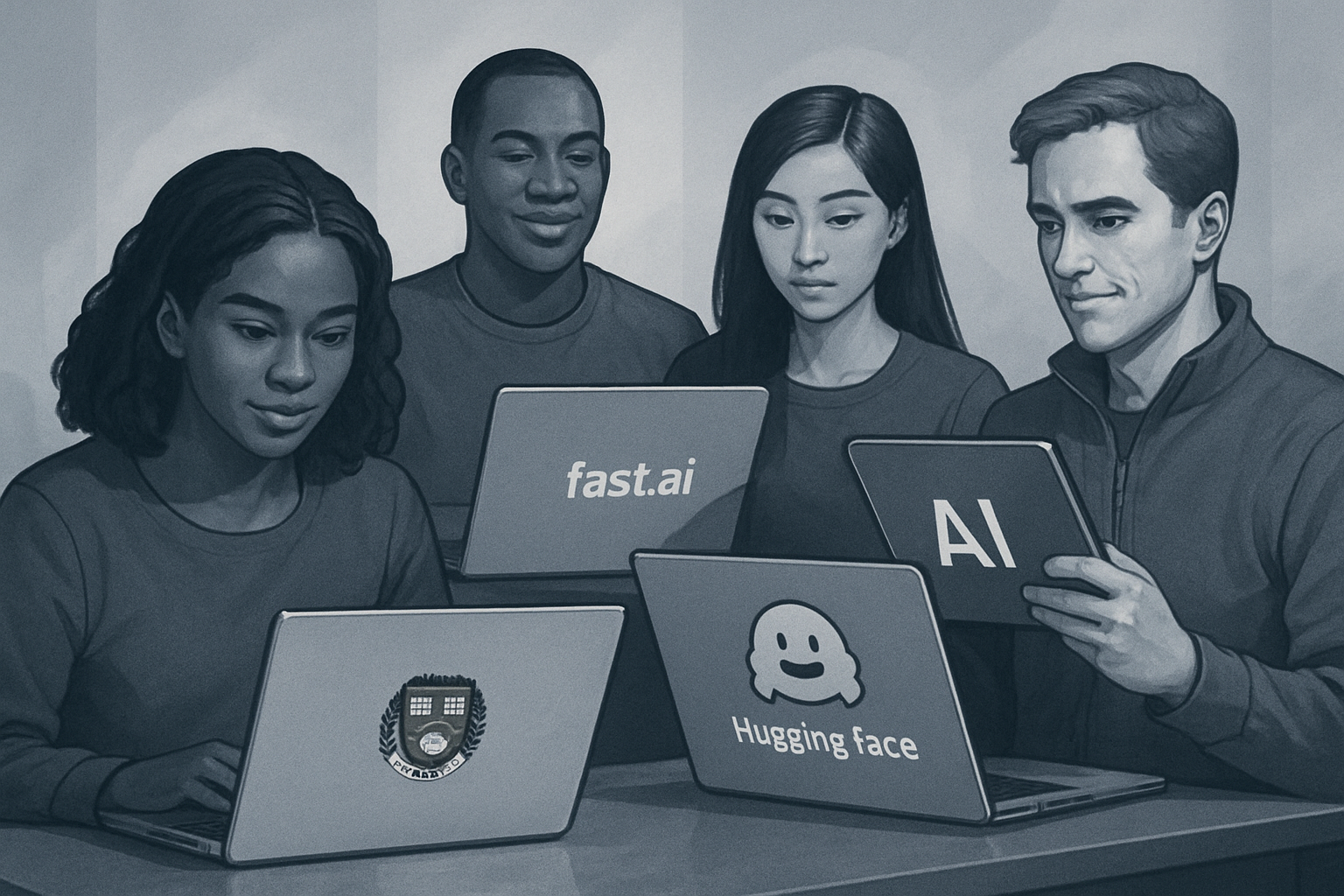
The Democratization of Artificial Intelligence Learning
In today's world, learning about artificial intelligence (AI) has never been more accessible. However, with the proliferation of "AI bootcamps" promising skills in a weekend for high fees, it's easy to feel lost. The reality is that, by 2026, the best educational resources in AI are available for free. Institutions developing cutting-edge technologies have opened their educational content as open source, allowing everyone to access it.
For those who already have a basic understanding of Python and wish to deepen their AI skills, there is no need to spend thousands of euros on a degree. A good curriculum is sufficient for progress.
This article offers a sequential roadmap of five free courses that will take you from the basics of AI to creating modern language models (LLMs). These courses are not only free but also highly practical and respected by industry recruiters.
Understanding the Foundations of AI
The first step toward serious education in AI is not about installing a library or using an API. It’s about building a mental model of how AI systems approach problems. The first two courses on our list establish this foundation, moving from classical AI logic to the fundamental mathematics of machine learning. Ignoring this step is a common mistake among self-taught learners, often revealed during technical interviews.
From Theory to Practice
Once the theory is absorbed, the goal is to build. The next two courses (numbers 3 and 4) are where most learners make a significant leap forward, as they require you to create functional models rather than just study them. By the end of this stage, you should be able to train, evaluate, and deploy a model on a dataset of your choice.
Becoming an AI Engineer
The final step is where practitioners become engineers. Building on frameworks is a skill, but understanding what these frameworks do in depth is a completely different level. The last course on our list removes every abstraction and pushes you to rebuild the architecture from fundamental principles. While it may not be the easiest material, it is the most enlightening.
1. Harvard's CS50: Introduction to AI with Python
Before diving into complex neural networks, it is crucial to understand the fundamental logic of AI. Harvard's CS50 AI course provides a solid bridge between standard software engineering and machine learning, emphasizing how AI systems think and make decisions.
What makes the CS50 AI course essential:
- It focuses on foundational concepts that precede the rise of deep learning, such as graph search algorithms, probability, and adversarial search.
- It requires coding in Python to solve classic AI problems, such as creating an AI to play tic-tac-toe or solve logic puzzles.
- It lays the theoretical groundwork for modern machine learning, ensuring you understand why a model works, not just how to use it via an API.
You can take CS50's Introduction to AI with Python for free on edX or through Harvard's OpenCourseWare platform.
2. Google’s Machine Learning Crash Course
Once the basics of AI logic are acquired, it’s time to learn how machines learn from data. Google’s Machine Learning Crash Course is the fastest and most effective way to understand the mathematics and fundamental mechanisms of modern machine learning. It’s the same course Google uses to train its internal engineering teams.
Key points of Google’s crash course:
- It offers visual and interactive lessons on key machine learning concepts like gradient descent, loss functions, and regularization.
- It introduces you to TensorFlow and Keras, teaching you how to build basic models using industry-standard libraries.
- It emphasizes feature engineering and data preparation, where data scientists spend the majority of their time.
Le brief IA que les pros lisent chaque soir
Les 7 actus IA du jour, décryptées en 5 min. Gratuit.
Inclus dès l'inscription : notre sélection des meilleurs guides & comparatifs IA.
Choisissez votre rythme
Gratuit · Pas de spam · Désabonnement en 1 clic
Access Google’s Machine Learning Crash Course directly on their developer portal. No registration is required to access the interactive modules and Colab notebooks.
3. fast.ai: Practical Deep Learning for Coders
Most courses start with mathematics and leave you building a model weeks later. Jeremy Howard from fast.ai completely flips this approach. This course is renowned for its top-down methodology, getting you to train a state-of-the-art deep learning model from the very first lesson, then explaining how it works throughout the course.
Why fast.ai is the ultimate course for practitioners:
- Designed for coders: if you know Python, you can immediately start building models for computer vision, natural language processing (NLP), and tabular data.
- It teaches practical production-ready skills, including how to extract your own datasets, train models on cloud GPUs, and deploy them on the web.
- It uses the fastai library based on PyTorch, significantly reducing the standard code required to train world-class neural networks.
Dive into Practical Deep Learning for Coders on the fast.ai website, where all lectures and Jupyter notebooks are completely free.
4. Hugging Face’s NLP Course
To work with modern generative AI, it is essential to understand Transformers. Hugging Face is the central hub for open-source AI, and their official NLP course is the definitive guide to using their ecosystem. It takes you from a functional understanding of NLP directly to fine-tuning the models powering today’s AI applications.
What you will gain from the Hugging Face course:
- An in-depth dive into the Transformer architecture, explaining self-attention mechanisms and how models process and represent text.
- Hands-on tutorials on using the transformers and datasets libraries to extract pre-trained models and adapt them to your specific use case.
- Practical experience with fine-tuning techniques, allowing you to take an open-source model and effectively train it on your own private data.
Hugging Face’s NLP course is completely free and interactive, available directly on their platform, with no subscription required.
5. Neural Networks: Zero to Hero by Andrej Karpathy
To truly progress from beginner to high-level practitioner, it is crucial to go beyond frameworks and build the architecture yourself. Andrej Karpathy, former Director of AI at Tesla and founding member of OpenAI, created this series to teach you how to build a neural network and ultimately a Generative Pre-trained Transformer (GPT) model completely from scratch.
Why this series stands out:
- You will write the backpropagation algorithm from scratch, ensuring you fully understand the calculus that makes deep learning possible.
- It culminates in the creation of a scaled-down version of the GPT architecture, writing every line of code live on screen with detailed explanations at each step.
- It bridges the gap between using high-level libraries and the low-level optimizations required for serious AI engineering, making you much more effective as a debugger and researcher.
Spend a few weekends on the Neural Networks: Zero to Hero playlist on YouTube. It is undoubtedly the most valuable free AI content available today.
Conclusion: Accessible and Comprehensive AI Training
There is no need to spend thousands of dollars to become a competent AI engineer. This sequence of five courses is designed to be followed in order, with each step building directly on the previous one. CS50 provides the logical foundation. Google’s crash course gives you the mathematical mechanisms. fast.ai has you building and shipping. Hugging Face puts the open-source ecosystem in your hands. Karpathy shows you what’s happening beneath it all.
The complete sequence takes about three to five months for someone studying part-time, but the depth of understanding it produces is solid. Most paid programs charge a significant amount for a similar outcome, and few are more comprehensive than what is linked here for free.
Start with CS50, progress at your own pace, and don’t rush the foundations. The rest of the roadmap will make much more sense when you do.
Brief IA — L'actualité IA en français
L'essentiel de l'actualité de l'intelligence artificielle, décrypté et expliqué chaque jour.