AI: Andrew Ng's 4 Skills and Business Expectations
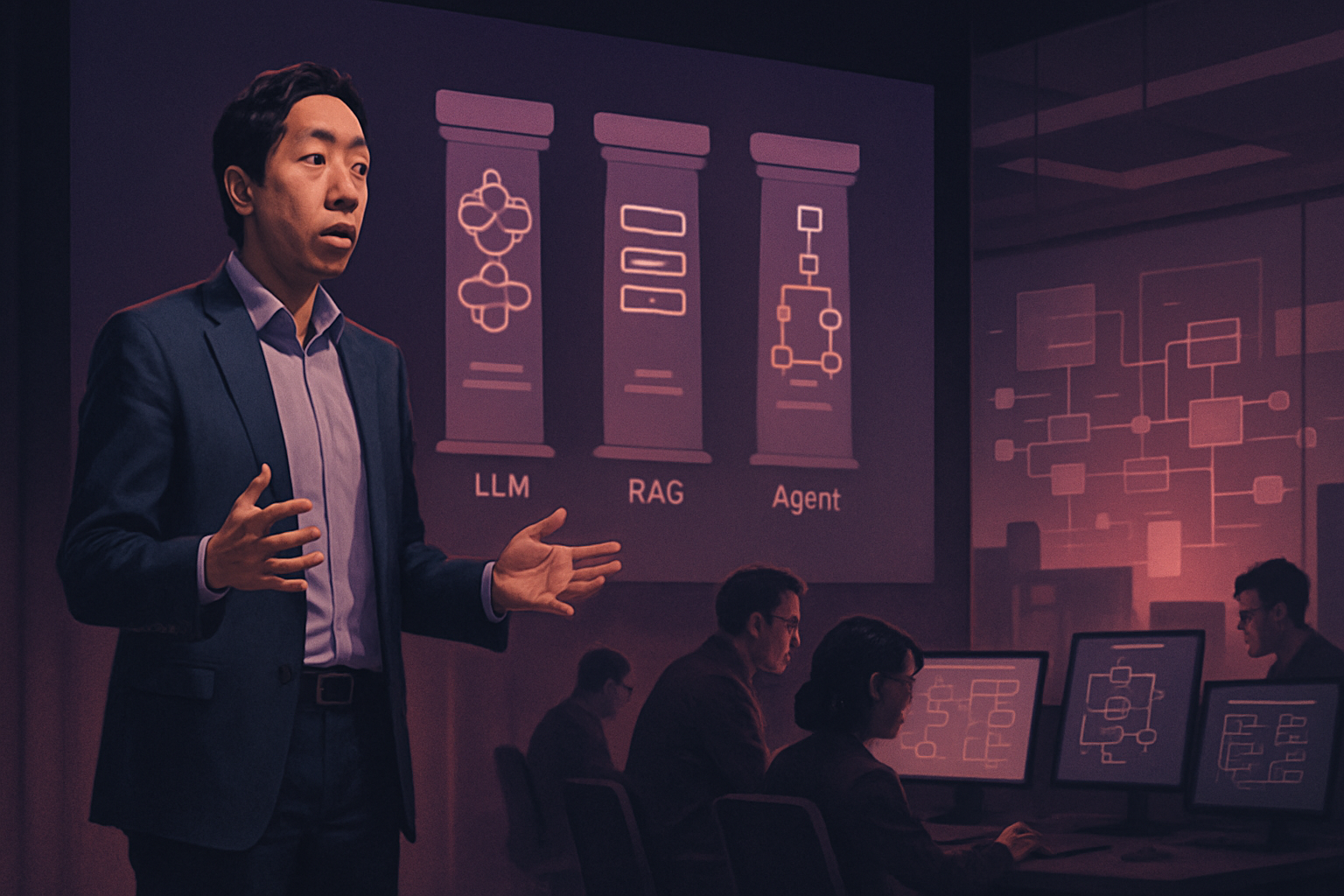
Andrew Ng, founder of Coursera and professor at Stanford, proposes four pillars for AI engineering, based on an analysis of over 10,000 job postings and interviews. Practitioners argue that orchestration, governance, and translating ambiguous business objectives into reliable systems weigh just as heavily as technical skills for achieving production.
Going into production requires governance, security, and infrastructure trade-offs
Thurai believes that innovation alone is not enough: observability, security, resilience, and governance are essential for reaching production. Naman Ahuja at Meta describes constant trade-offs between reliability, computational efficiency, costs, and user impact, which go beyond mere technical code corrections. Chris Matteson warns that without an understanding of the purpose and use of software, the productivity gains from AI can be lost in false starts and revisions. However, he nuances that revising is not always a loss: when generation is inexpensive and the insights valuable, prototyping becomes very effective. He recommends adopting a holistic view to identify irreversible decisions and define when to discard a prototype, emphasizing that too often, teams build in isolation instead of iterating in contact with reality.
Naman Ahuja emphasizes precise problem formulation
For Naman Ahuja, the engineering skills that are gaining value are moving away from traditional coding. AI enables rapid implementation generation; the main challenge becomes formulating the right problem, understanding business constraints, decomposing systems, orchestrating AI and software components, and judging real utility in production. According to him, the most sought-after engineers will be those who can translate ambiguous business objectives into reliable technical systems.
Andrew Ng's framework: four blocks to master
Andrew Ng puts forward four essential skills derived from the analysis of over 10,000 job postings and interviews with experts, recruiters, and hiring managers. First, building and deploying AI applications requires mastery of LLMs, contextual engineering, RAG, agentic flows, machine learning and deep learning, as well as the use of statistical techniques to measure, guide, and govern systems with more predictable behavior. Second, the fundamentals of software engineering—architecture, testing, and security—produce, in his view, better outcomes than development carried out without an understanding of the trade-offs made by code agents.
Le brief IA que les pros lisent chaque soir
Les 7 actus IA du jour, décryptées en 5 min. Gratuit.
Inclus dès l'inscription : notre sélection des meilleurs guides & comparatifs IA.
Choisis ton rythme
Gratuit · Pas de spam · Désabonnement en 1 clic
Third, the use of coding agents requires a solid mental model of how they function, knowledge of their limitations and workarounds, the ability to guide them quickly, and to balance human intervention to build robust software without wasting time or resources. Fourth, "shaping the build" means no longer waiting for a fixed design, but exercising product sense and understanding the business context and customer objectives. Ng believes that software creation has been profoundly transformed by generative and then agentic AI, that learning the right skills is made confusing by the hype, and that all developers—full-stack, data, DevOps, machine learning, and AI engineers—will need AI engineering.
In the enterprise, orchestration becomes a full-fledged profession
Sidana considers orchestration skills crucial for integrating AI into enterprise systems: it involves coordinating models, tools, data, evaluations, observability, human validations, and fallback mechanisms. He adds that the best engineers combine software fundamentals, domain knowledge, product judgment, communication, and accountability for measurable outcomes. Thurai completes the list with deterministic engineering and governance, multi-agent orchestration, agent arbitration, AI FinOps, execution economy, agentic observability and security, as well as the integration of socio-technical systems.
A counterpoint highlights the blind spot of the business problem
Critics directed at Andrew Ng call for greater consideration of the broader framework for problem-solving. A response to his post argues that his recommendations are too internally focused and not enough on business challenges.
Brief IA — L'actualité IA en français
L'essentiel de l'actualité de l'intelligence artificielle, décrypté et expliqué chaque jour.