AI for SMEs and Leaders: The 2026 Reference Guide

Field reports published between 2024 and 2026 show that SMEs integrating AI are already reducing certain costs by 10 to 30%, with tools often accessible for between €20 and €100 per month. The topic is no longer reserved for large corporations. It concerns customer invoicing, cash flow, support, quotes, reports, and commercial production. This guide provides a managerial method: the effective uses, tool families, rules to follow, pitfalls to avoid, and a simple plan to get started.
What AI Really Changes for SMEs and Their Leaders
AI does not transform an SME through a large IT program, but through a series of tasks executed more efficiently. In our analysis on reducing SME costs with AI, the most tangible gains focus on simple customer service requests, writing, invoicing, bank reconciliation, and follow-ups. The right reflex is to start from a business irritant and then measure the time spent before and after using the tool.
For a leader, the main change is organizational. Teams must learn to request, verify, correct, and document what AI produces. The Impulsion IA 2027 plan allocates over €80 million and specifically aims to support micro and small enterprises; our analysis on Impulsion IA 2027 shows that the challenge is as much about skills as it is about software. An SME that trains a few key personnel gains more than one that multiplies subscriptions.
The risk rarely comes from the model alone. It arises from a project without an owner, without indicators, or without reliable data. Our analysis on AI project failures reminds us that several studies published in 2025-2026 report over 80% failure rates on AI initiatives. To avoid this scenario, each experiment must have a business sponsor, a short scope, human validation, and a clear decision after the pilot.
 SME leader and team reviewing invoices and files around a table.
AI starts with measured tasks, validated by teams.
Effective Uses Today
The following uses do not all require the same level of maturity. Start with frequent, low-sensitivity, and easy-to-measure tasks, then progress to assistants connected to internal data.
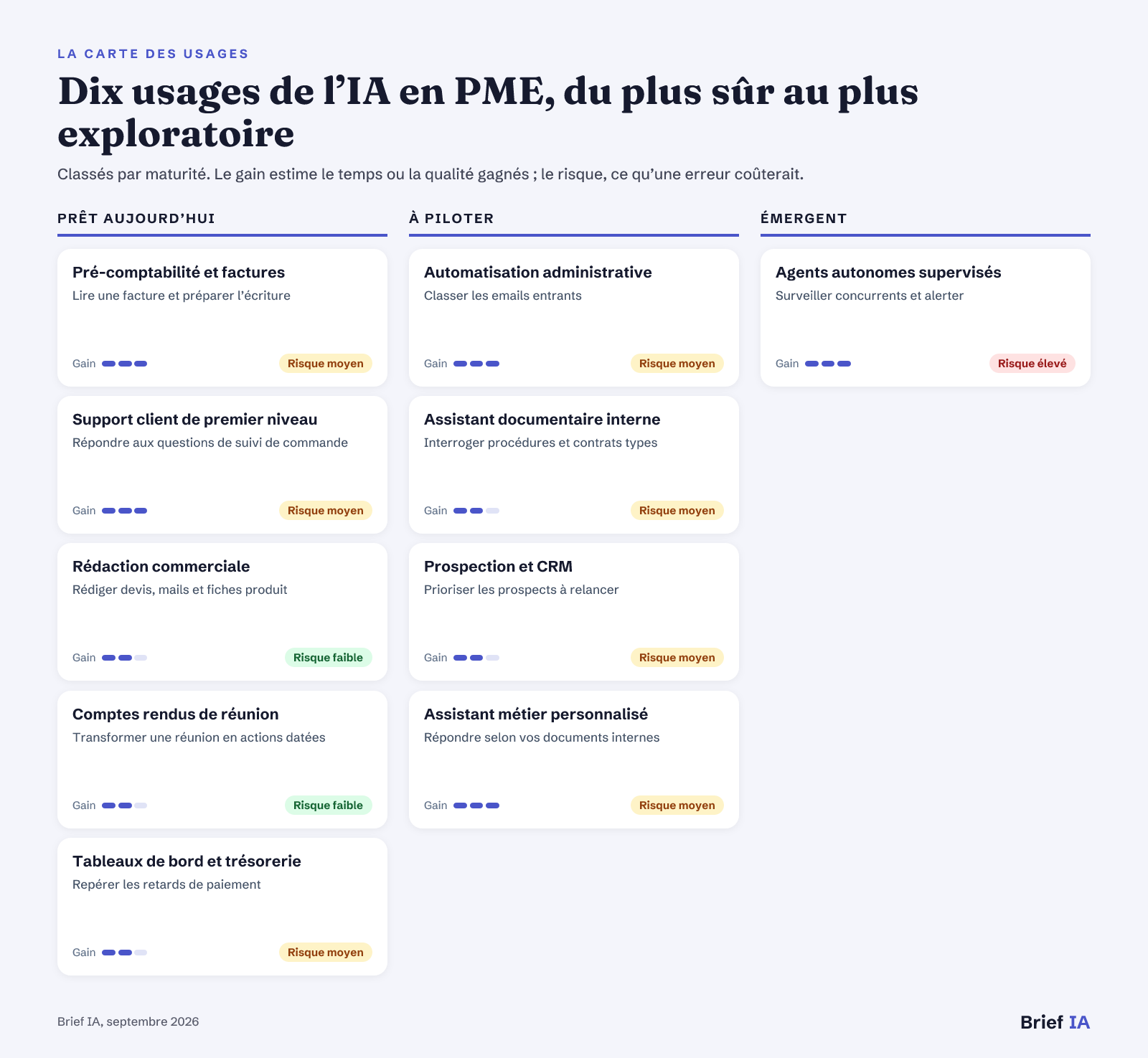 Map of AI uses for SME leaders
Uses classified by maturity, with expected gains and risks in case of errors.
Ready-to-Use Applications
Pre-accounting and invoices. AI-powered accounting software reads invoices, suggests categories, reconciles payments, and detects anomalies. Our analysis on SME accounting places solutions like Pennylane, QuickBooks, or Deeplook in a typical range of €15 to €30 per month per user. Final validation must remain human, especially before accounting or tax submission.
First-level customer support. An assistant can handle frequent requests: hours, order tracking, appointment scheduling, return conditions, or documents to provide. The right scope excludes disputes, complex refunds, and cases where the customer expects a business decision. The tool must indicate that it is AI, easily transfer to a person, and retain unanswered questions to enrich the documentation base.
Commercial writing. AI accelerates the initial drafts of emails, commercial proposals, product sheets, call scripts, and publications. It does not replace customer knowledge or the company’s promise. The leader must impose validated templates, examples of tone, and systematic proofreading before sending. Gains are rapid when teams start from existing documents rather than vague requests.
Meeting minutes. Transcription and summarization save time for sales, project, and management teams. The useful result is not a long summary but a list of actions, responsible parties, deadlines, and points to arbitrate. Sensitive conversations require a suitable tool choice, informing participants, and an internal rule on what can be recorded, retained, or shared.
Dashboards and cash flow. AI can help consolidate financial flows, identify delays, suggest follow-ups, and prepare management comments. The latest news on Vivid and B2B finance highlights that small businesses suffer from fragmented financial management, with accounts, expense reports, travel, and invoicing scattered. The use is relevant if the source data is up to date and cash flow decisions remain validated.
Uses to Pilot
Administrative automation. Sorting emails, preparing files, follow-ups, and document checks are good initial projects. Our analysis on administrative automation recommends a two to three-week audit, followed by two to four use cases for a first wave. The rule is simple: automate a repetitive step, never a sensitive decision without validation.
Internal document assistant. An assistant connected to procedures, pricing, notices, general conditions, or operating modes reduces internal search time. First, clean the documents, identify the reference version, and remove obsolete files. The tool must cite its sources, display the limits of its response, and allow a responsible person to correct the database. Without this document hygiene, the assistant repeats existing errors.
Prospecting and CRM. AI can classify prospects, suggest follow-ups, prepare proposals, and summarize customer history. The interest arises when the CRM is properly maintained and when salespeople validate messages before sending. Two pitfalls must be monitored: sending overly generic messages and over-solicitation. A test should measure the response rate, conversion time, and perceived quality by customers.
Customized business assistant. A personalized assistant can use your documents, rules, and examples to assist support, administration, or sales. Our guide on custom AI models reminds us that, in many cases for SMEs and mid-sized companies, a document and parameter-based approach is sufficient without leading to a heavy model. The test should focus on a reduced scope and real questions.
Emerging Uses
Supervised autonomous agents. Agents plan multiple actions, consult tools, and execute tasks in sequence. Our analysis on AI agent trends in business describes their integration into business processes, but an SME must proceed with caution. Prohibit payments, deletions, contractual commitments, and mass sends without human validation. Log each action and provide for an emergency stop.
Tools to Know
There is no universal ranking: the right choice depends on the software already in use, the data handled, the expected level of control, and the recurring budget.
- Office and collaborative assistants. They draft, summarize, prepare presentations, and help utilize daily documents. Our analysis on AI productivity tools for teams notably mentions Microsoft 365 Copilot for organizations already equipped with Microsoft 365 and Notion AI for collaborative workspaces. Requirements: access management, history, non-use of unplanned sensitive data, user training.
- Augmented accounting and invoicing solutions. They automate the ingestion of documents, categorization, bank reconciliation, follow-ups, and preparation of pre-accounting entries. Examples available for SMEs include Pennylane, QuickBooks, Indy, Freebe, Tiime, Odoo, Sage, Dolibarr, and Axonaut. Requirements: human validation, accounting export, correction log, compatibility with electronic invoicing.
- No-code automation platforms. They connect CRM, spreadsheets, messaging, forms, and business tools to trigger repetitive actions. Mentioned examples include Make, Zapier, n8n, and Gumloop, particularly beneficial for teams without a dedicated developer. Requirements: role-based permissions, testing before production, execution limits, alerts in case of failure.
- Document-connected business assistants. They respond based on procedures, standard contracts, catalogs, knowledge bases, or customer files. Deployment should start with a limited, validated, and regularly updated base. Requirements: cited sources, clear document scope, removal of obsolete versions, business review.
- AI agents for supervised processes. They execute multiple steps: monitoring, comparing, classifying, following up, or preparing a file. Their interest increases with data quality and process stability, but their autonomy must remain limited. Requirements: logging, mandatory validations, stop thresholds, prohibition of irreversible actions.
Le brief IA que les pros lisent chaque soir
Les 7 actus IA du jour, décryptées en 5 min. Gratuit.
Inclus dès l'inscription : notre sélection des meilleurs guides & comparatifs IA.
Choisissez votre rythme
Gratuit · Pas de spam · Désabonnement en 1 clic
The Framework: AI Act, GDPR, CSE, Data, and Invoicing
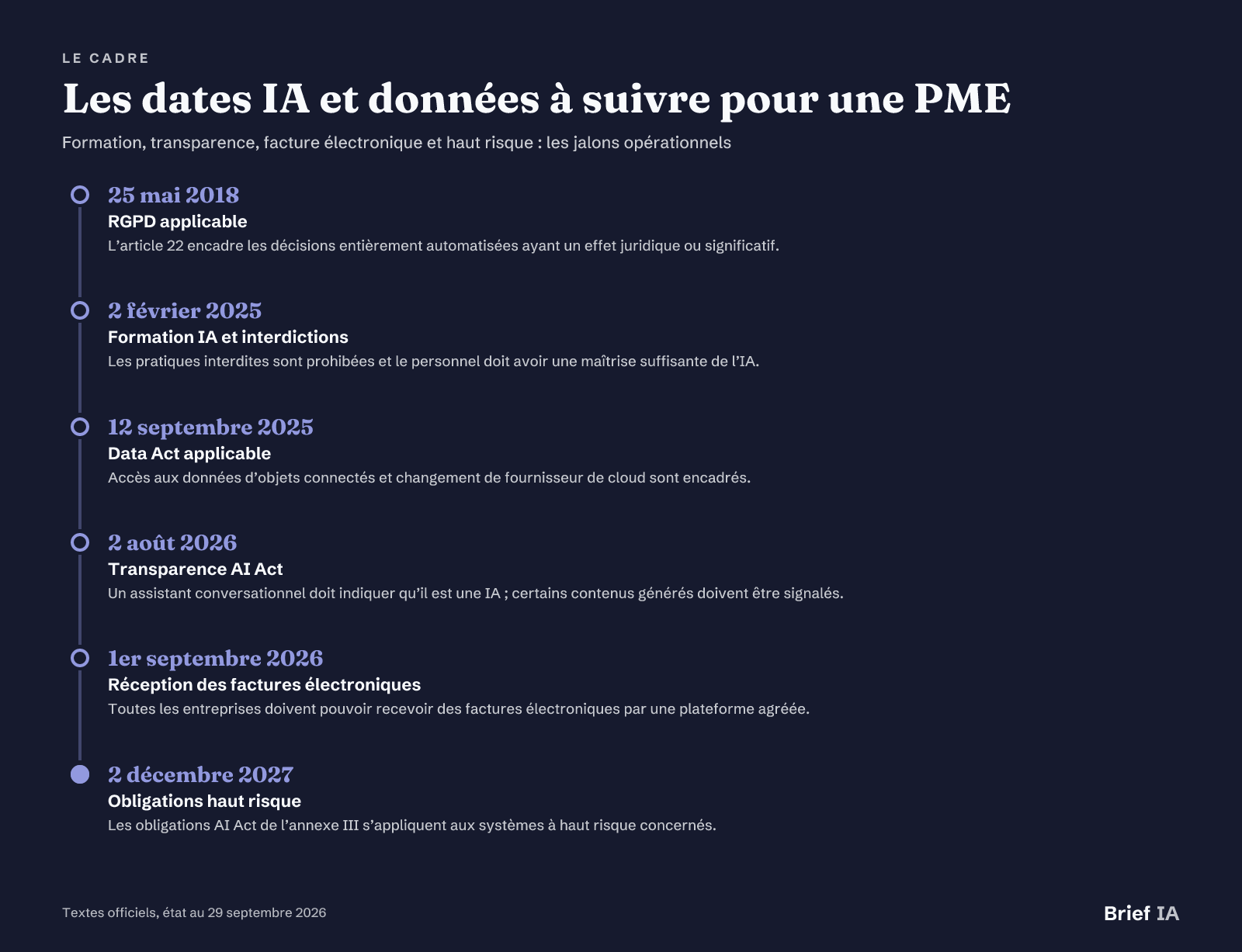 Key AI and data dates to follow for an SME
Key dates, status as of September 29, 2026.
AI Act: The Basics Already Applicable
The European regulation on AI came into effect on August 1, 2024, and applies in phases. Since February 2, 2025, prohibited practices are banned, and any organization using AI systems must ensure a sufficient level of AI mastery among its staff. Since August 2, 2026, transparency obligations apply: a conversational assistant must indicate that it is AI, and certain generated content must be labeled as such.
High Risk: Attention to Scope
High-risk systems listed in Annex III cover employment, education, certain access to essential services, critical infrastructure, police, migration, justice, and democratic processes. Following the Digital Omnibus, the obligations for these systems will apply from December 2, 2027. Writing, summarization, accounting, cash flow forecasting, or fraud detection tools without high-risk use are not classified as high-risk systems; they remain subject to general training and transparency obligations.
Personal Data and Social Dialogue
The GDPR has been applicable since May 25, 2018. Its Article 22 regulates decisions based solely on automated processing that produce legal or significant effects on a person. An SME must therefore avoid fully automated decisions about individuals, especially regarding employment or access to a service. The Labor Code also requires informing and consulting the CSE when introducing new technologies in the company.
Data, Cloud, and Electronic Invoicing
The Data Act has been applicable since September 12, 2025. It organizes access to data produced by connected objects and facilitates changing cloud providers. Regarding invoicing, since September 1, 2026, all companies must be able to receive electronic invoices, and large companies and mid-sized enterprises must issue them through an approved platform. SMEs and micro-enterprises will need to issue them starting September 1, 2027.
Pitfalls to Avoid
Automating without measuring. A tool may seem effective without actually reducing a cost. Before the pilot, measure the average time, monthly volume, error rate, and process cost. After the test, compare the same indicators.
Entrusting a sensitive decision. An AI output may prepare a response, classification, or recommendation. It should not independently decide on hiring, firing, significant refusals, disputed payments, or contractual commitments.
Feeding the tool with everything. Importing contracts, customer data, employee information, and trade secrets without sorting creates an immediate risk. Define allowed data, prohibited data, and the people authorized to connect an internal source.
Multiplying subscriptions. An SME can quickly accumulate assistants, automations, and integrated modules without coherence. Designate a responsible person, centralize purchases, and eliminate tools that do not produce regular use or measurable gains.
Forgetting the teams. AI changes tasks, control, and sometimes the customer relationship. Inform employees, train users, and consult the CSE when introducing new technology to avoid superficial adoption.
Taking Action: The 90-Day Plan
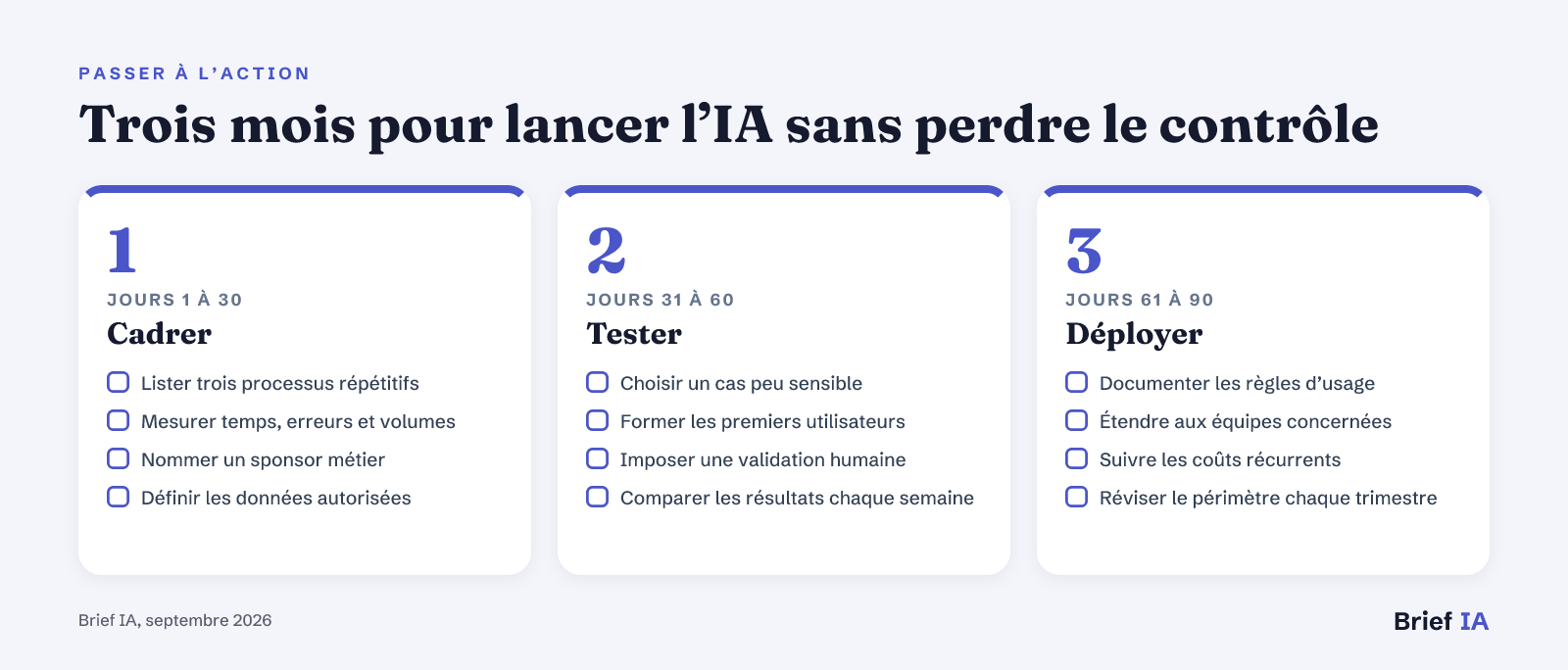 Three months to launch AI without losing control
Three steps: frame, test, deploy.
Start with a short diagnosis: three processes, three irritants, three starting figures. The first month is for choosing a low-sensitivity and frequent case, such as invoices, meeting minutes, or simple responses. The second month is for the pilot with human validation and weekly measurement. The third month is for deciding: stop, correct, or deploy. One well-adopted use is better than five demonstrations without an owner.
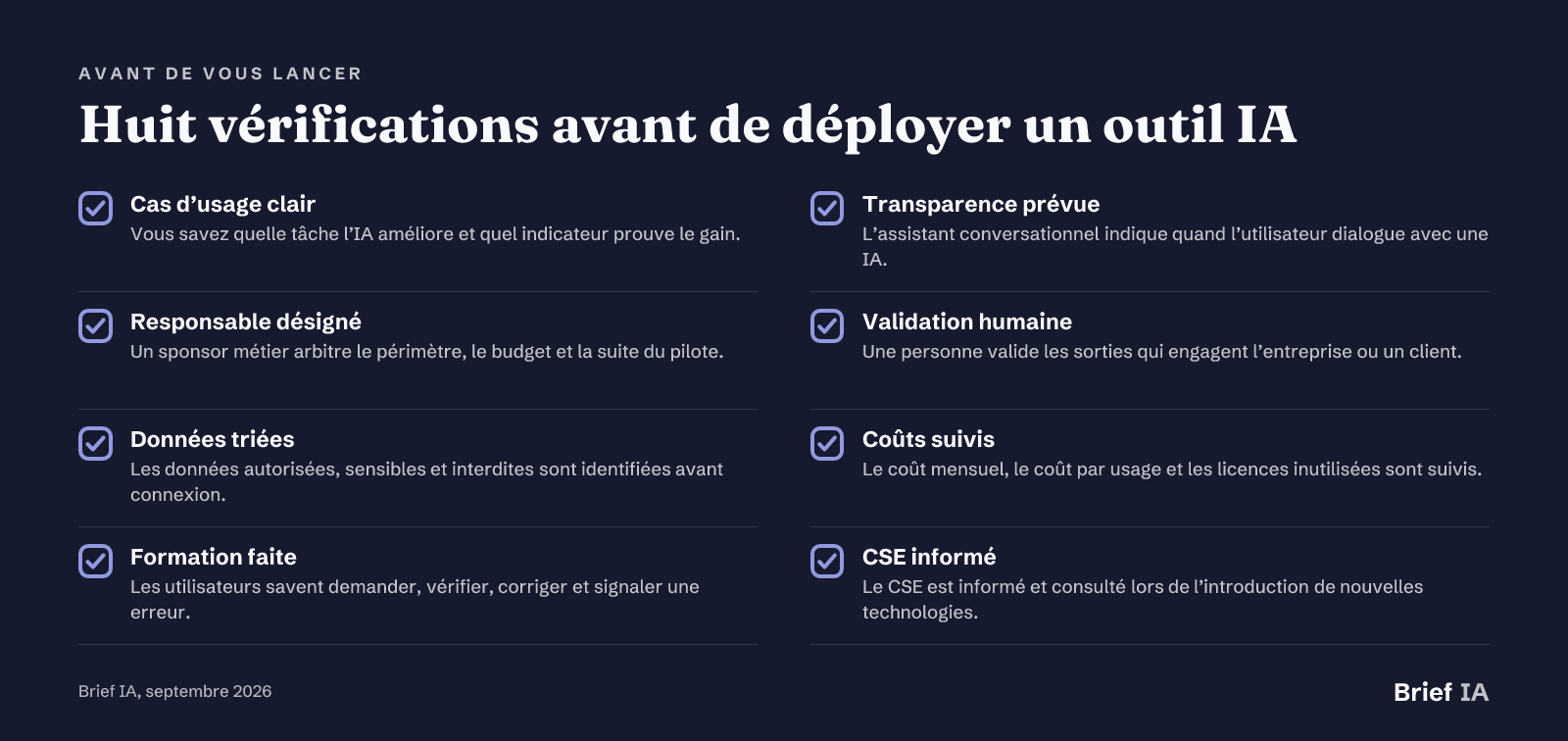 Eight checks before deploying an AI tool
Eight checks to perform before each new use.
Further Reading
Our analyses for SME leaders
- Reducing SME costs with AI. A method for choosing targeted tools, tracking costs, and aiming for gains in support, content, accounting, and automation.
- Choosing AI tools for team productivity. How to reason by work environment, daily uses, budget, and data control.
- Creating an AI assistant tailored to your business. How to connect a model to your documents and avoid a project that is too heavy for an initial cycle.
- Avoiding AI project abandonment. Governance, indicator, and leadership errors that lead to AI initiative failures.
- Impulsion IA 2027 and support for micro and small enterprises. What the public plan provides for training, raising awareness, and supporting businesses in adopting AI.
- Understanding AI agents in business. Possible uses of agents, their operational limits, and precautions before entrusting them with actions.
Key News to Remember
- The explainability of AI as a factor for adoption in business
- Less expensive AI models tested to reduce expenses
- Companies transitioning from AI demonstrations to robust systems
- Agentic AI: clarifying what an agent is for leaders
- Vivid aims to simplify finance for micro and small enterprises with AI
- The European Union is preparing up to seven AI gigafactories
Do you provide a solution for SMEs and their leaders?
This guide is read by SME leaders, administrative and financial managers, sales managers, and operations managers. Brief IA offers AI solution providers, management software, accounting tools, CRM, and automation platforms for SMEs dedicated articles, evening brief inserts, and promotion in the directory. Formats and rates at briefia.fr/partenaires.
The Essentials in Questions
How can an SME start with AI?
Start with a repetitive, frequent, and low-sensitivity task: meeting minutes, email sorting, simple responses, or pre-accounting. Measure the current time, choose a tool compatible with existing software, train a few users, and impose human validation. After a few weeks, decide based on figures, not on the impression of novelty.
What AI uses are the most profitable for an SME?
The most straightforward uses concern invoices, data entry, follow-ups, first-level customer support, commercial writing, and searching internal documents. They combine volume, repetition, and known rules. More autonomous uses, like agents executing multiple actions, require more control and logging.
Does the AI Act apply to SMEs?
Yes, as soon as an SME uses AI systems. Since February 2, 2025, it must ensure a sufficient level of AI mastery among its staff and comply with prohibited practices. Since August 2, 2026, transparency obligations apply. The obligations for high-risk systems in Annex III will apply from December 2, 2027.
Can customer data be put into an AI tool?
Not without internal rules. Necessary data must be identified, unnecessary sensitive information avoided, supplier conditions checked, access limited, and a record of uses maintained. The GDPR continues to apply to personal data. For significant decisions regarding a person, avoid any exclusively automated decision without an appropriate framework.
Should a custom AI model be created?
Not initially in most SMEs. A well-configured generalist assistant connected to validated documents is often sufficient for testing value. A more personalized model becomes relevant if responses must follow specific internal procedures, if the volume is high, or if integration with business tools becomes central.
Brief IA — L'actualité IA en français
L'essentiel de l'actualité de l'intelligence artificielle, décrypté et expliqué chaque jour.