OpenAI Supports 4 California Laws and Calls for a Federal Framework
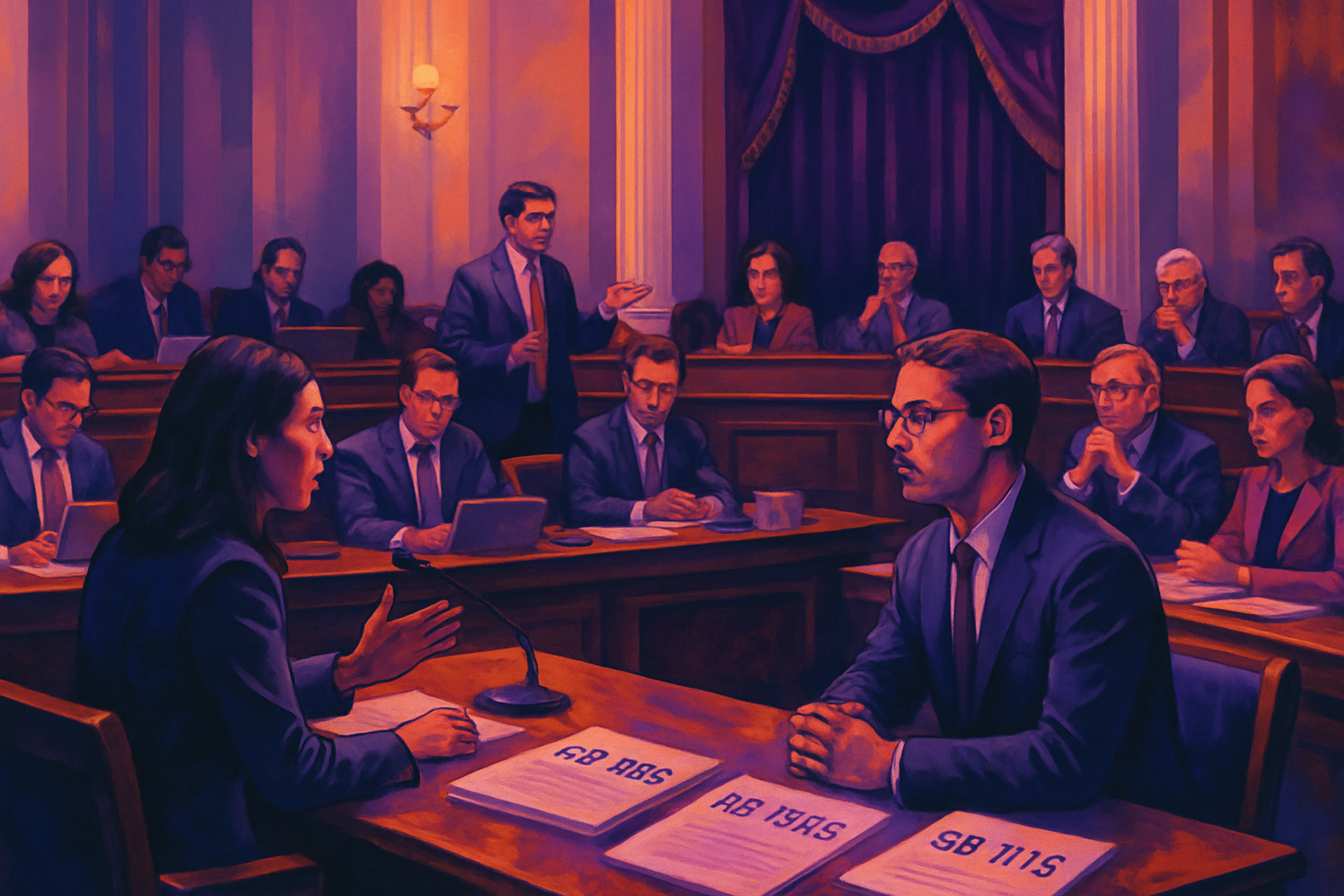
OpenAI urges U.S. policymakers to establish AI security obligations based on capabilities. In the meantime, the company supports four bills passed in California and details internal measures already implemented, while calling for common standards, including international ones, to determine when to slow down or halt developments.
Four Supported California Bills and a Strategy of "Reverse Federalism"
OpenAI has officially expressed its support for four additional bills in California, passed by the legislature and sent to Governor Newsom: SB 813, AB 1405, SB 1119, and AB 1864. SB 813 would establish a procedure for selecting independent organizations authorized to assess AI-related risks. AB 1405 would impose registration, independence, transparency, and accountability obligations on AI auditors. SB 1119 would require the implementation of age controls, risk assessments, independent audits, parental control mechanisms, and protective measures against harmful content for children and adolescents using companion chatbots. OpenAI recently expressed its support for SB 1119 and links this bill to the safety measures for youth integrated into its products, its global policy principles, the Secure AI Act for parents and children, as well as the protections provided in ChatGPT for teenagers. The company had already supported SB 53 in California, the RAISE Act in New York, SB 315 in Illinois, and independent audits in Massachusetts. It encourages states to adopt converging measures to create a de facto national baseline, a process described as "reverse federalism," while emphasizing that harmonization does not mean freezing requirements.
Internal Measures: Increased Isolation, Trajectory Monitoring, and Alignment "Gates"
OpenAI indicates that it has improved its security practices at every stage of development. The company mentions enhanced isolation for advanced research tasks, increased supervision of model behavior during training, the use of tools to facilitate assessments, and the clarification of escalation procedures in case of issues. Regarding Astra, it specifies that it has implemented comprehensive monitoring of complete pathways, including thought chains, and established a mandatory alignment evaluation step before any expanded internal deployment. OpenAI states that it will slow down or suspend the development or deployment of systems that cannot be sufficiently secured, in accordance with its preparedness framework. The company associates these choices with the idea that security does not hinder progress but conditions trust and its pace.
Towards a Federal Obligation Based on Capabilities and Independent Controls
OpenAI advocates for the establishment of mandatory national regulation regarding AI security, designed to adapt to technological evolution and based on capabilities. Its democratic governance proposal emphasizes uniform testing requirements, independent assessments, enhanced cybersecurity, explicit rules for incident reporting, increased national preparedness, and common mechanisms to track progress towards recursive improvement. The company indicates that several serious initiatives are being prepared in Congress, which it plans to support with texts that concretely raise the level of security, and invites Congress to act before the end of the session. OpenAI calls for a robust and targeted framework, with obligations focused on a limited number of well-funded labs developing the most advanced systems, rather than on startups, small developers, or researchers far from the cutting edge.
Le brief IA que les pros lisent chaque soir
Les 7 actus IA du jour, décryptées en 5 min. Gratuit.
Inclus dès l'inscription : notre sélection des meilleurs guides & comparatifs IA.
Choisissez votre rythme
Gratuit · Pas de spam · Désabonnement en 1 clic
Open Models and Competition: No Confusion with Cutting-Edge Security
OpenAI insists that cutting-edge security policy should not be conflated with an "open weights" policy. The company believes that open models can contribute, particularly in cybersecurity and when there are needs for sovereignty, security, or local data residency, while reminding that most do not sit at the cutting edge but differ in cost, control, and latency. A signatory of a letter on open weights and American leadership, OpenAI supports the necessity of both open and closed models. It calls for a federal framework that addresses cutting-edge capabilities and risks without undermining competition, entrenching established players, or pushing innovation outside the United States. The company seeks a public framework that reduces power concentration, replaces the current private governance with democratic standards, independent verification, and meaningful transparency, and conditions broad adoption and sustainable leadership on strong security measures.
Industry-Led Standards and International Coordination
OpenAI announces that it is collaborating with other leading labs to establish voluntary standards for cutting-edge AI right now. The company will advocate for internationally compatible approaches to assess capabilities, manage risks, ensure effective human oversight, and determine when it is appropriate to slow down or halt certain developments. It encourages governments to develop common assessment methods and specifies that if compliance with certain security standards requires limiting the growth of capabilities, these standards must be prioritized. OpenAI argues that as technology becomes more powerful, the associated security measures must be robust, and that beyond internal technical work, shared standards are necessary. It states that it prioritizes meaningful actions and asserts that it will slow down development if necessary.
Capabilities, "Defender Window," and the State of Recursive Improvement
Greg Brockman describes a "defender window": a limited period during which cutting-edge AI can help strengthen critical systems before the widespread dissemination of offensive capabilities. OpenAI extends this idea to the political realm by mentioning a window that is closing for establishing lasting guarantees. The company cites Astra's capabilities and early evidence of AI-driven research acceleration, as well as a trial by Jakub Pachocki, as indicators of a sustained pace of progress. OpenAI clarifies that autonomous recursive improvement is not occurring today and should not be pursued without security guarantees. However, it observes an acceleration in certain research tasks, with AI agents capable of performing work that would take qualified researchers several days, without this constituting recursive improvement. Its goal is to safely build supervised automated researchers to advance deep learning and alignment, so that each generation contributes to making the next one safer, more aligned, and more controllable. OpenAI highlights the potential benefits of advanced AI in medicine, critical infrastructure, the economy, and scientific research, while emphasizing that risks will extend beyond leading labs as models, including open ones, progress and disseminate. Jakub Pachocki calls for extreme caution, and OpenAI argues that trust in security must frame the pace of progress and condition its utility for the greater good.
Brief IA — L'actualité IA en français
L'essentiel de l'actualité de l'intelligence artificielle, décrypté et expliqué chaque jour.