Pentagon: $30.3M for Controversial AI Polygraph
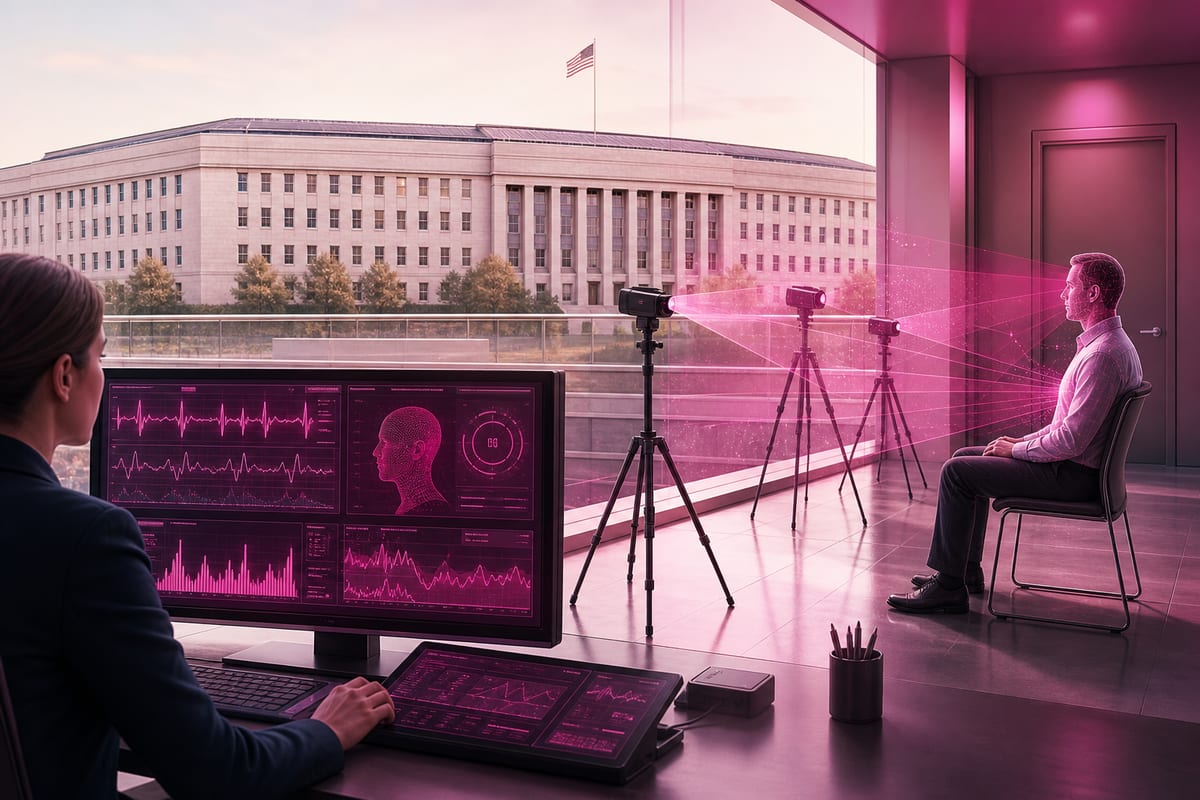
The Department of Defense wants to fund a next-generation lie detector that relies on AI and contactless sensors. This ambition faces decades of controversy over the reliability of polygraphs and criticism regarding their use as a deterrent tool rather than a truth-telling device.
Critics Highlight a Psychological Tool and Biases
Several experts doubt the relevance of evolving the polygraph with AI. Marion Oswald fears that new devices will primarily serve as psychological instruments rather than scientific tools, potentially being perceived as a threat to elicit confessions. The interpretations of the tests are described as subjective, with results varying depending on the examiners and an increased risk of misjudging individuals from minority groups. For Sophie van der Zee, an informed subject can outsmart the test, and the primary effect of the devices remains deterrence, which only works if people believe in the machine's effectiveness. Kyri Kotsoglou believes that combining AI and polygraph adds uncertainty to an already invalid tool, in the absence of a baseline truth that reliably associates physiological patterns with lying.
A Context of Fighting Leaks and Increased Usage
Under the leadership of Defense Secretary Pete Hegseth, the Department of Defense has intensified the use of tests to identify potential sources of leaks. According to the New York Times, nearly 50 members of the Joint Chiefs of Staff underwent polygraph tests in September, following reports mentioning the depletion of U.S. weapon stocks in the conflict against Iran.
The Polygraph+ Project Aims at Recruitment and Internal Threats
The Pentagon plans to allocate $30.3 million over five years for a program called Polygraph+ or Polygraph Next. The roadmap mentions AI-based scoring algorithms and machine learning, as well as standoff sensing, to modernize polygraphs and credibility assessment. The device would be managed by the Defense Counterintelligence and Security Agency, responsible for background checks, for recruitment needs and detection of internal threats. The budget still requires Congressional approval, and the selected technologies have not been specified at this stage. The DCSA did not respond to requests for information. These details are part of a budget request from the Department of Defense, which was first reported by Inside Defense.
Le brief IA que les pros lisent chaque soir
Les 7 actus IA du jour, décryptées en 5 min. Gratuit.
Inclus dès l'inscription : notre sélection des meilleurs guides & comparatifs IA.
Choisissez votre rythme
Gratuit · Pas de spam · Désabonnement en 1 clic
Contactless and Multimodal Approaches Tested by the DIU
In 2023, the Defense Innovation Unit sought proposals for deception detection technologies and selected Presage Technologies and Altec Research for prototypes. Presage claims to estimate heart rate and respiration using standard cameras. Altec, stemming from medical sensors, is focusing on contactless approaches, with a prototype that tracks head movements, facial temperature, and pore activity, according to an illustration shared by the DIU. Both companies did not respond to inquiries, and the DIU declined to comment. Methodologically, multimodal detection, which seeks to aggregate multiple measurements into an overall score, is presented as a likely avenue, with three targets distinguished by Sophie van der Zee: physiological stress, cognitive load, and conscious efforts to conceal. Current technology only covers one aspect, and combining methods addressing these three angles could, according to her, improve performance. AI is also mentioned as potentially capable, in theory, of identifying patterns inaccessible to human examiners.
A Disputed Scientific Legacy and Abandoned Precedents
The practice of polygraphy, based since the 1920s on blood pressure, pulse, respiration, and sweating, compares reactions to baseline questions and target questions. Despite tens of thousands of annual tests in federal recruitment, the tool is contested: in 1983, the Congressional Office of Technology Assessment pointed out the lack of evidence for screening; in 2003, the National Research Council deemed the evidence of effectiveness "weak at best." Without assistance, humans barely exceed a 50% success rate, while the American Polygraph Association claims 80 to 94% accuracy, a level that the NRC nonetheless considered a source of numerous errors, problematic given the 2.8 million DoD employees and likely to lead to many unfounded accusations. Multiple alternative attempts—thermal cameras, pupil tracking, brain MRIs—have not confirmed their reliability outside of laboratory settings. Van der Zee emphasizes the absence of a universal indicator of lying. Projects like Silent Talker, integrated into iBorderCtrl, or AVATAR at U.S. borders, have ultimately faded away. Additionally, learned countermeasures, such as provoking reactions to baseline questions or even walking on a pin in one’s shoe, are documented.
Brief IA — L'actualité IA en français
L'essentiel de l'actualité de l'intelligence artificielle, décrypté et expliqué chaque jour.