Samsung: Two Health AI Models for Smartwatches
Le brief IA que les pros lisent chaque soir
Les 7 actus IA du jour, décryptées en 5 min. Gratuit.
Inclus dès l'inscription : notre sélection des meilleurs guides & comparatifs IA.
Choisis ton rythme
Gratuit · Pas de spam · Désabonnement en 1 clic
Samsung Research America unveils two health-focused AI models centered on signals captured by smartwatches. The company reports gains over existing approaches in 15 out of 19 tested tasks and achieves inference in less than a millisecond on a smartwatch CPU. The work, accepted at ICML and ICLR, aims for continuous on-device analysis and aligns with the Connected Care vision presented in July 2026.
Samsung reports gains on 15 tasks and near-instant local inference
Samsung reports that xMAE has outperformed unimodal models and existing multimodal methods in 15 out of 19 evaluation tasks, covering cardiovascular prediction, anomaly detection in tests, and sleep stage classification. The company also claims that HiMAE achieves high performance despite being smaller than existing models and can produce results in less than a millisecond on a smartwatch-type processor. This capability, described as placing analysis on the device rather than in the cloud, is said by Samsung to have the potential for transferring learned features across sensor devices, body locations, and collection contexts. Fundamental models trained on unlabeled physiological streams are presented as a mechanism for extracting diagnostic markers, performing predictive classifications, and generating advice from consumer hardware, without relying on a continuous server connection.
xMAE learns to project ECG from PPG for continuous cardiovascular monitoring
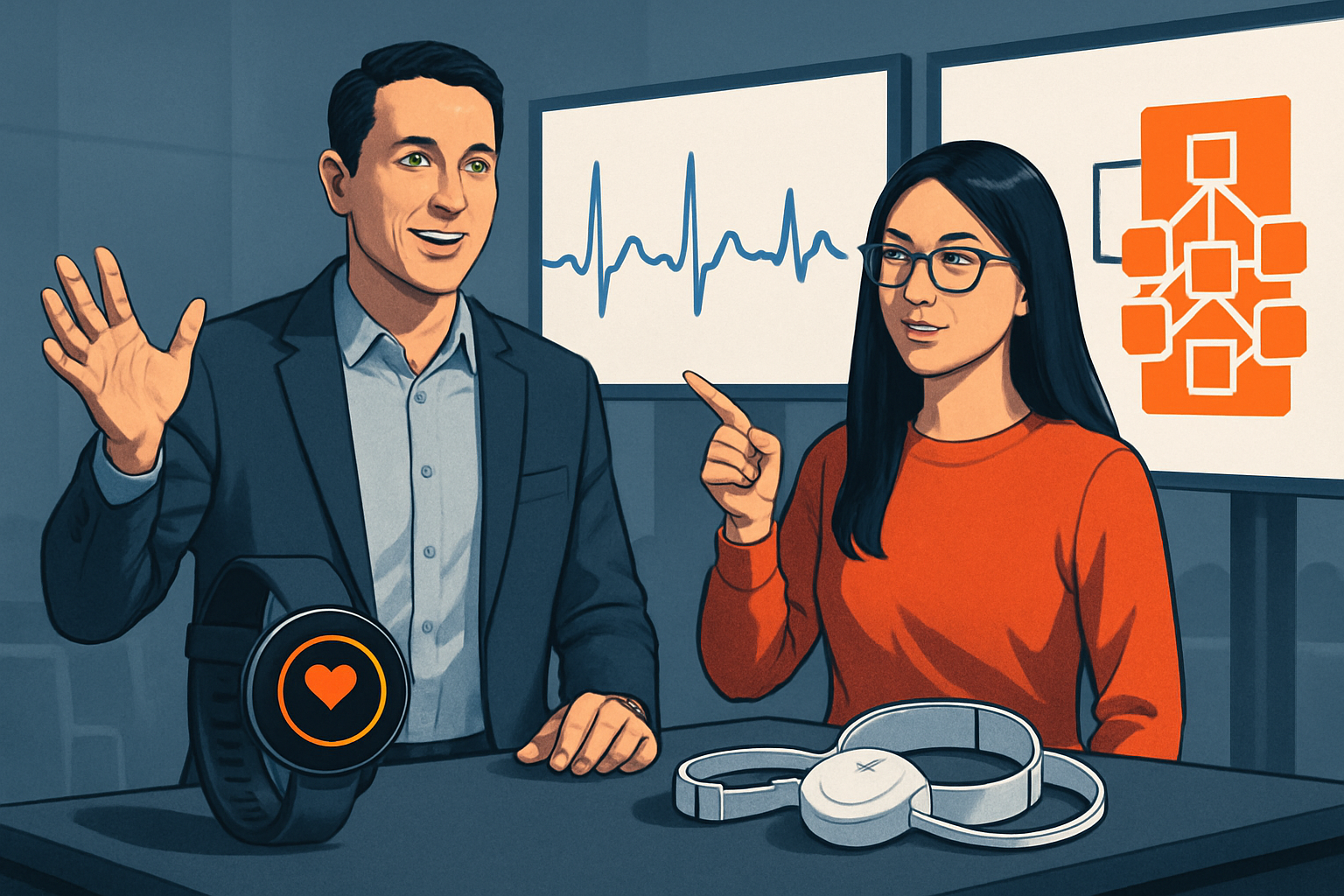
Electrocardiograms directly measure the heart's electrical activity and, according to Samsung, are used to assess heart rate and variability while identifying rhythm anomalies and risks associated with conditions such as atrial fibrillation. These wearable measurements generally require user action, whereas photoplethysmography passively detects variations in blood flow through smartwatch sensors. Samsung emphasizes that the two signals, stemming from the same cardiac activity, exhibit a time delay comparable to thunder following lightning. xMAE learns this relationship by reconstructing masked portions of ECG from PPG data, with the stated goal of analyzing cardiovascular features from continuous PPG without requiring manual ECG readings. The pre-training involved approximately 9,400 hours of ECG and PPG data.
HiMAE isolates the useful timescale and covers classification, regression, and generation
Wearable data carries information that varies with the duration of observation: short segments trace rapid signals, while long windows reveal patterns of sleep or physical activity. HiMAE relies on multiple encoders to separately process short and long segments and, according to Samsung, deduces the relevant timescale for a given task. Its training reconstructs masked portions to learn in contexts where labeling is rare. From a single pre-trained model, HiMAE supports classification, numerical prediction, and data generation while simultaneously analyzing both short and long intervals.
Two models, a self-supervised framework, and acceptances at ICML and ICLR
The claimed framework relies on self-supervision to extract representations from unlabeled biosignals, with, according to Samsung, contributions to diagnostics through signal analysis, biomarker development, and health problem prediction. The research describes two complementary approaches: xMAE for learning inter-signal temporal relationships and HiMAE for multi-scale patterns in wearable time series. Samsung presents this work as focused on physiological relationships and temporal structures, with each model addressing a distinct component of wearable device data analysis. Both studies have been accepted at the International Conference on Machine Learning and the International Conference on Learning Representations, respectively.
Connected Care and projects: what Sharanya Desai and Subbu Venkatraman say
At the Galaxy Unpacked Health Forum in July 2026, Samsung outlined its Connected Care vision for preventive, personalized, and connected care, positioning the foundational models as a lever for future consumer experiences. Sharanya Desai, head of digital health algorithms, believes that the work lays the technical groundwork for effective, accurate, and continuous health insights. She announces the continuation of model development applicable to various biosignals and capable of functioning on devices with limited sensors and resources. Subbu Venkatraman, who leads the lab, describes biosignals as intrinsically dynamic and asserts that the central contribution is to demonstrate the viability of models capturing inter-signal relationships and temporal structures. He indicates the intention to advance this research and translate it into solutions beneficial for people's well-being.
Brief IA — L'actualité IA en français
L'essentiel de l'actualité de l'intelligence artificielle, décrypté et expliqué chaque jour.