The CNCF Welcomes Six New AI Infrastructure Projects
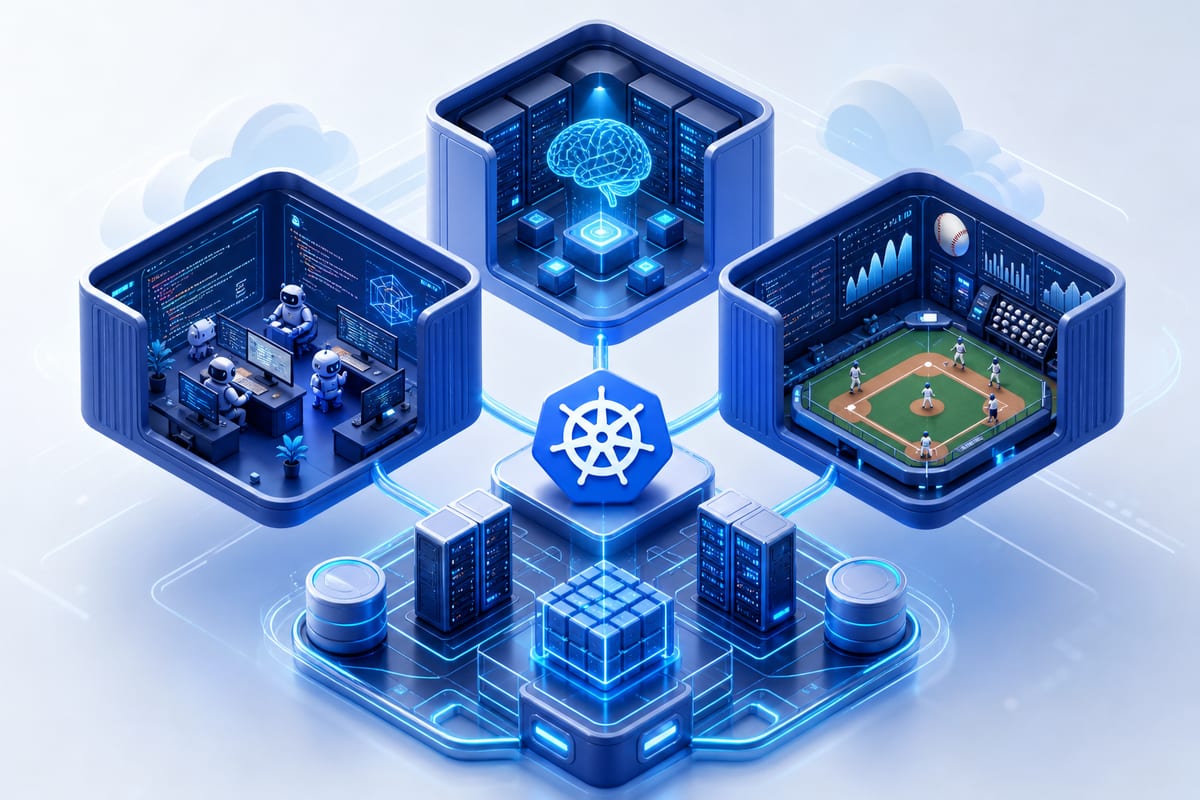
The Cloud Native Computing Foundation (CNCF) has welcomed six projects directly dedicated to AI infrastructure among its 32 additions in the past 12 months. At KubeCon in Salt Lake City, several companies described their technical adaptations, as well as internal resistance and frequent re-evaluations of their software choices.
Apple Maps and the Phillies Face Internal Resistance
At Apple Maps, transferring petabytes of data to Kubernetes took years, reports Ying Xiong, head of data infrastructure. He describes this migration of massive data processing as challenging but successful. The lack of data locality had particularly led to some team members refusing to try Kubernetes. These migrations also involve large organizations equipped with Hadoop, which are now considering Apache Spark or Flink on Kubernetes.
At the Philadelphia Phillies, the resistance focused on abandoning Jupyter Notebooks associated with locally stored data, explains Long Nguyen, software engineer for the franchise. In his view, gaining user buy-in proves to be more difficult than deploying the platform.
Swissquote Frequently Re-evaluates Its Software Choices
Andrew Boswell, CIO of Swissquote, a financial services company based in Gland, Switzerland, describes a series of re-evaluations driven by new AI versions. According to him, his company changed its software stack several times last year before deploying Agent Substrate into production. For running large language models, with Ollama, vLLM, or llm-d, he finds it necessary to reassess the relevance of the entire setup every two to three months.
Agent Substrate itself transitioned from its first code contribution to general availability under CNCF governance in six months. Google and its partners brought the project to the foundation on November 10. For some organizations, the European AI Act also imposes a thorough evaluation of new tools while providing a framework for this review.
Podium Isolates Tasks from Its Agents
Podium, which sells an AI operating system to small businesses, was already practicing AI and Kubernetes before the arrival of Claude Opus 4.5 in November 2025. During a presentation at KubeCon on November 11, Drew Bowman, the company's software engineering lead, explained that this release convinced his engineers of the viability of always-active programming agents. These agents automatically prepare integration requests for developers to review, based on customer prompts or telemetry alerts.
According to Drew Bowman, their support required modifying a Kubernetes infrastructure previously reserved for human developers, particularly to maintain service reliability. Podium thus built an orchestration that isolates agent tasks and keeps resources available during their startups and shutdowns. Individual Kubernetes namespaces for developers were replaced with small nested spaces for agents and their sub-agents to avoid infrastructure sprawl.
Le brief IA que les pros lisent chaque soir
Les 7 actus IA du jour, décryptées en 5 min. Gratuit.
Inclus dès l'inscription : notre sélection des meilleurs guides & comparatifs IA.
Choisissez votre rythme
Gratuit · Pas de spam · Désabonnement en 1 clic
Podium's implementation bore similarities to Agent Substrate, although Drew Bowman did not mention this project during his talk. He did indicate that he would likely prefer an existing solution today rather than a new internal build. His team is exploring other ways to ensure this orchestration.
The Phillies Process Their Statistics in Hours
The platform team of the Philadelphia Phillies consists of four engineers and has modernized its data science infrastructure with open-source software over the past two years. After replacing the old system with Kubernetes, it added KubeRay this year to schedule AI computations, KServe to serve models, and Knative to process data in response to events. Matthew Dering, lead software engineer for this Major League Baseball franchise, states that the platform hosts 25 data scientists and 100 data products, varying in maturity.
According to Matthew Dering, the old batch processing for AI and machine learning could take two weeks; fixing bugs in data pipelines could also take two weeks. The new platform can, he says, process several seasons of baseball statistics in a matter of hours. Long Nguyen believes that cloud-native and open-source foundations now make AI advancements easier to absorb.
CNCF Projects and Foundation Support
The CNCF now has 231 projects; the newcomers directly related to AI infrastructure are Agent Substrate, OpenShell, gVisor, KubeRay, OpenRL, and llm-d. It is part of the Linux Foundation, along with the Open Source Security Foundation and the Agentic AI Foundation. Established in August 2025, the latter now encompasses ten projects, up from three at its inception.
Developments also concern existing projects: this year, Kubeflow, dedicated to data processing, achieved graduated project status. HAMi, which organizes the scheduling and sharing of heterogeneous accelerators on Kubernetes, moved from the experimental "sandbox" stage to incubation. Dynamic resource allocation, delivered with Kubernetes 1.34 in August 2025, saw its functions significantly expanded by version 1.37 released in September.
The proponents of Modelplane and Broadcom's VM API also presented approaches for managing hybrid infrastructures. CNCF leaders announced other early-stage projects focused on accelerator portability. However, they expressed a desire to facilitate exchanges among developers rather than differentiate solutions.
Jonathan Bryce, Executive Director of Cloud and Infrastructure at the Linux Foundation, reminded attendees that the individuals gathered at the conference to solve these issues do not work for the foundation. He noted that the CNCF aims to promote free access for open-source projects to testing infrastructures provided by its members, including neocloud providers. Software supply chain security is another area of support he mentioned.
Brief IA — L'actualité IA en français
L'essentiel de l'actualité de l'intelligence artificielle, décrypté et expliqué chaque jour.