Yann LeCun Launches AMI Labs and Defends World Models
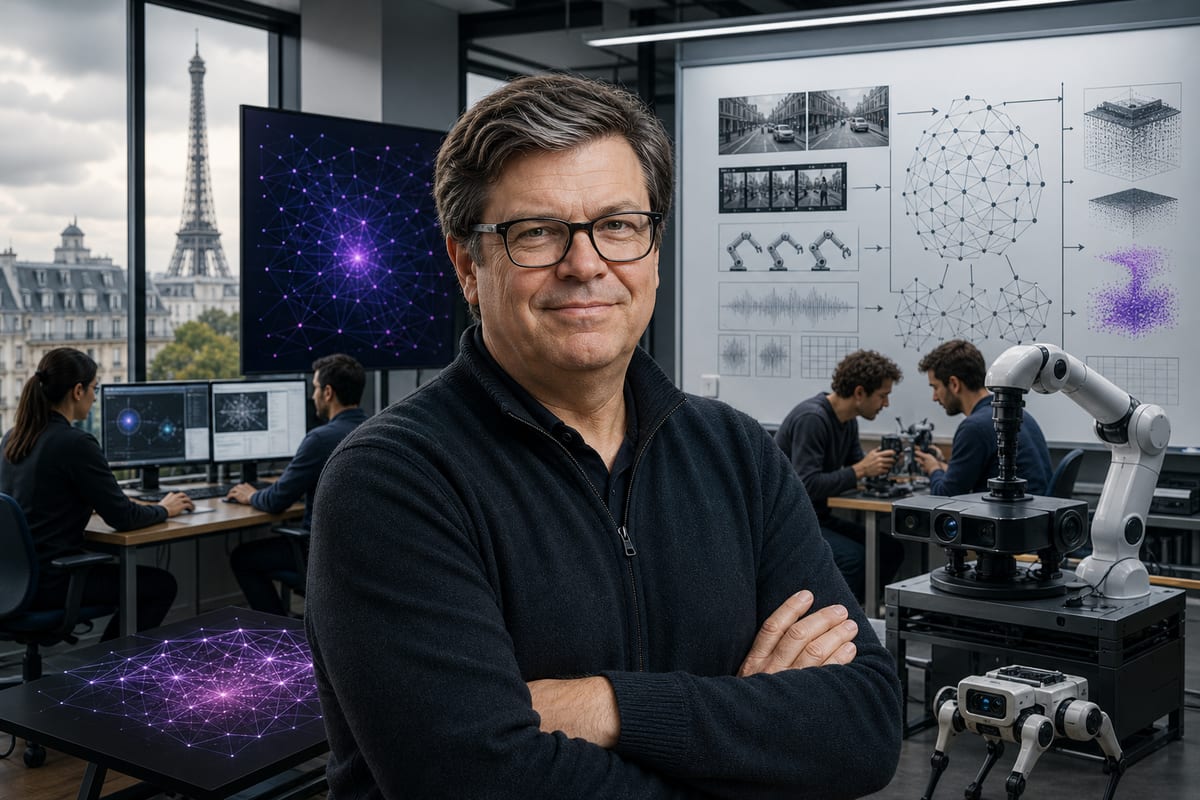
After Meta, Yann LeCun launched AMI Labs in Paris and completed a $1.03 billion seed round in March 2026, with NVIDIA, Jeff Bezos, and Eric Schmidt as investors. Opposed to the monoculture of LLMs, he advocates for "world models," open source, and participates in the Tapestry project of the AI Alliance for a shared and decentralized model.
AMI Labs raises $1.03 billion and aims for a shared model via the AI Alliance
AMI Labs, founded by Yann LeCun and based in Paris, completed a $1.03 billion seed round in March 2026. NVIDIA, Jeff Bezos, and Eric Schmidt are among the investors. The startup plans to tackle robotics, automation, healthcare, and connected devices through a different approach. At the same time, Yann LeCun serves as the chief scientific advisor within the AI Alliance, which is leading the Tapestry project. This initiative aims to create a globally accessible AI model through a decentralized network, where universities, companies, and states can participate without relinquishing control of their own data. In this context, he supports open source, which he considers essential for ensuring a plurality of perspectives, and asserts that AI should not be monopolized by a small number of players, citing threats to culture and democracy.
He challenges LLMs and develops "world models"
Yann LeCun opposes LLMs, which he describes as a monoculture and a dead end. He acknowledges their performance on text or code but believes they lack an understanding of the physical world and are incapable of predicting the consequences of their actions. AMI Labs is designing "world models," which are predictive systems capable of learning from rich sensory data such as images, videos, sounds, or information from robotic sensors. Similar to how a young child learns, these models aim to equip AI with planning, reasoning, and safe action capabilities. This direction is at the core of AMI Labs' mission.
Le brief IA que les pros lisent chaque soir
Les 7 actus IA du jour, décryptées en 5 min. Gratuit.
Inclus dès l'inscription : notre sélection des meilleurs guides & comparatifs IA.
Choisissez votre rythme
Gratuit · Pas de spam · Désabonnement en 1 clic
Meta shifts its focus on AI, LeCun departs after product emphasis
Recruited in 2013 by Mark Zuckerberg to establish FAIR, Yann LeCun led it for four years before becoming Chief AI Scientist in 2018. There, he prioritized long-term research over immediate applications. The company later shifted its strategy with the arrival of LLMs and invested billions to catch up with ChatGPT and Gemini, a race in which he did not participate. In the summer of 2025, Mark Zuckerberg entrusted the leadership of AI to Alexandr Wang and emphasized rapid product development, relegating FAIR to the background. Yann LeCun then decided to leave Meta and founded AMI Labs shortly thereafter.
From CNNs to recognition with the 2018 Turing Award
At Bell Labs, Yann LeCun developed convolutional neural networks and led research in image processing at AT&T. These networks were used by banks for the automated reading of handwritten checks and now form the foundation of computer vision and autonomous vehicles. After becoming a professor at New York University in 2003 and founding and directing its data science center, he received the Turing Award in 2018 alongside Geoffrey Hinton and Yoshua Bengio, often referred to as the "Nobel Prize of Computing," which honors achievements in deep learning. This journey was built during a time when neural networks were largely overlooked by most researchers, a path he continued to follow despite the prevailing trends.
Origins, education, and other scientific commitments
Born in 1960 in Soisy-sous-Montmorency and raised in the suburbs of Paris, Yann LeCun is the son of a mechanical engineer and inventor. In high school, he built synthesizers for his band and began programming on a rudimentary computer. Graduating from ESIEE and then earning a doctorate from Sorbonne University in the 1980s, at a time when machine learning was very isolated in France, he pursued a postdoctoral fellowship at the University of Toronto. In 1988, he moved to the United States and joined AT&T Bell Labs in New Jersey. Outside of AMI, he sits on the scientific board of Cellular Intelligence, a startup specializing in cellular modeling. The current technological landscape is largely focused on agents and LLMs.
Brief IA — L'actualité IA en français
L'essentiel de l'actualité de l'intelligence artificielle, décrypté et expliqué chaque jour.