AI for Procurement and Supply Chain: The 2026 Reference Guide

According to Ironclad, 92% of purchasing teams surveyed report already using AI in one form or another by 2026. Our analysis of purchasing AI also highlights a major operational limitation: 33% of professionals spend more time verifying AI results than they save. For procurement and supply chain, the issue is not adoption, but control. This guide reviews the successful use cases, tool families, applicable rules, deployment pitfalls, and a simple plan to get started without jeopardizing operations.
What AI Really Changes for Procurement and Supply Chain
AI shifts procurement from a processing job to an arbitration role. It categorizes spending, flags off-contract purchases, compares offers, summarizes contracts, and prepares orders. In our analysis on purchasing AI, the projected gains can reach 30% in demand forecasting, inventory adjustments, and automation of orders and deliveries. This potential is only valuable if teams measure stockouts, overstock, urgent purchases, and errors before the pilot.
For purchasing centers, the most significant change comes from agents capable of executing multiple steps: detecting low stock, preparing a request for quotation, pre-selecting suppliers, comparing offers, and producing a purchase order for validation. Our analysis on purchasing centers reminds us that McKinsey estimates efficiency improvements between 25% and 40% for autonomous agents, depending on the scope and level of automation. Scaling up requires authorization rules, traceability, and the possibility of stopping processes.
In the supply chain, AI becomes useful when it connects physical events to business decisions. ETAs, supplier delays, stock levels, quality incidents, and logistics documents feed into recommendations. The most structured example is CMA CGM, which claims more than 55 AI projects in production and over 200 identified use cases. Its deployment shows a clear limitation: simple requests can be automated, but disputes, exceptions, and sensitive arbitrations must remain escalated to human teams.
 Buyer and planner compare an order near a stock of components.
AI helps prioritize, but the purchasing decision remains supervised.
Use Cases That Work Today
The best use cases do not replace the buyer: they reduce uncertainty, accelerate repetitive tasks, and make discrepancies visible sooner. Start with use cases where data already exists and where human decision-making remains identifiable.
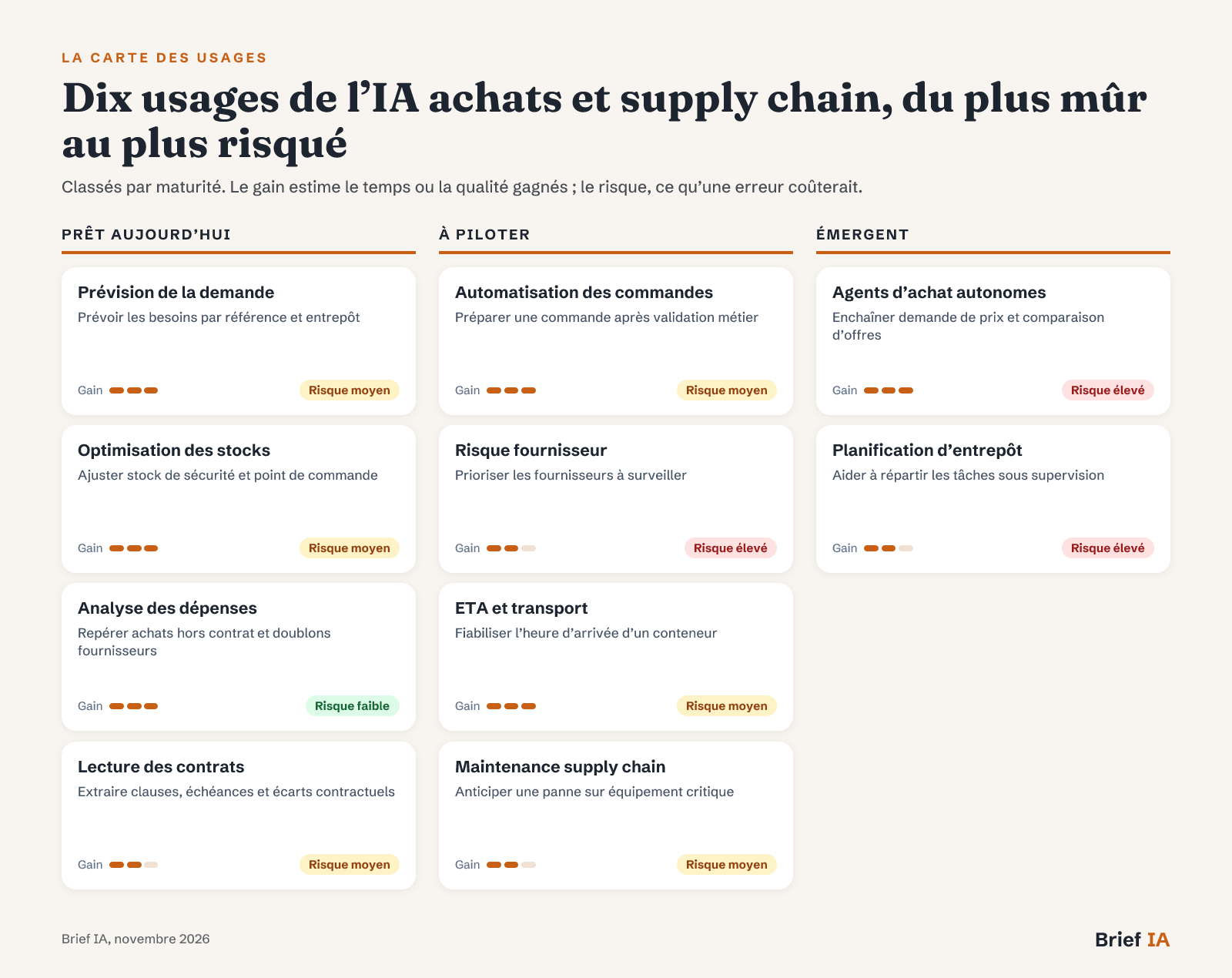 Map of AI use cases for our analyses for purchasing directors, supply chain managers, procurement officers, and industrial buyers
Use cases classified by maturity, with expected gain and risk in case of error.
Ready-to-Use Use Cases
Demand Forecasting. Models analyze sales, orders, lead times, stockouts, promotions, and seasonal variations to produce forecasts by reference, site, or period. The use is solid if item codes are standardized and if forecasting errors are tracked by product family. The test should compare AI to a simple method, then measure stockouts, immobilized stock, and urgent purchases.
Inventory Optimization. AI can recommend safety stock levels, reorder points, and purchase quantities while considering actual lead times, minimum order quantities, and observed consumption. The gain should be verified by critical reference, not on an overall average. The validation rule must remain stricter for long-lead items, unique components, and items that block a line.
Spend Analysis. Automatic classification of spending makes value leaks visible: duplicate suppliers, poorly coded families, off-contract purchases, or price discrepancies. This is often the first profitable project because the result can be measured in captured savings. The priority is to clean supplier, contract, cost center, and taxonomy references before automating analyses.
Contract Review. Generative AI helps extract clauses, identify deadlines, compare a contract to a purchasing policy, and flag atypical conditions. The risk comes from scanned documents, disparate annexes, and non-standardized templates. The best practice is to produce an assisted reading sheet, then have sensitive clauses validated by legal teams, responsible buyers, or relevant departments.
Use Cases to Pilot
Order Automation. Purchase requests, purchase orders, invoice reconciliations, and supplier reminders can be automated when rules are stable. The system should prepare, not impose, decisions that commit the company. Set thresholds for amounts, excluded families, controls on new suppliers, and human validation for exceptions, urgent orders, and price discrepancies.
Supplier Risk. Tools can cross-reference delays, non-conformities, supplier dependency, documentary incidents, and external signals to prioritize follow-ups. The risk is turning a score into an automatic delisting decision. The best practice is to use the score as an alert, document the criteria, and plan for a human review before any significant commercial consequences.
ETA and Transport. ETA prediction improves dock, warehouse, and customer commitment planning when it relies on reliable transport data. CMA CGM cites ETA prediction, vessel routing, and smart cargo release among its structuring uses in our analysis on its logistics AI. The pilot must measure anticipated delays, avoided rescheduling, and alert quality.
Supply Chain Maintenance. In warehouses and industrial sites, predictive maintenance leverages vibrations, temperature, pressure, operating cycles, or electrical consumption to signal a drift. Cornille Havard aims for up to a 20% reduction in production costs with real-time analysis, predictive maintenance, and enhanced quality control, according to our industrial analysis. The scope should remain limited to expensive and measurable equipment.
Emerging Use Cases
Autonomous Purchasing Agents. Agents capable of executing multiple steps promise significant gains but require stricter safeguards than a writing assistant. They must work with authorized suppliers, adhere to amount thresholds, trace each action, and stop on exceptions. Relevant deployment starts with repetitive processes: collecting quotes, structured comparisons, document preparation, and simple reminders.
Warehouse Planning. Planning tools can help anticipate load, allocate resources, and signal bottlenecks. Caution is necessary as soon as AI influences task allocation, evaluation, or monitoring of employees, as these uses fall under high-risk systems in Annex III of the AI Act starting December 2, 2027. Managerial supervision must be explicit.
Tools to Know
There is no universal ranking: procurement must compare tool families based on their data, processes, and risk level.
- Procurement suites from request to payment. They cover purchase requests, suppliers, orders, contracts, reconciliations, and reminders. They are suitable if the process is already formalized and if approval rules are clear. Requirements: action traceability, validation thresholds, exception logs, role-based rights.
- Agent and orchestration platforms. They chain multiple actions in procurement systems, ERP, messaging, or document databases. The MAIA example at CMA CGM shows the value of a platform connected to business applications, with use cases ranging from routing to document processing. Requirements: stop on exceptions, human validation, limited scopes, real-world testing.
- Spend analysis tools. They classify spending lines, identify price discrepancies, off-contract purchases, and supplier duplicates. They create value if the supplier reference and purchasing taxonomy are stabilized. Requirements: clear categorization rules, error rate tracking, manual correction, proof exports.
- Document and contract assistants. They extract clauses, deadlines, amounts, commitments, and anomalies from contracts, invoices, bills of lading, or claims. Their performance heavily depends on the quality of scans, templates, and annexes. Requirements: citations of source passages, retained versions, legal validation, contractual confidentiality.
- AI supplier supervision tools. They monitor cyber exposure and vulnerabilities of technology providers. Black Kite indicates that 29.7% of evaluated AI companies are highly susceptible to ransomware in our article on AI supply chains. Requirements: continuous monitoring, prioritization of fixes, notification clauses, proof of remediation.
Le brief IA que les pros lisent chaque soir
Les 7 actus IA du jour, décryptées en 5 min. Gratuit.
Inclus dès l'inscription : notre sélection des meilleurs guides & comparatifs IA.
Choisissez votre rythme
Gratuit · Pas de spam · Désabonnement en 1 clic
The Framework: AI Act, Data, Suppliers, and Industrial Products
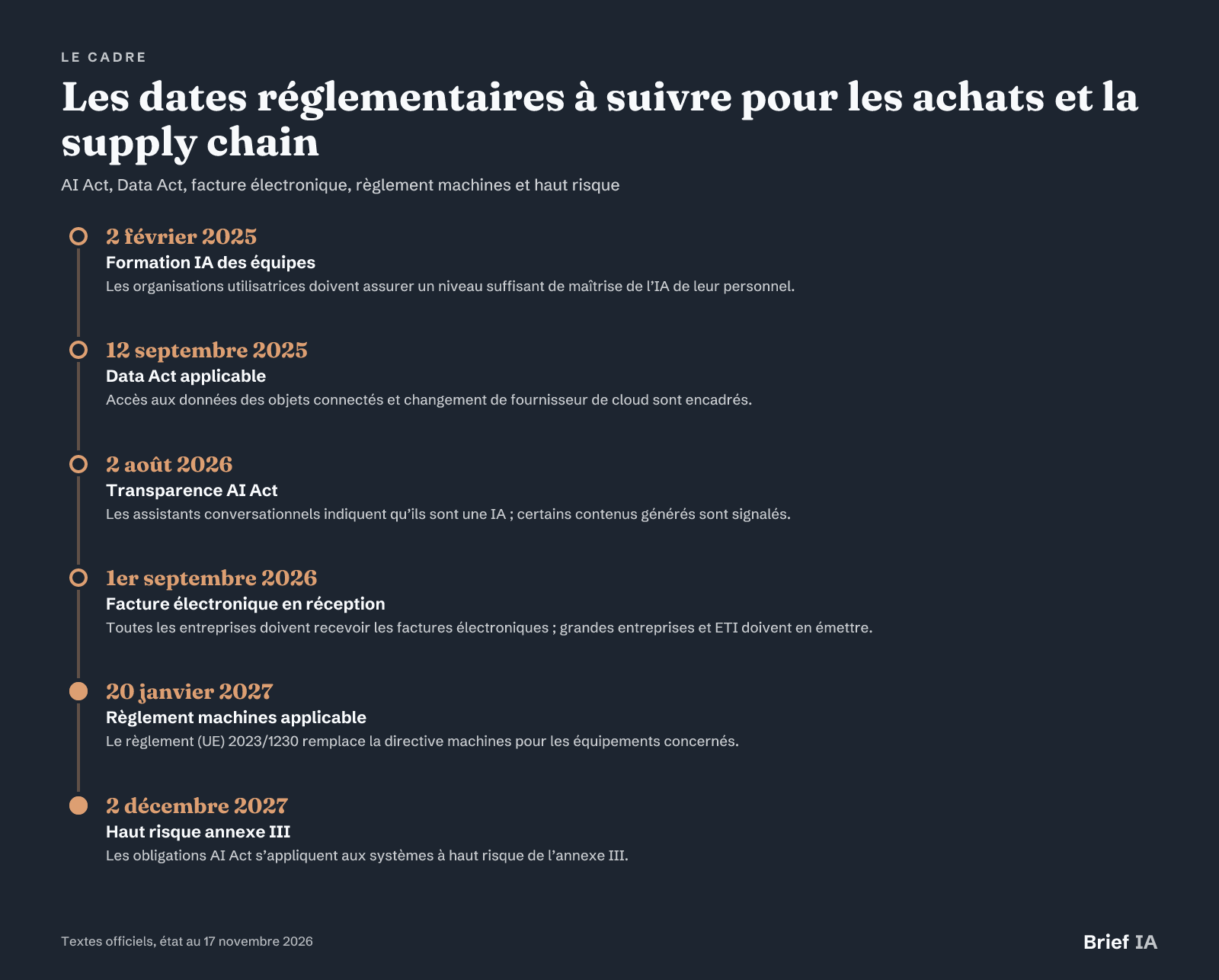 Regulatory dates to follow for procurement and supply chain
Key dates, status as of November 17, 2026.
AI Act and Procurement Use Cases
Since February 2, 2025, prohibited practices are banned, and any organization using AI systems must ensure a sufficient level of AI mastery among its personnel. From August 2, 2026, transparency obligations apply: a conversational assistant must indicate that it is AI, and certain generated content must be flagged. Writing, summarization, accounting, cash flow forecasting, or fraud detection tools without high-risk use are not considered high-risk systems.
High-Risk Cases in Warehousing
Annex III of the AI Act classifies certain employment-related uses as high-risk systems, including recruitment, selection, promotion, dismissal, task allocation, evaluation, and monitoring of employees. For procurement and supply chain, the focus is on planning or productivity tools that directly affect operators. Following the Digital Omnibus, the obligations of high-risk systems in Annex III will apply from December 2, 2027, not in August 2026.
Data, Connected Objects, and CSE
The GDPR has been in effect since May 25, 2018, and its Article 22 regulates decisions based solely on automated processing that produces legal or significant effects on an individual. The Data Act, applicable since September 12, 2025, organizes access to data produced by connected objects and facilitates changing cloud providers. The Labor Code requires informing and consulting the CSE when introducing new technologies in the company.
Products, Machines, and Invoices
Electronic invoicing requires all companies to be able to receive electronic invoices since September 1, 2026; large companies and mid-sized enterprises must also issue them through an approved platform. SMEs and micro-enterprises will have to issue them starting September 1, 2027. For industrial equipment, the machinery regulation applies from January 20, 2027. Since September 11, 2026, manufacturers of products containing digital elements must report actively exploited vulnerabilities and serious incidents, with alerts within 24 hours and notifications within 72 hours.
Pitfalls to Avoid
Automating Without Reference. A pilot without initial measurement proves nothing. Before purchasing a tool, measure stockouts, immobilized stock, urgent orders, dispute costs, processing time, and errors. Without a starting point, AI becomes a difficult expense to justify.
Confusing Score and Decision. A supplier score, forecast, or alert is not a business decision. The risk increases when a model automatically triggers a delisting, a sensitive order, or a workload distribution. Thresholds, exceptions, and validations must be documented before going live.
Underestimating AI Costs. API bills and unnecessary calls can escalate quickly. EY indicates that an AI router has reduced its token consumption by 60% since April, according to our article on its AI governance. Procurement should request consumption limits, usage tracking, and budget alerts.
Neglecting Supplier Security. AI solutions are often purchased and then integrated into internal systems, increasing the attack surface. Initial evaluation is not enough: demand continuous monitoring, incident notification commitments, correction timelines, and the ability to isolate a compromised connector.
Leaving Teams Alone. Individual AI creates scattered practices, data copied into unvalidated tools, and results impossible to audit. Ofelia emphasizes orchestrating AI rather than isolated use. For procurement, this means approved tools, common rules, and identified business responsibility.
Taking Action: The 90-Day Plan
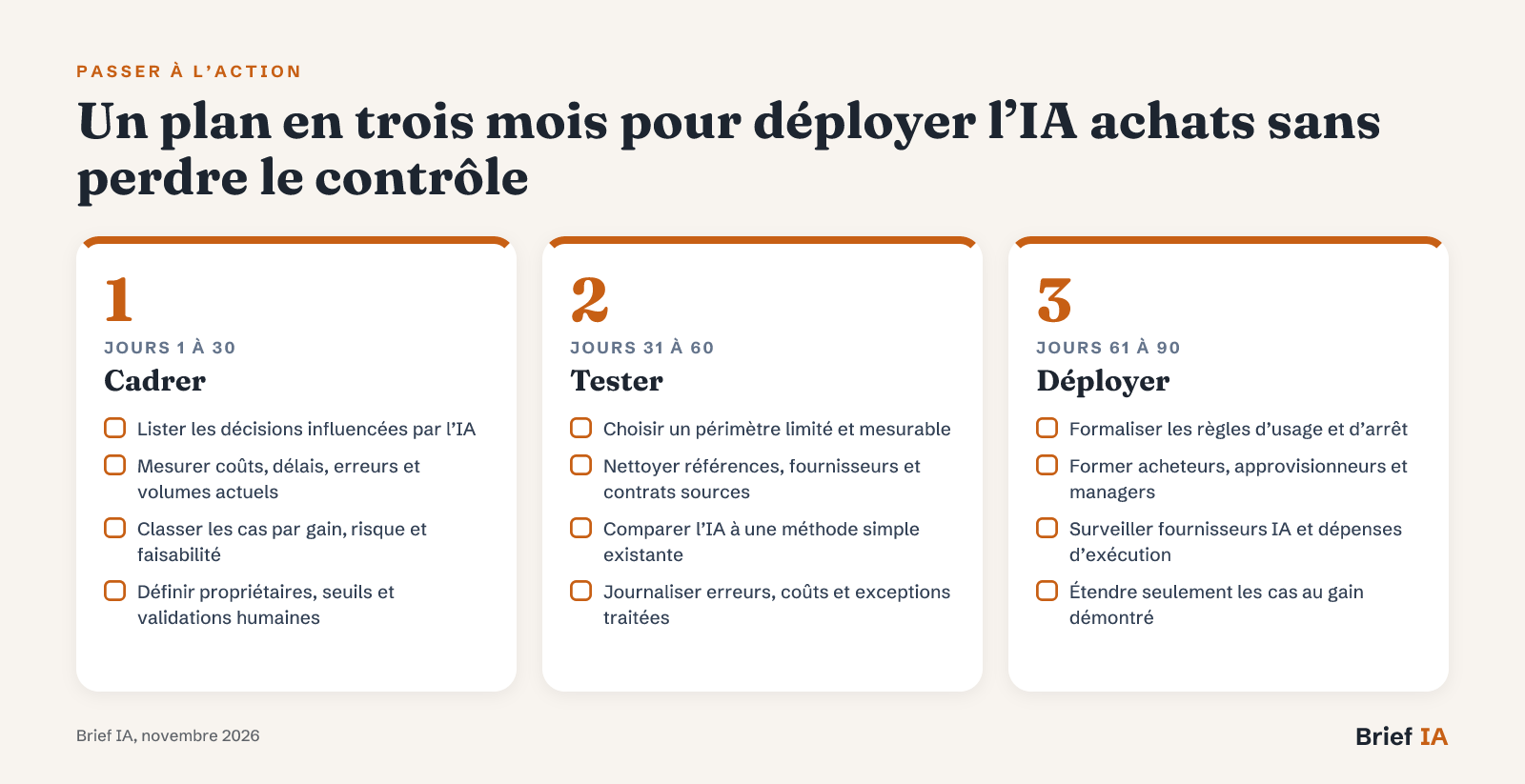 A three-month plan to deploy purchasing AI without losing control
Three steps: frame, test, deploy.
Start with a narrow scope: a purchasing family, a warehouse, an invoice flow, or a group of suppliers. During the first month, measure the current situation and clean the data. In the second month, test two use cases with human validation and cost tracking. In the third month, keep only what improves an operational indicator and formalize the rules before any broader deployment.
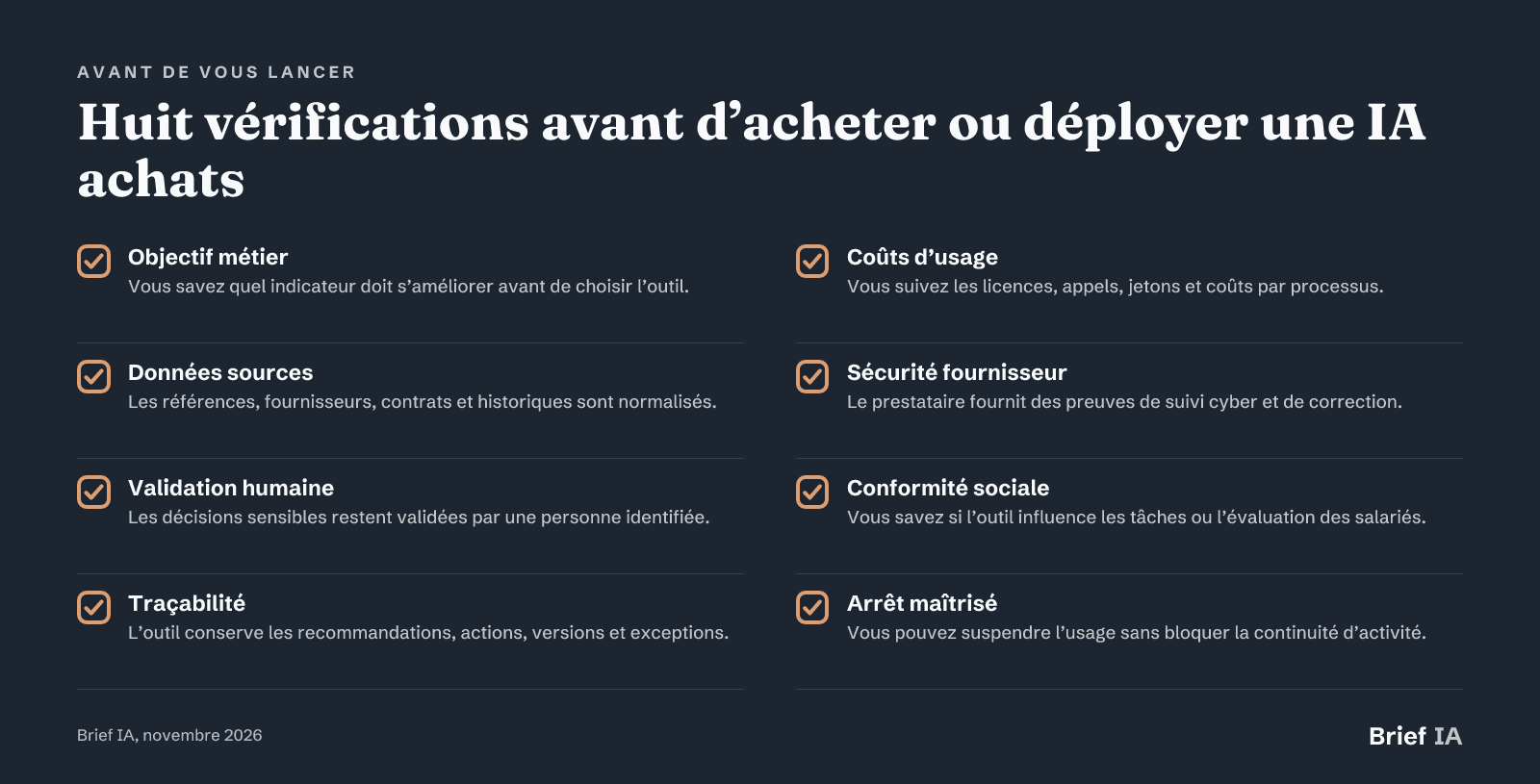 Eight checks before purchasing or deploying purchasing AI
Eight checks to perform before each new use case.
Further Reading
Our analyses for purchasing directors, supply chain managers, procurement officers, and industrial buyers
- Purchasing AI: stocks, suppliers, and orders under control. The method to link forecasting, stocks, suppliers, and automation without losing human validation.
- Purchasing Centers: five AI innovations to watch. Agents, spend analysis, contracts, and supplier risks, with their gains and limitations.
- CMA CGM: AI agents and global logistics. A corporate case on MAIA, ETAs, routing, warehouses, and customer request processing.
- Industrial AI Governance: the AVEVA method. How to frame human supervision, security, traceability, and actions on critical operations.
- Mastering AI Costs in Business. Safeguards to avoid token consumption without measurable value or governance.
- Industrial AI: reducing production costs methodically. The method to choose a scope, measure stoppages, scrap, and gains before industrializing.
Key News to Note
- AI Supply Chains: Black Kite warns of supplier vulnerabilities
- EY reduces its token consumption with an AI router
- 91% of professionals believe the value of AI remains unfulfilled
- GreenOps: AI can help IT, but only with strict framing
- CameraMatics raises 49 million euros for fleet AI
- Oracle reaches 80% AI adoption but needs to revise its processes
Do you provide a solution for procurement and supply chain?
This guide is read by purchasing directors, supply chain managers, procurement officers, and industrial buyers. Brief IA offers solution providers in procurement, supply chain, logistics, and industrial AI dedicated articles, evening brief inserts, and promotion in the directory. Formats and rates at briefia.fr/partenaires.
The Essentials in Questions
What are the best uses of AI in procurement?
The most mature uses are demand forecasting, inventory optimization, spend analysis, assisted contract reading, and automation of transactional tasks. Autonomous agents become interesting for repetitive processes, but they must remain limited by amount thresholds, authorized suppliers, and human validation.
Can AI place orders automatically?
It can prepare or trigger certain orders if the rules are stable, the data reliable, and the authorization thresholds clear. For high amounts, new suppliers, critical families, or price discrepancies, human validation must remain mandatory. The action log should allow understanding why the order was proposed.
How to measure the return on investment of purchasing AI?
It is essential to start from a measured baseline: processing time, stockouts, overstock, urgent purchases, errors, disputes, administrative costs, and captured savings. The pilot must compare the AI recommendation to an existing method. Deployment is only justified if the business indicator improves without increasing operational risks.
Are purchasing AI tools high-risk under the AI Act?
Writing, summarization, spend analysis, forecasting, or accounting automation tools without high-risk use are not considered high-risk systems. However, a tool that influences task allocation, evaluation, or monitoring of employees falls under high-risk uses in Annex III, with obligations applicable from December 2, 2027.
What to ask an AI supplier for the supply chain?
Ask for the precise purpose, the data used, access rights, traceability, consumption limits, shutdown procedures, security commitments, and incident notification timelines. Also, demand tests on your own flows, an explanation of known errors, and the ability to correct recommendations without solely relying on the provider.
Brief IA — L'actualité IA en français
L'essentiel de l'actualité de l'intelligence artificielle, décrypté et expliqué chaque jour.