AI for HR and Recruitment: The 2026 Reference Guide

Le brief IA que les pros lisent chaque soir
Les 7 actus IA du jour, décryptées en 5 min. Gratuit.
Inclus dès l'inscription : notre sélection des meilleurs guides & comparatifs IA.
Choisis ton rythme
Gratuit · Pas de spam · Désabonnement en 1 clic
According to Apec, 31% of executives used generative AI to apply for jobs in 2025, compared to 15% in 2024. Recruiters are facing better-prepared applications that are more aligned with keywords, while their own tools automate profile searches, sorting, follow-ups, and part of the evaluation process. This topic is no longer experimental: it impacts selection quality, candidate experience, compliance, and team training. This guide details effective uses, tools, rules, pitfalls, and a plan to get started.
What AI Really Changes for HR and Recruitment
Recruitment is becoming the most advanced area of application. According to SHRM, 27% of organizations are already using AI for hiring. In France, Apec indicates that by 2025, 27% of companies will use an ATS to manage applications, with a rate exceeding 70% in large companies. The concrete change is less about replacing recruiters and more about redistributing work: the tool classifies, summarizes, matches profiles, and suggests actions, while the human makes the final decision. Our analysis on optimizing recruitment with AI details this shift.
The power dynamics with candidates are also changing. Apec observes that 31% of executives used generative AI to apply in 2025, which is double the rate from 2024. Resumes and cover letters can be better aligned with keywords, and interviews can be better prepared. Therefore, recruiters must shift their evaluation towards concrete evidence: achievements, practical cases, critical judgment, and the ability to explain the use of a tool. Our analysis on talent criteria in AI-assisted recruitment highlights the importance of transparency.
Talent management goes beyond recruitment. ADP Assist is described as a set of personalized agents covering the employee lifecycle, from recruitment to payroll and performance. Training or mobility recommendations can help, but they become sensitive if they pigeonhole employees into categories. For an HR director, the right indicator is not just the recruitment timeline but the quality of the entire system, from the published offer to integration. Our analysis on AI in HR, recruitment, training, and talent management provides this overview.

AI accelerates sorting, but the grid and decision remain human.
Effective Uses Today
The most robust applications are those that reduce repetitive tasks without solely deciding the fate of a candidate or employee. Evaluation uses require stricter management.
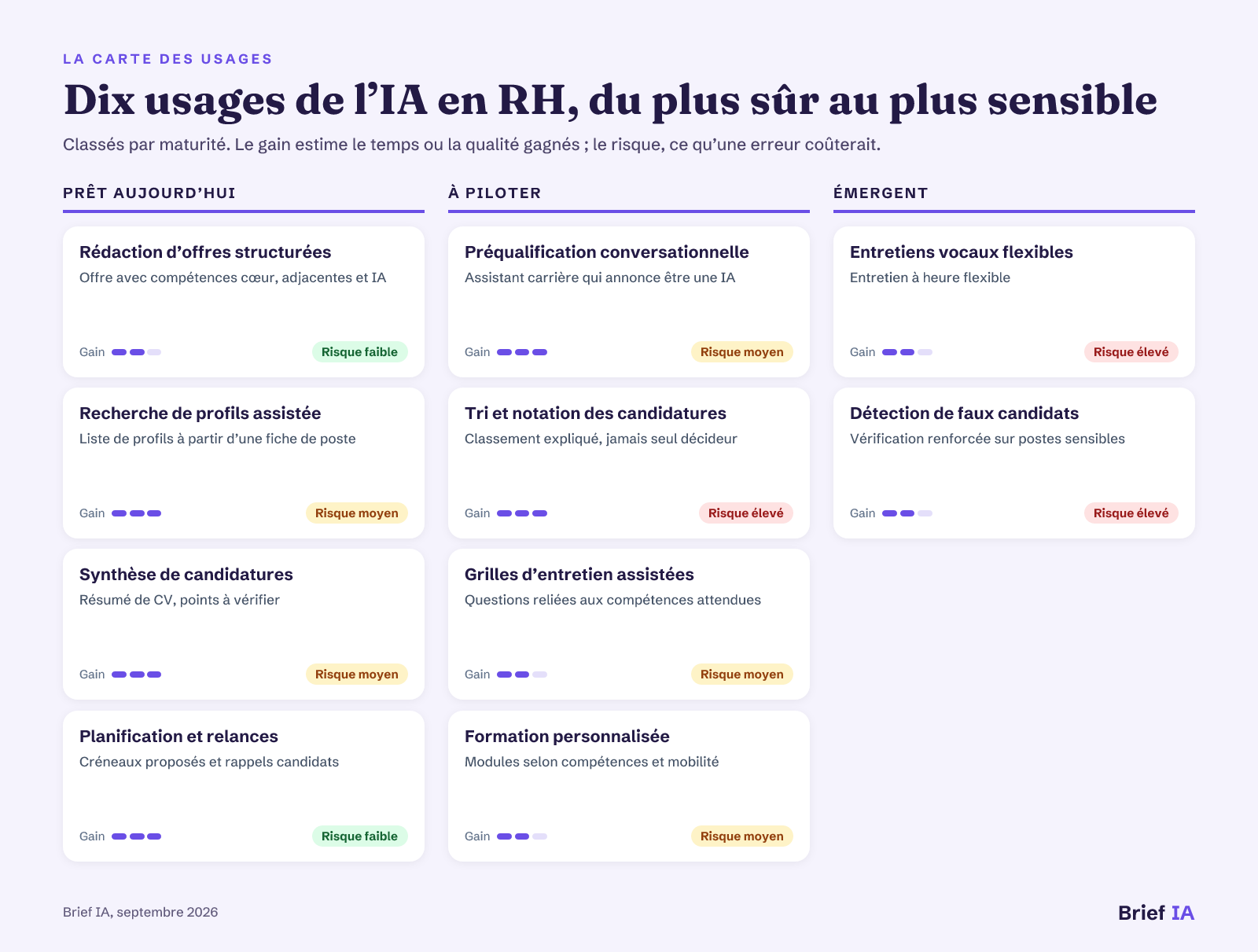
Uses classified by maturity, with expected gains and risks in case of error.
Ready-to-Use Applications
Structured Job Descriptions. Breaking down each job into core skills, adjacent skills, and AI skills makes the need clearer for candidates, managers, and tools. This method avoids vague phrases like "proficiency in AI" and specifies whether the position requires using, supervising, or critiquing generated outputs. It also improves coherence between the job announcement, interview grid, and selection criteria.
Assisted Profile Search. Assisted profile search transforms a job description into queries, profile lists, and outreach messages. The gains are most evident when there are many or hard-to-fill positions. The main risk lies in implicit criteria: a tool that favors certain backgrounds, schools, or keywords can narrow the talent pool. Therefore, it is essential to compare multiple queries, check excluded profiles, and document the criteria used.
Candidate Summarization. Summarizing resumes, cover letters, and interview notes speeds up preparation for discussions with managers. It should not replace reading key elements, especially for atypical profiles. Best practice involves requesting a factual summary, points of caution, and missing information, then verifying against the original documents. Our analysis on generative AI in recruitment reminds us that recruiters primarily gain operational throughput.
Scheduling and Follow-Ups. Appointment setting, reminders, confirmations, and follow-up messages are tasks suited for automation. They reduce downtime and improve the consistency of candidate communication. Control mainly focuses on tone, exposed data, and the ability to regain control. An automated message must remain clear, useful, and signed by the organization, without giving the impression that a decision has already been made.
Uses to Manage
Conversational Prequalification. A conversational assistant can answer recurring questions, check availability, gather simple criteria, and guide a candidate. Since August 2, 2026, it must indicate that it is an AI. This use case becomes sensitive as soon as it classifies, eliminates, or strongly influences a candidacy. The questions asked must be related to the position, understandable, and accessible, with a human channel available in case of blockage.
Sorting and Rating Applications. Automated sorting and rating are useful for handling high volumes, but they directly affect access to employment. The tool should provide decision support, not make autonomous decisions. It is essential to know the criteria, test for disparities in treatment, keep a record of decisions made, and allow a recruiter to reintegrate a file. This use case falls under the high-risk employment category of the AI Act, with obligations applicable from December 2, 2027.
Assisted Interview Grids. AI can suggest interview questions, prompts, and a comparison grid linked to expected skills. The use is relevant if the grid standardizes evaluation without impoverishing it. The recruiter must eliminate irrelevant questions, add business context, and reject speculative psychological interpretations. Emotion recognition in the workplace has been prohibited since February 2, 2025, except for medical or security reasons.
Personalized Training. HR tools can recommend training content based on the position, targeted skills, internal mobility, or expressed needs. Management must avoid pigeonholing employees into categories. A useful recommendation offers options, explains why they are relevant, and allows the manager or employee to adjust the path. Since February 2, 2025, any organization using AI systems must ensure sufficient AI proficiency among its staff; our analysis on work relationships transformed by AI helps frame the support.
Emerging Uses
Flexible Voice Interviews. Flexible voice interviews can broaden access for candidates who work irregular hours or cannot free up time during the day. They become risky if the tool evaluates personality, sincerity, or motivation based on opaque signals. The choice must remain proportionate to the position, announced to the candidate, and accompanied by a human alternative, with criteria focused on skills.
Detection of Fake Candidates. The widespread use of generative tools necessitates better verification of identity, consistency of background, and actual ability to perform the announced tasks. Checks must focus on proof of achievement, synchronous exchanges, and integration steps. They must remain proportionate to the risk of the position, especially for sensitive or remote-access roles.
Tools to Know
There is no universal ranking: good choices are made by tool families, depending on recruitment volume, legal risks, and integration into the HR system.
- AI-Enhanced Applicant Tracking Software. These centralize applications, extract information from resumes, produce summaries, and can suggest matches between profiles and offers. Apec indicates that in France, 27% of companies will use an ATS in 2025, with a rate exceeding 70% in large companies. Requirements: configurable criteria, action logs, data export, human resumption.
- Profile Search Agents. They search for profiles, generate lists, and automate outreach messages. They are particularly suitable for teams recruiting in volume or for hard-to-fill positions, provided that criteria and data sources are controlled. Requirements: data source, message control, volume limits, response tracking.
- Conversational Candidate Assistants. They answer questions, prequalify certain criteria, and schedule interviews. Since August 2, 2026, a conversational assistant must indicate that it is an AI. Requirements: identification as AI, human channel, job-related questions, traceability.
- HR Writing and Summarization Tools. They assist in drafting announcements, rephrasing candidate messages, summarizing interviews, or preparing grids. They are suitable for production tasks, but every content sent to a candidate must be reviewed and adapted. Requirements: confidentiality, standard instructions, mandatory proofreading, absence of sensitive data.
- HR, Payroll, and Talent Suites. They connect recruitment, employee data, payroll, training, and mobility. ADP Assist is described as a set of agents covering recruitment, payroll, and performance, which imposes strict access rights. Requirements: access rights, data separation, vendor audit, HRIS integration.
The Framework: AI Act, GDPR, and Social Dialogue
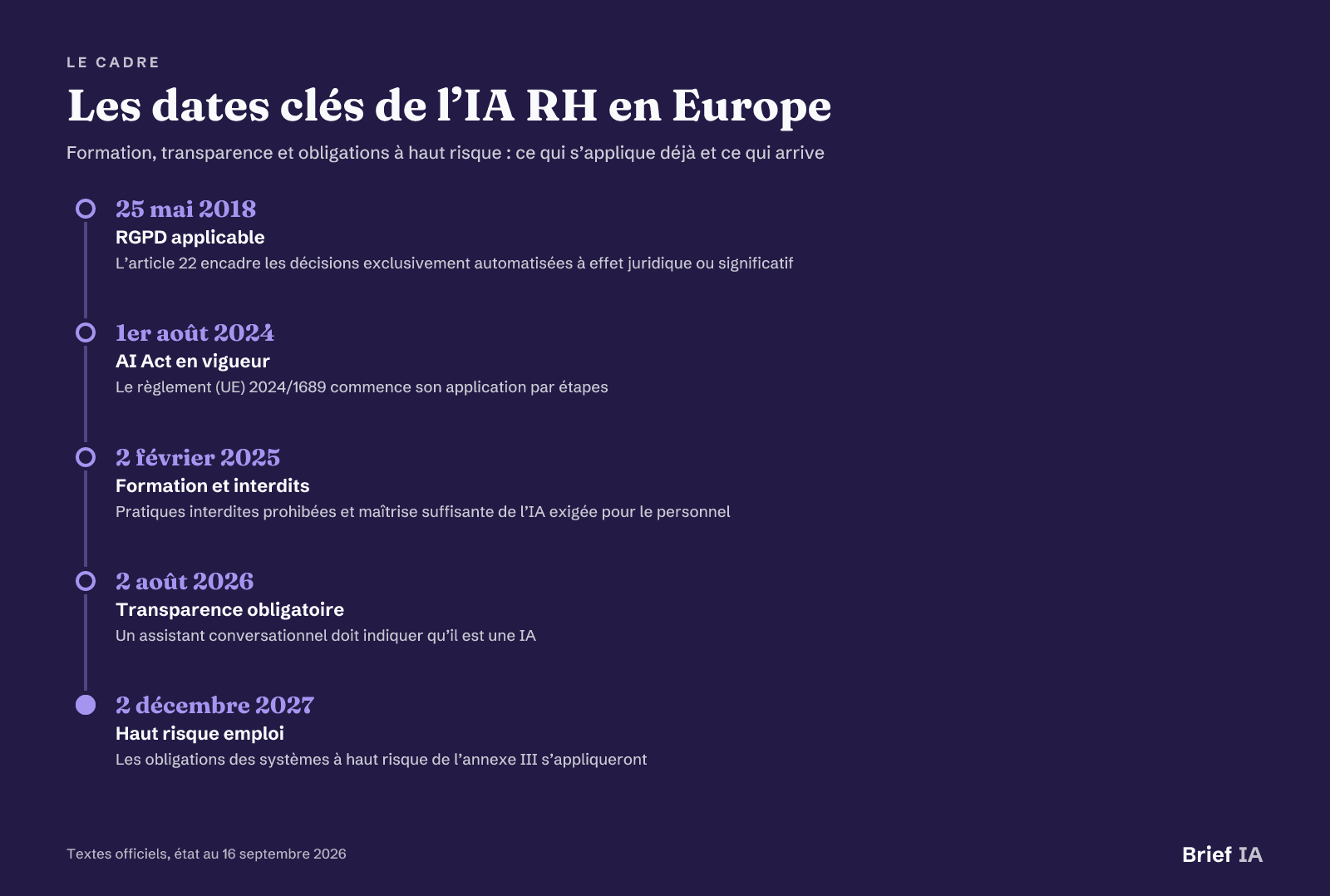
Key dates, status as of September 16, 2026.
AI Act: Three Obligations Already Active
Regulation (EU) 2024/1689 came into effect on August 1, 2024. Since February 2, 2025, prohibited practices are banned, and organizations using AI systems must ensure a sufficient level of AI proficiency among their staff. Since August 2, 2026, transparency obligations apply: a conversational assistant must indicate that it is an AI, and certain generated content must be labeled as such.
Employment: High Risk in 2027
AI systems used for recruitment, selection, promotion, dismissal, task allocation, evaluation, and monitoring of employees fall under Annex III of high-risk systems. Following the Digital Omnibus, published in the Official Journal on July 24, 2026, and effective from July 27, 2026, the corresponding obligations will apply from December 2, 2027. They do not yet apply as of September 16, 2026.
Prohibitions and Sanctions
Since February 2, 2025, the AI Act prohibits social scoring, manipulation exploiting vulnerabilities, and emotion recognition in the workplace and educational institutions, except for medical or security reasons. Sanctions can reach €35 million or 7% of global annual revenue for prohibited practices, €15 million or 3% for other obligations, and €7.5 million or 1% for inaccurate information.
GDPR and CSE
The GDPR has been in effect since May 25, 2018. Its Article 22 regulates decisions based solely on automated processing when they produce legal or significant effects on a person. In companies, the Labor Code also requires informing and consulting the social and economic committee when introducing new technologies. An AI HR project must therefore combine data protection, explanation of uses, and social dialogue.
Pitfalls to Avoid
Automating Decisions. A note should not become an automatic rejection. The GDPR regulates exclusively automated decisions with significant effects, and the obligations of high-risk employment systems under the AI Act will apply from December 2, 2027. The practical rule remains simple: AI advises, the recruiter decides.
Confusing Fluidity with Fairness. A faster process can be less fair if it eliminates atypical profiles, career changers, or less optimized resumes. Candidates also use AI to adapt their documents. Therefore, it is essential to test excluded profiles, compare results by type of background, and maintain criteria related to the position.
Forgetting the Candidate Experience. Context-free generated messages damage the relationship. Automated prequalification, flexible interviews, or standard rejections can be effective, but they must explain the next steps in the process, offer a human recourse, and avoid impersonal formulations. Time savings do not compensate for a loss of trust.
Underestimating Fake Profiles. Generative tools make it easier to produce resumes, responses, and fake identities. Checks must focus on proof of achievement, synchronous exchanges, and integration steps. They must remain proportionate to the risk of the position, especially for sensitive or remote-access roles.
Deploying Without Social Dialogue. Introducing a new technology in the company requires informing and consulting the CSE. Waiting for the tool to become widespread creates social and operational risks. The right time to involve employee representatives is during the framing: targeted uses, processed data, impacts on jobs, and planned training.
Taking Action: The 90-Day Plan
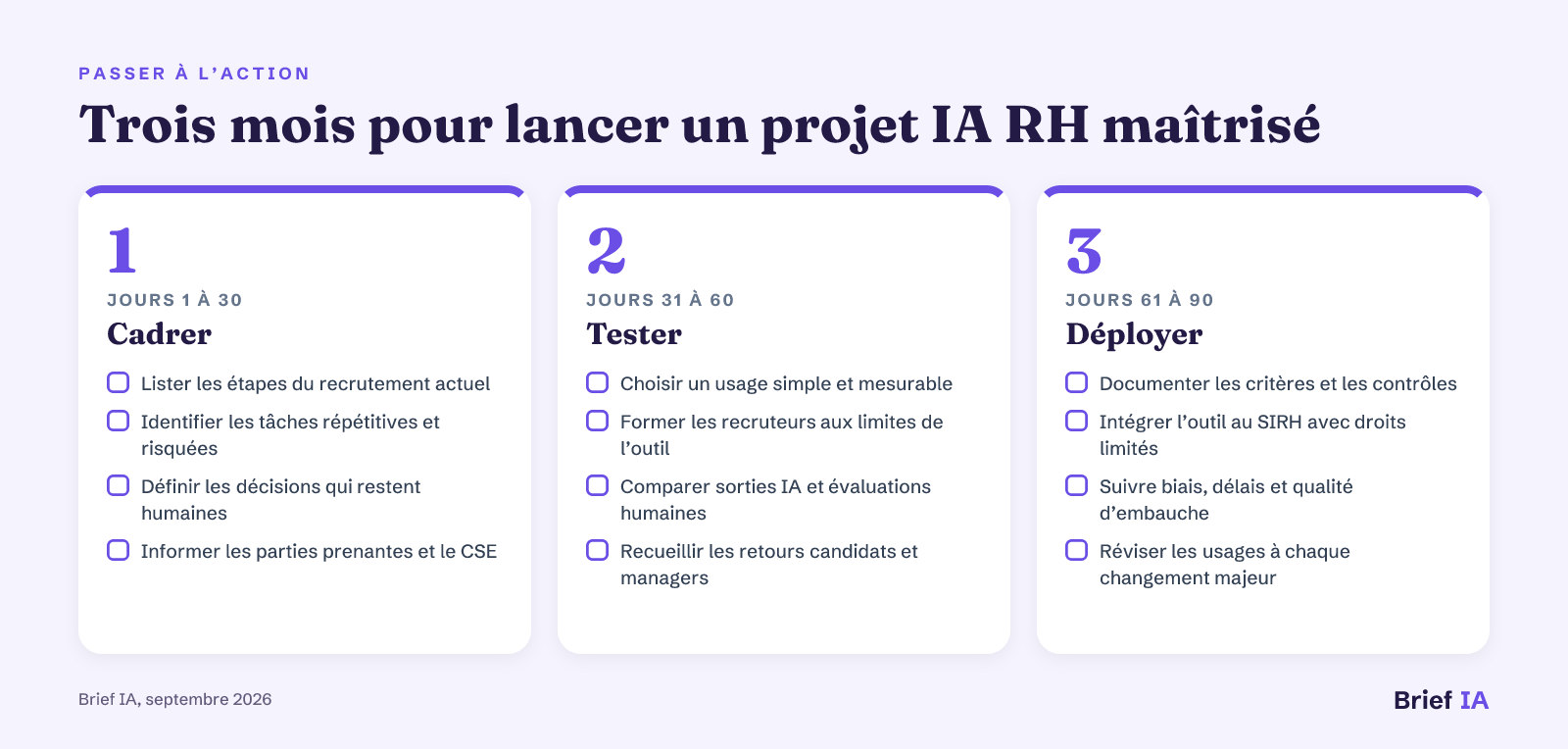
Three steps: frame, test, deploy.
Start with a single high-volume process, such as drafting job offers, profile searching, or scheduling. Over three months, map tasks, set human criteria, test on a few recruitments, and measure effects on timelines, application quality, and candidate experience. Our analysis on effective recruitment with AI reminds us that a project starts with the process, not the technology.
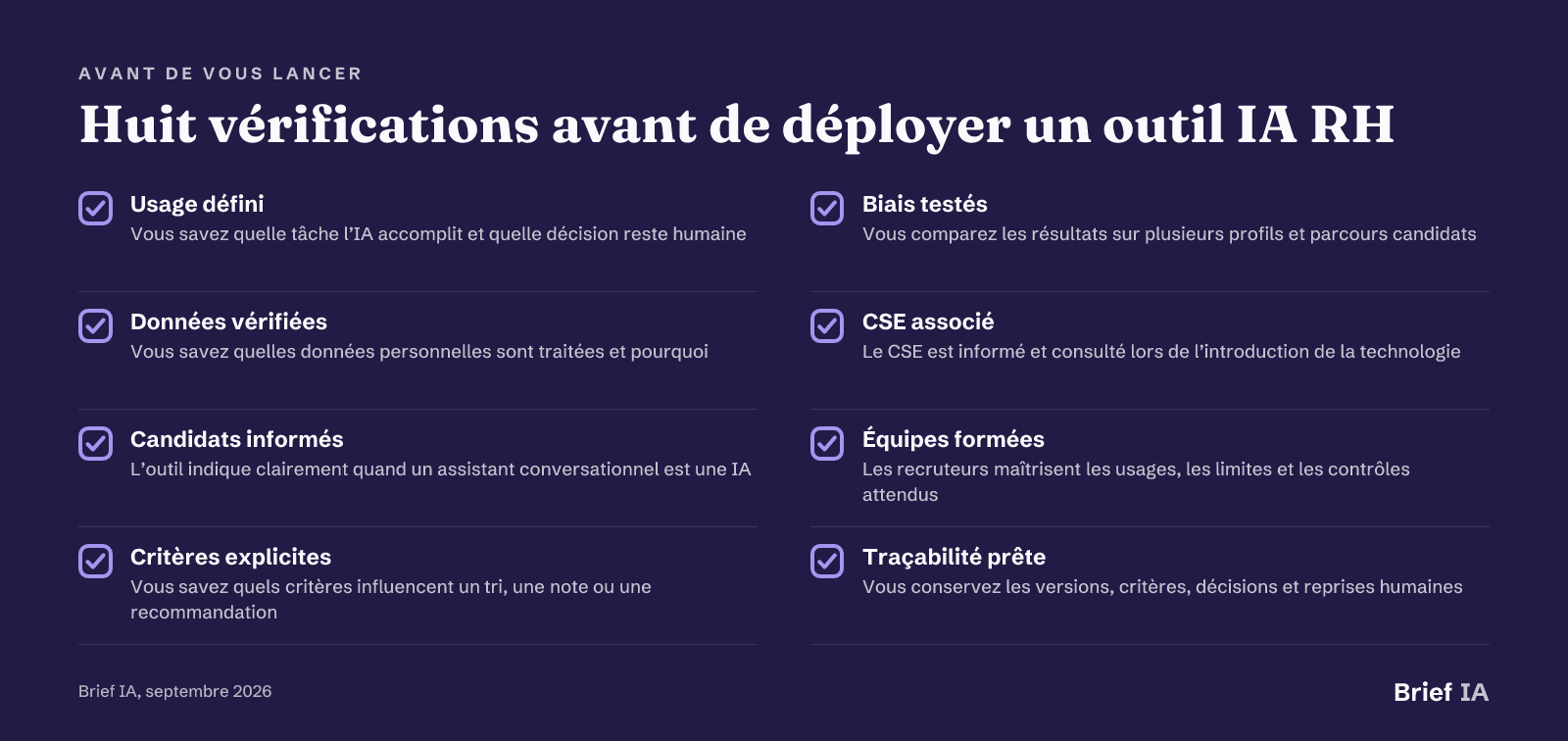
Eight checks to make before each new use.
Further Reading
Our analyses for HR professionals
- AI for HR: Recruitment, Training, and Talent Management. Here you will find an overview of HR uses, agents, and points of vigilance.
- Optimizing Recruitment with AI in 2026. Here you will learn how to map recruitment steps before choosing tools.
- What Talents Expect from AI-Assisted Recruitment. Here you will see why transparency and human decision-making matter in the candidate experience.
- Generative AI and Recruitment: What Really Changes. Here you will understand the effects on sorting, entry-level profiles, and job visibility.
- AI and Work Relationships: New Team Balances. Here you will find the impacts of AI on coordination, trust, and work organization.
- AI and Recruitment: Junior Profiles Under Pressure. Here you will follow signals regarding entry-level positions and expected skills from beginners.
Key News to Note
- Emergent uses ChatGPT to analyze interview transcripts
- AI and Recruitment: Tool Evaluation at the Center of the Bias Debate
- Welcome to the Jungle integrates a conversational AI into its platform
- General Motors lays off 600 IT employees to hire AI experts
- A Harvard-INSEAD study describes more senior AI startups
Do you provide a solution for human resources?
This guide is read by HR directors, recruiters, talent acquisition managers, and training managers. Brief IA offers HR solution providers, ATS, HRIS, training, and recruitment dedicated articles, evening brief inserts, and promotion in the directory. Formats and rates at briefia.fr/partenaires.
Essential Questions
How to Use AI in Recruitment Without Discrimination?
AI should be limited to clearly defined tasks, document the criteria used, test results on varied profiles, and maintain a human decision. The criteria must be job-related. Recruiters should check excluded profiles and be able to correct the tool. Since February 2, 2025, practices prohibited by the AI Act are banned.
Is a CV Sorting Tool Legal in France in 2026?
A CV sorting tool can be used, but it must not lead to an exclusively automated decision producing a significant effect without complying with Article 22 of the GDPR. The transparency obligations of the AI Act already apply to conversational assistants and certain generated content. The obligations specific to high-risk employment systems will apply from December 2, 2027.
Should Candidates Be Informed That an HR Assistant is an AI?
Yes. Since August 2, 2026, the transparency obligations of the AI Act apply. A conversational assistant must indicate that it is an AI. In a recruitment process, this information should be clear from the outset, especially if the assistant collects responses, guides the candidate, or prepares a prequalification.
What AI HR Uses Are the Safest to Start With?
The safest uses are those that produce writing, summarization, or organizational assistance without deciding the fate of a candidate or employee. Starting with job offers, follow-ups, reports, or scheduling allows teams to be trained and controls to be tested before addressing sorting or rating.
Must the CSE Be Consulted Before an AI HR Tool?
Yes, the Labor Code requires that the social and economic committee be informed and consulted when introducing new technologies in the company. For an AI HR tool, it is necessary to present the uses, processed data, expected effects on work, human controls, and planned training for the relevant teams.
Brief IA — L'actualité IA en français
L'essentiel de l'actualité de l'intelligence artificielle, décrypté et expliqué chaque jour.