AI in Healthcare: The 2026 Reference Guide for Doctors and Institutions

Every week, more than 300 million people ask health questions to ChatGPT, according to OpenAI. At the same time, a study published in Nature Medicine shows that participants assisted by a chatbot only identify the correct condition in 34.5% of cases. Between these two figures lies the entire question of AI in health: a powerful tool that is only as valuable as the usage made of it by professionals. This reference guide gathers what a doctor, a healthcare team, or a facility management must know: effective uses, tools, rules, pitfalls, and a plan to get started.
What AI is Already Changing in Care
AI has entered practices through two doors. The first is the patients: they arrive for consultations with a chatbot's response, sometimes with a reading of their own medical file. The second is the caregivers themselves. In the United States, 72% of doctors report using AI in their practice according to the American Medical Association, up from 48% in 2024.
What is truly changing is the amount of time spent on screens. A report prepared during the consultation, a letter drafted in seconds, a pile of messages sorted automatically: all these save minutes for the patient. Boston Children’s Hospital claims to have saved 60,000 hours thanks to around fifty automations.
In France, the Haute Autorité de santé published its "First Keys to the Use of Generative AI in Health" in October 2025. The message is pragmatic: to take ownership of these tools in a reasoned approach, while remaining in control of every decision.
 A radiologist examines X-rays annotated by AI
In imaging, AI acts as a second reader: the radiologist remains in control.
Effective Uses Today
 Map of AI uses in health
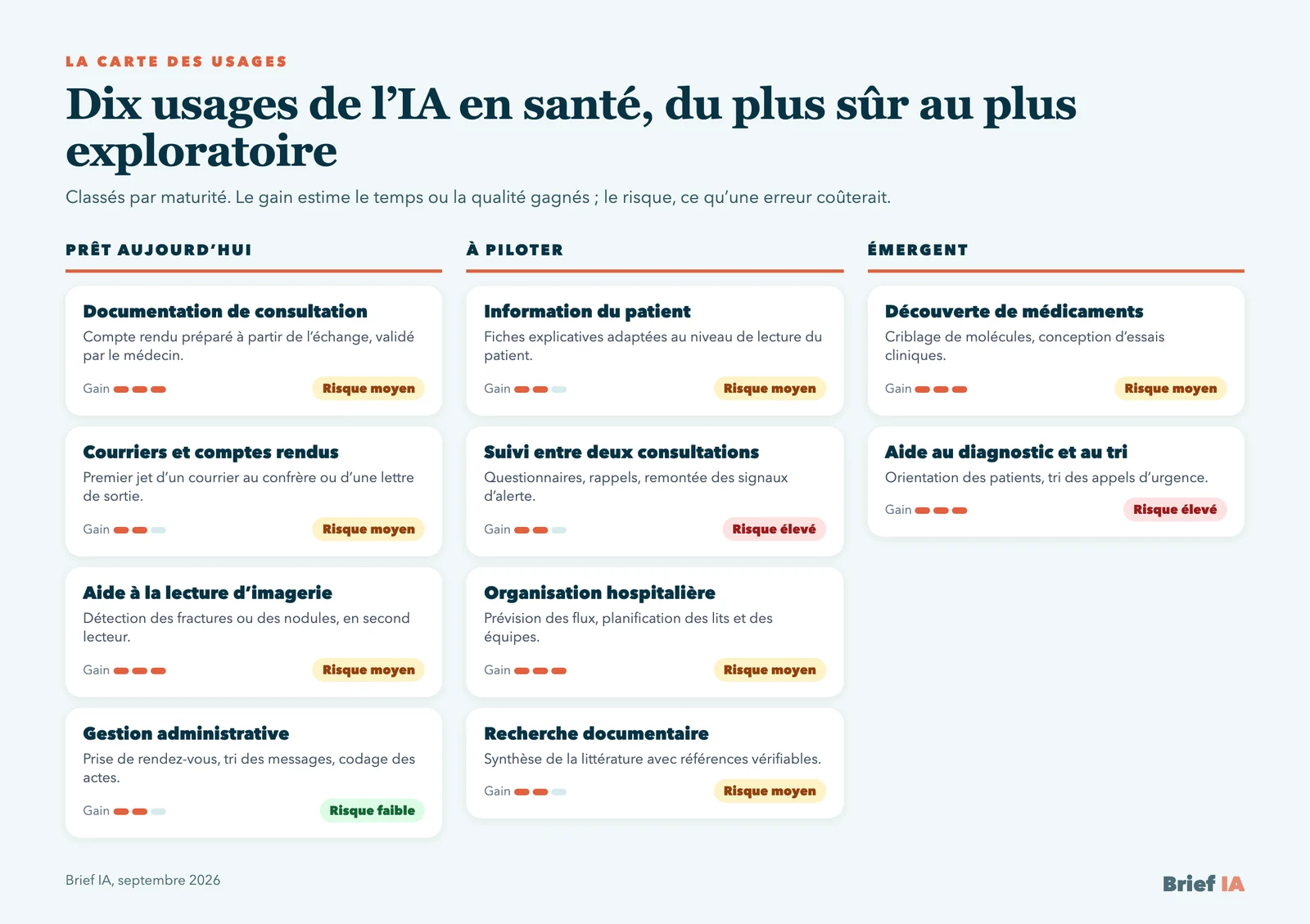
Ten uses classified by maturity, with expected gains and risks in case of error.
Ready-to-Use Applications
Consultation Documentation. Assistants listen to the exchange and prepare a report that the doctor reviews and validates. The Cleveland Clinic is testing five with 250 doctors. The quality of transcription is improving rapidly: in consultations conducted in German, a locally hosted solution correctly transcribed 91% of medical terms, compared to 82% for a general cloud service. The challenge remains the hosting of audio, which must stay within a certified framework.
Letters and Reports. Letters to colleagues, operative reports, discharge letters: AI provides a template that the professional corrects. The gain is immediate, and the risk is manageable as long as proofreading is systematic.
Imaging Reading Assistance. Detection of fractures, nodules, or mammographic anomalies: certified tools serve as a second reader. Expectations must remain realistic. In the United States, 59% of radiologists hoped for fewer callbacks in mammography thanks to AI; only 35% reported this outcome.
Administrative Management. Appointment scheduling, message sorting, coding of procedures: this is the safest area, as an error can be corrected without clinical consequences.
Uses to Pilot
Patient Information. Explanatory sheets tailored to each individual's reading level improve understanding, provided they are validated by the team.
Follow-Up Between Consultations. Telemonitoring increasingly relies on AI to detect warning signals. The MedicWise solution from Semeia monitors 35,000 patients across more than 500 facilities. The key question is organization: who receives the alert, and how quickly?
Hospital Organization. Predicting flows, planning beds and teams: the potential is significant, but management cites funding and return on investment as primary barriers.
Literature Research. Synthesizing literature saves hours, on one condition: verify each reference. An analysis published in The Lancet shows that fictitious citations have multiplied since 2023 in scientific literature.
Emerging Uses
Drug Discovery involves major laboratories, such as Novo Nordisk with AWS, but no quantified research gains have yet been published. Diagnostic Assistance is progressing in research: in a study published in Science involving 76 emergency patients, an OpenAI model made the correct diagnosis at triage in 67% of cases, compared to 55% and 50% for two doctors. These results are based on textual data, and no accountability framework currently accompanies these uses.
Tools to Know
The market evolves every month. Rather than a ranking, here are the main categories of tools and what to demand from each.
- Documentation Assistants, which listen to the consultation and prepare the report. Requirements: certified HDS hosting, proofreading before integration into the file, clear rules for audio deletion.
- Certified Imaging Solutions, used as a second reader in radiology or mammography. Requirements: CE marking, published validation studies, integration into reading software.
- Clinical Research Assistants, which answer a question by citing their references. Our comparison between Vera Health and Doctolib shows the difference between a clinical verification tool and a practice management tool. Requirements: verifiable references and clear regulatory status.
- Patient Orientation Assistants. In France, Alan has deployed its assistant to 800,000 insured individuals, and Doctolib's assistant refuses to make a diagnosis during a test conducted by AFP. Requirements: limited scope and systematic referral to a professional.
- Generalist Assistants like ChatGPT, Claude, or Le Chat de Mistral: useful for drafting or researching, but to be avoided for patient data outside a certified framework. In the United States, ChatGPT can now read a patient's medical record in read-only mode; this is not the case in Europe.
The Framework: Data, HAS, and AI Act
 Regulatory timeline for AI in health
Le brief IA que les pros lisent chaque soir
Les 7 actus IA du jour, décryptées en 5 min. Gratuit.
Inclus dès l'inscription : notre sélection des meilleurs guides & comparatifs IA.
Choisissez votre rythme
Gratuit · Pas de spam · Désabonnement en 1 clic
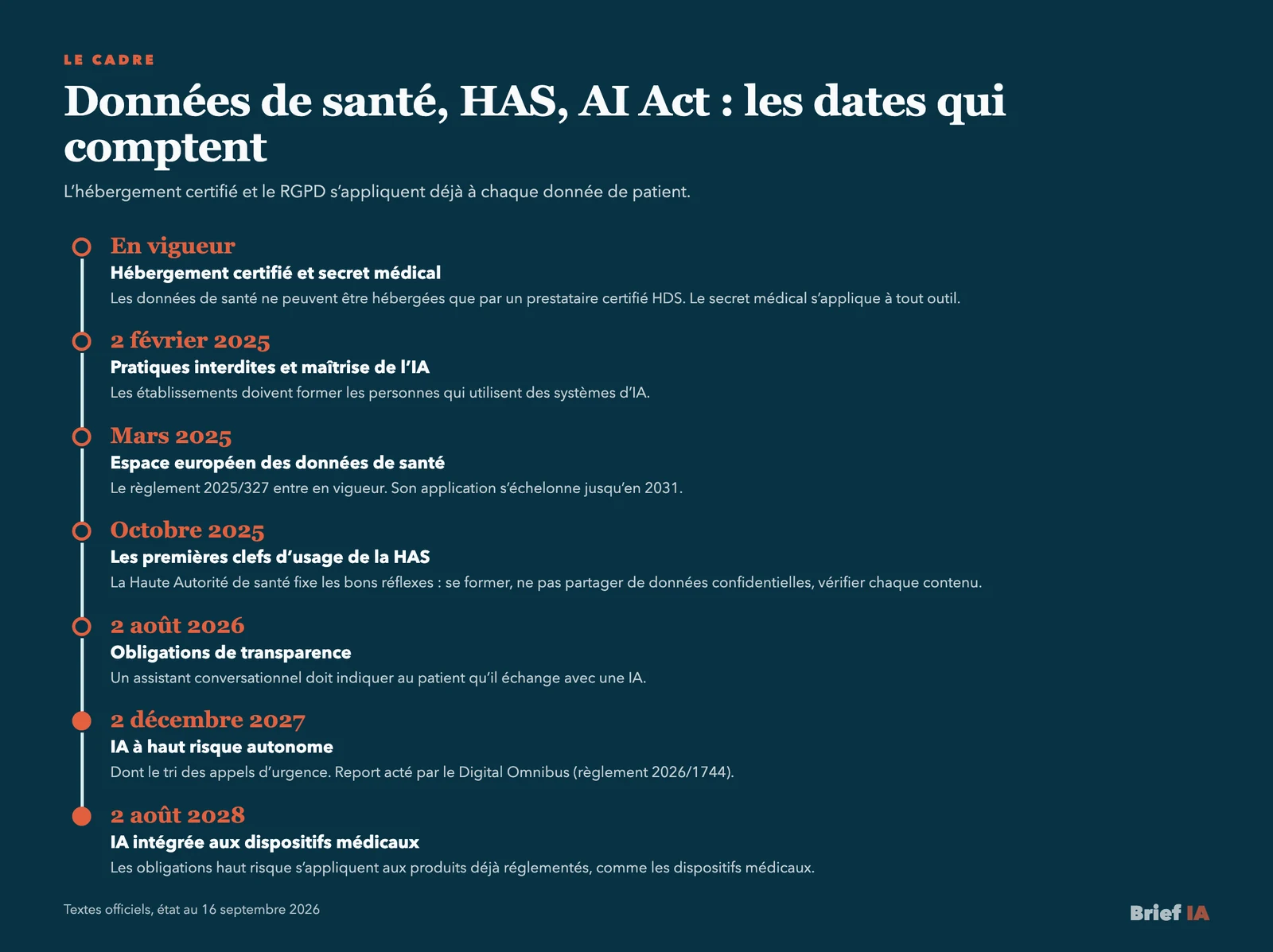
Key dates, from certified hosting to AI in medical devices.
Health Data
Health data can only be hosted by a certified HDS provider, and medical confidentiality applies to all digital tools. The GDPR classifies them as sensitive data. Sovereignty has become a standalone issue: in April 2026, the Health Data Platform chose the French host Scaleway to move away from Microsoft. Read our article on this choice.
HAS Recommendations
The HAS guide from October 2025 invites each professional to train in the functioning of the tools, not to share confidential information, to consider each generated content as a proposal that may contain errors, and to be transparent with patients.
Medical Devices
Software intended to make a diagnosis, guide treatment, or triage patients is generally subject to the European regulation on medical devices and must bear a CE marking. Several publishers of consumer tools specify that their results "do not constitute medical diagnoses."
The AI Act
Since February 2, 2025, establishments must train individuals who use AI systems. From August 2, 2026, a conversational assistant must inform the patient that they are interacting with AI. High-risk autonomous AI systems, such as emergency call triage, will be subject to their obligations on December 2, 2027. AI integrated into already regulated products, such as medical devices, will follow on August 2, 2028, after the postponement decided by the Digital Omnibus. Our complete overview of the AI Act timeline.
The European Health Data Space
Effective March 2025, Regulation 2025/327 organizes the sharing of health data in Europe and its reuse for research. Its application will extend until 2031.
Pitfalls to Avoid
The Patient Alone with the Chatbot. In the Nature Medicine study, participants assisted by a chatbot found the correct course of action only 44.2% of the time. Legal proceedings have already been initiated in the United States after erroneous medical advice. Discussing the tools patients use has now become part of the consultation.
Overconfidence in Models. In a demanding radiology test, radiologists scored 988.7 out of 2,000, compared to 758 for the best model, which was nonetheless very confident. An assured response is not necessarily a correct response.
Invented References. An article, recommendation, or study cited by AI must always be traceable to its source.
Publisher Statistics. OpenAI claims that 99.1% of its evaluated health assistant responses are safe. This is a publisher's figure, not an independent assessment. In the United States, 65% of hospitals use predictive AI, but only two-thirds of them have evaluated its accuracy.
Silence Towards the Patient. According to the Pew Research Center, 72% of American patients want to be informed when AI is involved in their care, and 47% do not know if this is already the case.
Mental Health. Deaths have been documented after prolonged exchanges with chatbots. This is the area where vigilance must be the highest.
Data Reuse. Doctolib's research project with Inria, Inserm, and the University of Paris Cité has raised concerns, particularly from the League of Human Rights. Any project of this type must allow the patient to easily oppose it.
Taking Action: The 90-Day Plan
 90-day plan to integrate AI into a practice or healthcare facility
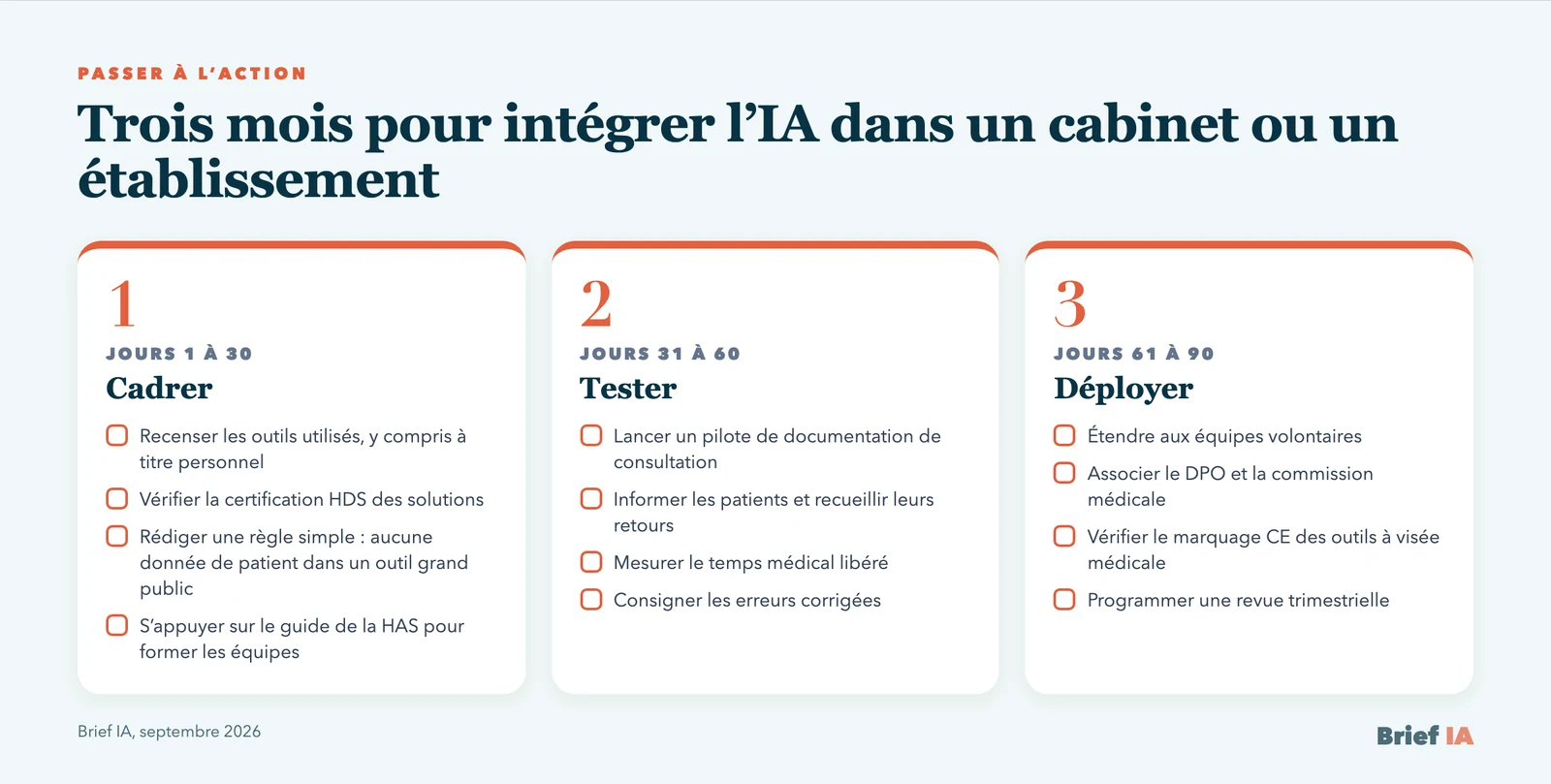
Three steps: frame, test, deploy.
The safest starting point is documentation: it frees up medical time without affecting clinical decision-making. One month to frame, one month to test with a willing team, one month to expand what works, involving the data protection officer and the medical commission.
 Checklist before using AI with patients
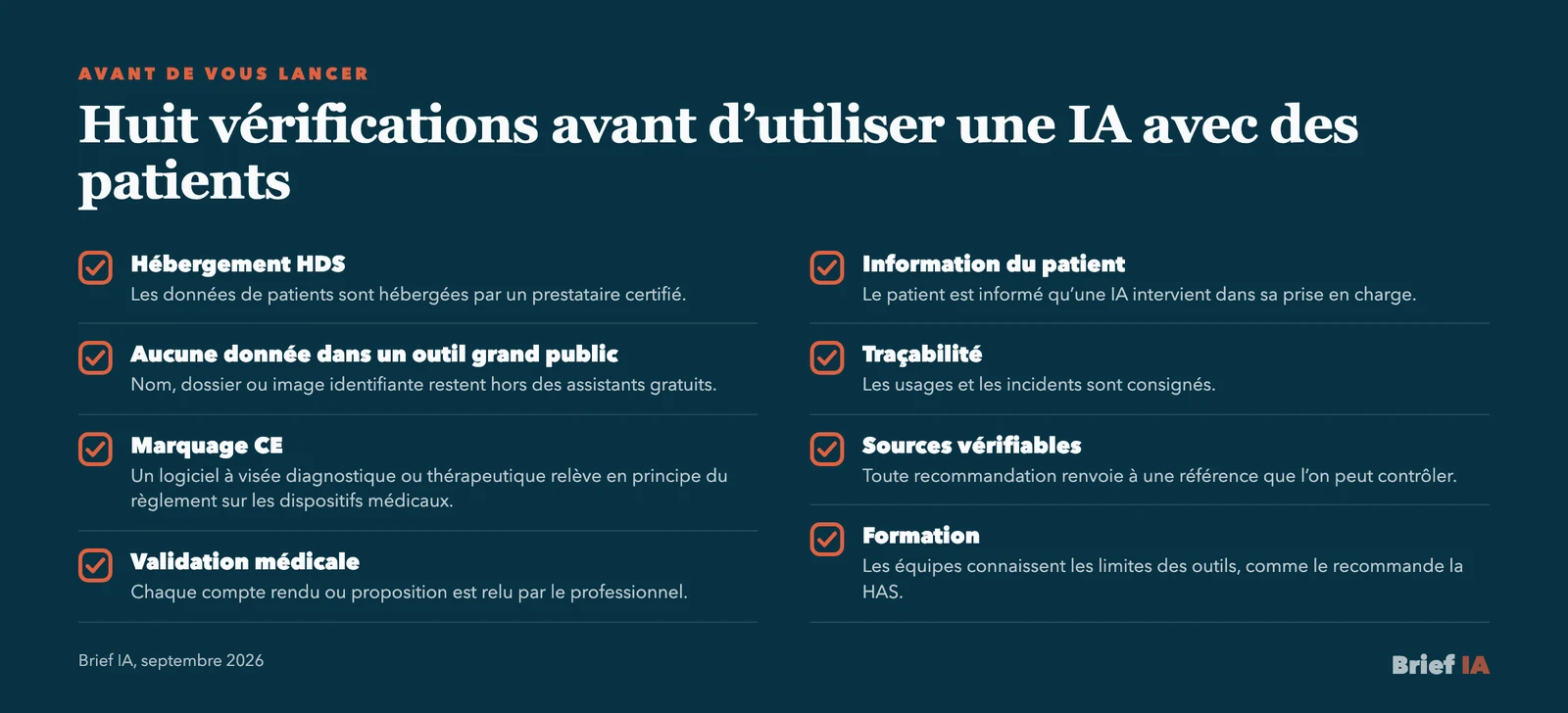
Eight checks to perform before each new use.
For Further Reading
Our analyses for healthcare professionals
- Rare Diseases: What AI Changes for Diagnosis and Trials. The reanalysis of unresolved cases has led to an additional 4.8% of diagnoses, all validated by clinicians.
- The Organizational Challenges of AI in Hospitals. Mapping tools, classifying them, then piloting one or two uses with indicators.
- Supporting Patients Between Consultations. Start with dictation and reports, reserving diagnosis for certified devices.
- Novo Nordisk and AWS: AI in Drug Discovery. What is confirmed, and what remains to be proven.
- Vera Health or Doctolib: Which Tool for Which Need. Verify a clinical question or manage the practice.
Key News to Note
- Chatbots Miss More Than Half of Diagnoses
- A Harvard Study Compares AI and Doctors in Emergency Care
- Cleveland Clinic Tests Documentation Assistants
- Medical Transcription: The Advantage of Locally Hosted Models
- In the United States, 72% of Patients Want to Be Informed About AI Use
- Invented Citations by AI in Medical Literature
Do you edit a health solution?
This guide is read by doctors, healthcare teams, and facility management. Brief IA offers health solution publishers dedicated articles, sections in the evening brief, and promotion in the directory. Formats and rates at briefia.fr/partenaires.
Key Questions
Can a doctor use ChatGPT in their practice?
Yes, with caution. The HAS recommends training, not sharing any confidential information, and verifying each produced content. For anything related to patient data, a tool hosted by a certified HDS provider is essential.
What AI uses are the safest for a caregiver?
Consultation documentation, letters, and administrative management: they free up time without intervening in clinical decision-making, and each content is reviewed by the professional.
Should a diagnostic assistance AI tool be certified?
In principle, yes. Software intended to make a diagnosis or guide treatment falls under the European regulation on medical devices and must bear a CE marking. The AI Act will add its own obligations starting August 2, 2028.
What does the AI Act say for health?
Training of users since February 2025, transparency of conversational assistants since August 2026, obligations for high-risk autonomous AIs, such as emergency call triage, in December 2027, and then for AI in medical devices in August 2028.
Should patients be informed of AI use?
This is a recommendation from the HAS and a strong expectation: in the United States, 72% of patients want to be informed when AI is involved in their care.
Brief IA — L'actualité IA en français
L'essentiel de l'actualité de l'intelligence artificielle, décrypté et expliqué chaque jour.