AI and Copyright: The 2026 Reference Guide

Researchers examined over 14,000 ebooks sold on Amazon between 2023 and 2026: titles containing AI-generated text are multiplying, while books without detected AI-generated text are losing market share. For creators, publishers, and legal professionals, AI is no longer just a production tool. It alters proof, negotiation, distribution, and the risk of copying. This guide reviews the effective uses, tools, rules, pitfalls, and a plan to get started.
What AI Really Changes for Creators and Publishers
AI accelerates production, but it primarily shifts value towards traceability. A cover, illustration, summary, or synthetic voice must now be accompanied by an exploitable history: instructions, drafts, corrections, human validation, tools used, entry rights, and exit rights. Our analysis on copyright strategies in the face of AI emphasizes this reflex: a creation that is difficult to prove becomes more fragile in negotiation or litigation.
Publishers are also seeing their distribution change. AI response and summary engines can capture attention before the click, while lawsuits multiply around model training. In U.S. cases, OpenAI invokes fair use and implicit licenses via robots.txt, while publishers demand compensation and control. Our analysis on training AI with protected content shows why access, blocking, and licensing choices must be arbitrated together.
The third change concerns visible transparency. Since August 2, 2026, the transparency obligations of the AI Act apply: a conversational assistant must indicate that it is an AI, and certain generated content must be marked as such. For a media outlet, publishing house, or studio, reporting becomes an editorial process, not just a technical adjustment. Our analysis on watermarks and reporting helps distinguish public mention, metadata, and human control.
 Editors and illustrators review manuscripts and proofs in a publishing house.
Before publishing with AI, rights must be verified page by page.
Effective Uses Today
The best uses are those that reduce uncertainty: better identifying rights, better tracing decisions, better choosing content entrusted to models. More sensitive uses should remain contractualized, tested, and revised.
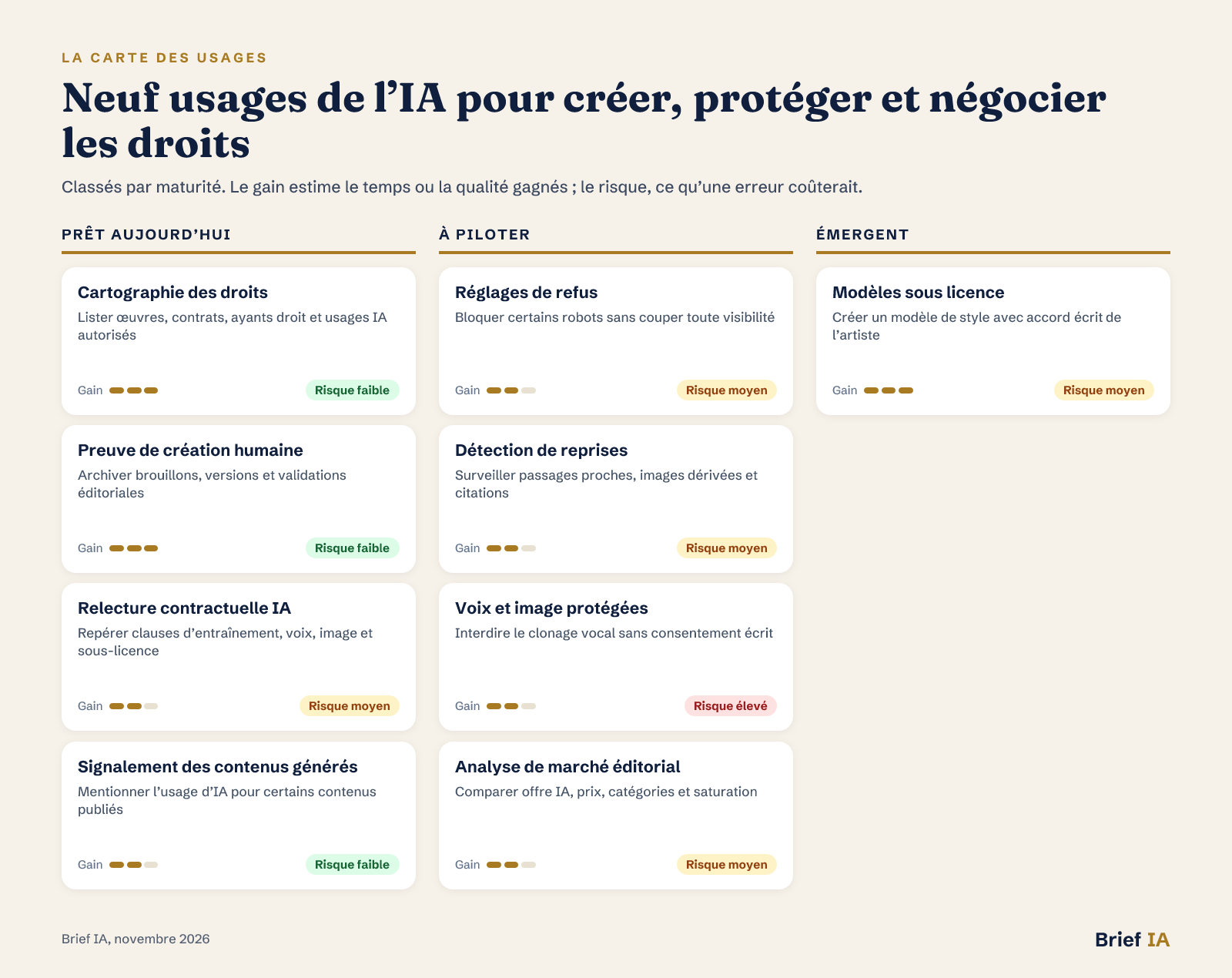 Map of AI uses for creators, publishers, and their legal teams
Uses classified by maturity, with expected gain and risk in case of error.
Ready-to-Use Applications
Rights Mapping. Start by inventorying texts, images, covers, voices, databases, trademarks, illustration contracts, and licenses. The goal is simple: know what can be used for research, summarization, training, adaptation, or promotion. A useful mapping associates each asset with a holder, duration, territory, permitted uses, and AI-related restrictions.
Proof of Human Creation. Organize a creation log for AI-assisted works. It should show human decisions: brief, selection of tracks, rewriting, edits, editorial arbitration, rejection of weak outputs, and final validation. This method serves both creators and publishers, as it transforms a diffuse process into verifiable elements during a transfer, audit, or dispute.
AI Contract Review. Review commissioning, publishing, platform, and distribution contracts with an AI checklist. Look for training permissions, derivative content generation, voice cloning, metadata reuse, and sublicensing. When the contract is silent, add an amendment rather than letting technical practices decide for the parties.
Reporting Generated Content. Define a simple policy: when AI has generated or modified content intended for the public, the team knows whether a visible mention, metadata, or both are necessary. Since August 2, 2026, certain transparency obligations apply. The right reflex is to document the tool, the share of generation, human validation, and the formulation presented to the reader.
Uses to Manage
Rejection Settings. Rejection settings should be treated as a distribution decision. For a publisher, blocking access from certain systems can protect a catalog but also reduce exposure in AI interfaces. Track classic research, generative responses, training, and content reuse separately. The lawsuits against OpenAI and Microsoft illustrate the importance of these arbitrations in the press facing licenses and fair use.
Detection of Reuses. Implement monitoring for textual, visual, and vocal reuses on priority channels: marketplaces, social networks, response engines, video platforms, and bookstores. The tool does not decide alone. It signals similarities, then a qualified human assesses the risk, documents prior art, contacts the platform, or prepares a contractual or legal action.
Protected Voices and Images. For audio authors, narrators, actors, photographers, and children's publishers, voice and image require separate treatment. Contracts must specify whether voice synthesis, imitation, automated dubbing, promotional use, and derivative creations are permitted. Without a clear agreement, it is better to exclude these uses and plan for renegotiation for each project.
Editorial Market Analysis. AI can also be used to read the market, provided that the analyzed works are not copied. Publishers can track saturation signals and the evolution of supply to adjust their positioning. Researchers examined over 14,000 ebooks sold on Amazon between 2023 and 2026 and observed a multiplication of titles containing AI-generated text, with a decline in books without detected AI-generated text.
Emerging Uses
Licensed Models. Models trained on an authorized style or corpus open a new avenue: the artist or publisher no longer sells just a work but a usage right framed by the corpus. Key points to establish include compensation, duration, prohibited uses, quality control, model cessation, and audit possibilities.
Tools to Know
There is no universal ranking: choose families of tools based on the rights handled, the data entrusted, and the expected proof.
- Intellectual Property Mapping Tools. These help inventory works, contracts, licenses, rights holders, and usage restrictions. In tech startups, AI is already used to accelerate patent searches and refine trend analysis. Requirements: data export, change log, customizable rights fields, role-based access.
- Creation and Rewriting Assistants. They speed up drafts, text variants, summaries, and communication materials. They should be reserved for content you can entrust to them and integrated into a documented human validation process. Requirements: non-reuse of inputs, version history, available reporting, clear exit conditions.
- Reporting and Provenance Systems. They add mentions, metadata, or watermarks to AI-generated or modified content. Since August 2, 2026, the transparency mandated by the AI Act makes this component operational for the relevant content. Requirements: machine-readable provenance, configurable visible mention, timestamp, integrity proof.
- Access Control and Robots Tools. They manage what platforms and robots can consult or reuse. For publishers, they should be linked to licensing choices, traffic statistics, and distribution strategy. Requirements: domain-based settings, robot tracking, activation logs, documentation of expected effects.
- Locally Executed Open Weight Models. Running a model locally can keep data on your devices and avoid a subscription, as highlighted by recent news on open weight AI models. This choice does not eliminate questions of licensing, security, and safeguards. Requirements: verified license, isolated environment, tracked updates, data leak tests.
Le brief IA que les pros lisent chaque soir
Les 7 actus IA du jour, décryptées en 5 min. Gratuit.
Inclus dès l'inscription : notre sélection des meilleurs guides & comparatifs IA.
Choisissez votre rythme
Gratuit · Pas de spam · Désabonnement en 1 clic
The Framework: AI Act, Copyright, and Personal Data
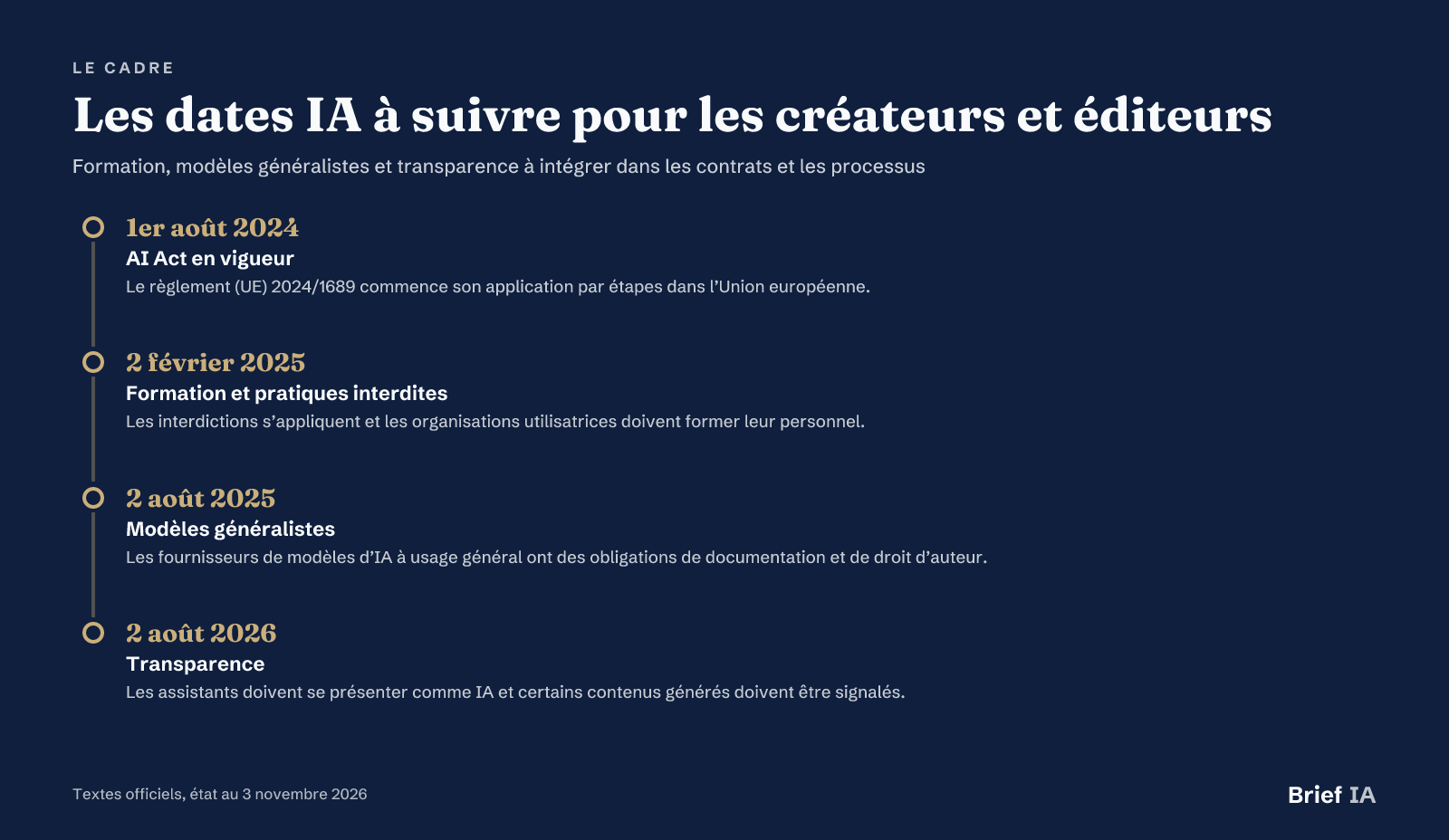 Key AI dates to follow for creators and publishers
Key dates, status as of November 3, 2026.
Ordinary Editorial Uses
Regulation (EU) 2024/1689 came into effect on August 1, 2024, and applies in phases. For writing and summarization tools without high-risk use, only general obligations apply: training and transparency. Since February 2, 2025, any organization using AI systems must ensure a sufficient level of AI proficiency among its staff. Prohibited practices expose organizations to penalties of up to 35 million euros or 7% of annual global revenue.
Generalist Models
Since August 2, 2025, providers of general-purpose AI models have their own obligations, particularly regarding documentation and copyright. For a publisher or creator, this does not replace contracts but changes the requests to be addressed to suppliers: copyright compliance policy, available information on data, and guarantees on the reuse of entrusted content.
Reporting Generated Content
Since August 2, 2026, transparency obligations apply. A conversational assistant must indicate that it is an AI, and certain generated content must be reported as such. For a publisher, this imposes a clear circuit: identify the relevant content, choose an understandable mention, retain proof of the process, and verify that the provider supplies the necessary technical means.
Identifiable Persons and GDPR
The GDPR has been in effect since May 25, 2018. Its Article 22 regulates decisions based solely on automated processing that produce legal or significant effects on a person. In creative projects, this vigilance mainly concerns images, voices, testimonials, subscriber data, community contributions, and content involving identifiable persons.
Pitfalls to Avoid
Confusing Output and Rights. A text, image, or voice generated quickly is not automatically exploitable. Check entry rights, tool conditions, reuse restrictions, and human validation before any commercial publication.
Leaving Default Options. Several platforms shift the burden of rejection onto creators. A default-enabled setting may allow content usage for AI. Regularly audit accounts, team spaces, privacy options, and modified conditions.
Reporting Without Explanation. A technical watermark does not replace a comprehensible mention when the public needs to be informed. Prepare simple, consistent, and legally validated formulations to avoid disparate mentions between editorial, marketing, and product teams.
Publishing Too Quickly. News about AI-generated ebooks on Amazon shows that the multiplication of affected titles feeds a risk of saturation. Speed does not compensate for a weak editorial line, absent proof, or unproofed quality.
Forgetting Third-Party Works. An AI project can integrate text, image, music, voice, reader contributions, and platform data. If each layer has a different holder, a single misidentified right can block exploitation, sale, or adaptation.
Taking Action: The 90-Day Plan
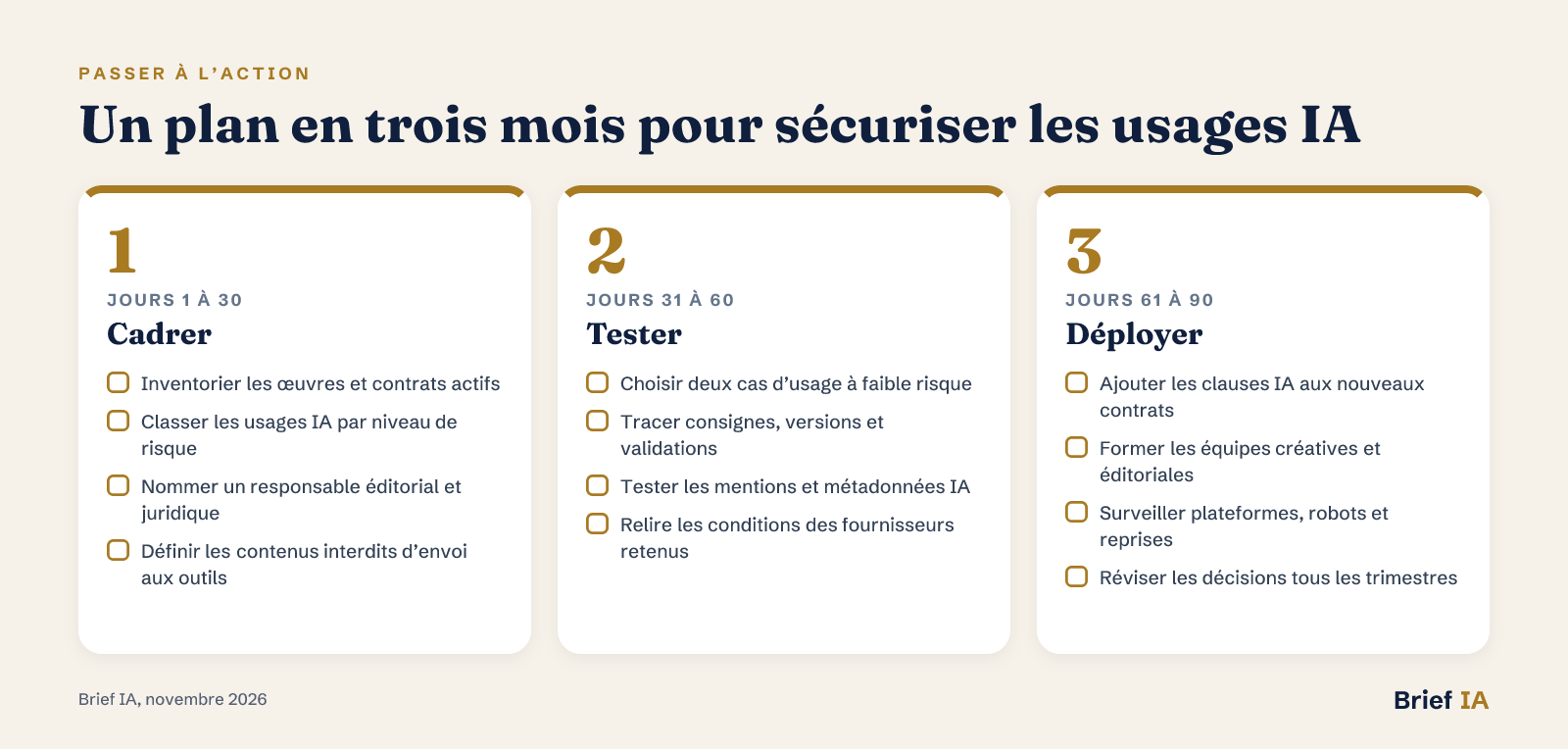 A three-month plan to secure AI uses
Three steps: frame, test, deploy.
Start with a tight inventory of works, contracts, tools, and platforms. During the first month, classify AI uses by risk and cut undocumented practices. In the second month, test two simple cases with a creation log, mentions, and legal validation. In the third month, deploy only proven processes, with named responsible parties, standard clauses, rejection control, and periodic review.
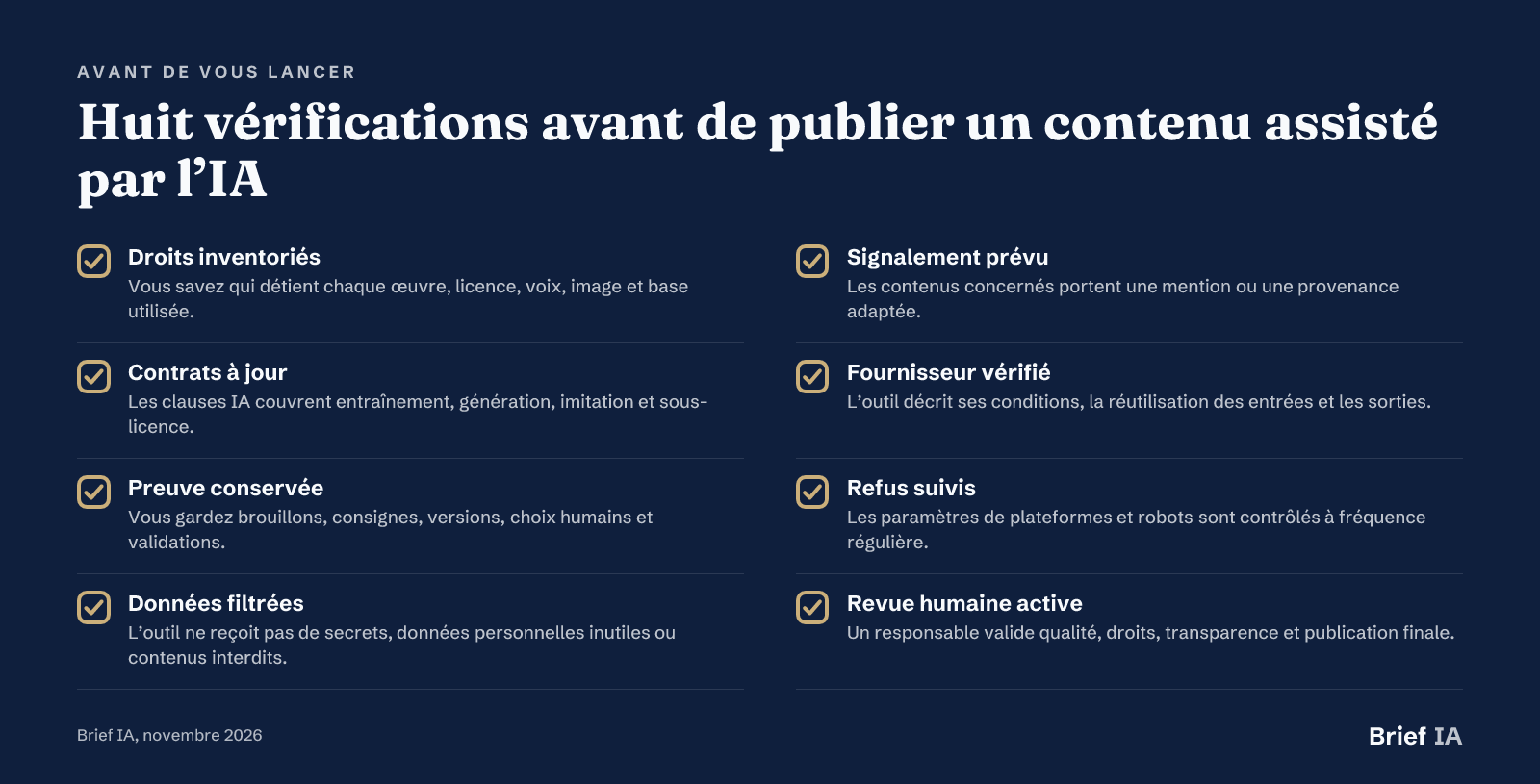 Eight checks before publishing AI-assisted content
Eight checks to perform before each new use.
Further Reading
Our analyses for creators, publishers, and their legal teams
- Five strategies to secure copyright in the face of AI. How to organize proof of creation, contracts, and tool choices when AI is involved in production.
- Optimizing intellectual property with AI. A method for mapping intangible assets, internal data, licenses, and supplier risks.
- Training AI on protected content. The arbitrations between licenses, rejection settings, platform rules, and exploitation of protected corpora.
- Watermarks and reporting generated content. What reporting and watermarks change for product, editorial, and legal teams.
- Protecting a voice against AI cloning. Contractual and operational reflexes for artists, narrators, audio publishers, and producers.
- What licensed artist models change. Why consented training on a style can become a new format for creative licensing.
Key News to Note
- Press and AI: licenses and fair use before the judge
- Seattle Times and Newsday sue OpenAI and Microsoft
- Summer of AI: content reporting, advertising in ChatGPT, and SEO
- AI-generated ebooks on Amazon: multiplication of titles and decline of others
- Anthropic and the marking of AI outputs: the Thompson debate
- Open weight models: local control, licenses, and security
Are you publishing a solution for creation, publishing, and rights management?
This guide is read by creators, publishers, legal professionals, and editorial management. Brief IA offers publishers solutions for rights management, assisted creation, and AI compliance with dedicated articles, evening brief inserts, and promotion in the directory. Formats and rates at briefia.fr/partenaires.
The Essentials in Questions
Can AI be used to create a book cover?
Yes, if the process is framed. Check the tool's conditions, commercial reuse rights, absence of confidential data in the instructions, and the need for reporting. Keep the creation steps, human choices, and validations. For a strategic cover, prefer an explicit contract with the illustrator or studio.
How to prove that a work is not solely generated by AI?
Maintain a creation file: brief, sketches, instructions, intermediate versions, comments, corrections, source files, and final validation. The goal is not to accumulate unnecessary captures but to show human decisions. This proof serves in negotiation, rights audits, and in case of disputes by a partner or platform.
Should all content produced with AI be reported?
Since August 2, 2026, transparency obligations apply: a conversational assistant must indicate that it is an AI, and certain generated content must be reported as such. In practice, define an internal rule by content type, target audience, and degree of AI intervention, then apply it consistently.
Should a publisher block AI robots?
Not automatically. Blocking can protect certain content, but it can also reduce exposure in search or response services. The right approach is to distinguish between classic research, training, generative summarization, and commercial reuse. Each choice must be documented, linked to the licensing strategy, and revised based on observed effects.
Are local AI models safer for a catalog?
They can reduce certain risks, as data remains on your machines if the installation is well managed. But they do not resolve everything: model licensing, security, updates, safeguards, and output quality still need to be verified. A local model must therefore undergo the same legal and editorial examination as an online service.
Brief IA — L'actualité IA en français
L'essentiel de l'actualité de l'intelligence artificielle, décrypté et expliqué chaque jour.