AI for Film and Audiovisual: The 2026 Reference Guide

Netflix indicated that generative AI workflows were used on approximately 300 titles in 2026, primarily in post-production. This figure summarizes the shift in cinema and audiovisual production: AI is no longer just a demonstration tool; it is entering the production chains, from concept to visual effects. However, fully generated productions remain rare, costly to control, and legally sensitive. This guide details the successful applications, tool families, rules to follow, operational pitfalls, and a plan to get started without losing artistic control.
What AI Really Changes for Cinema and Audiovisual
AI primarily changes the speed of exploration. A team can compare atmospheres, sets, palettes, or camera movements more quickly before renting a studio or mobilizing VFX. In our analysis of Netflix and the 300 AI-assisted titles, the most telling case remains the massive use in post-production: crowds, establishing shots, historical reconstructions, and visual effects. The value lies not in total automation but in the controlled multiplication of options before human validation.
The second disruption concerns the production chain. AI tools require a clear sheet: relevant scenes, tools used, elements belonging to rights holders, individuals whose image or voice may be reproduced, deliverables, and validations. This discipline prevents treating a generated draft as a final shot. It also allows for distinguishing reversible trials from binding decisions: shooting, rights acquisition, publication, crediting, delivery to a channel or platform.
The third evolution is industrial. Disney and Adobe announced a multi-year alliance on November 9, 2026, around Firefly Foundry, with early access to Firefly, Premiere, and Photoshop, and dedicated resources for production workflows. Our analysis of Disney and Adobe's custom AI models highlights the stakes: moving from generalist models to systems capable of respecting protected characters, environments, and visual styles.
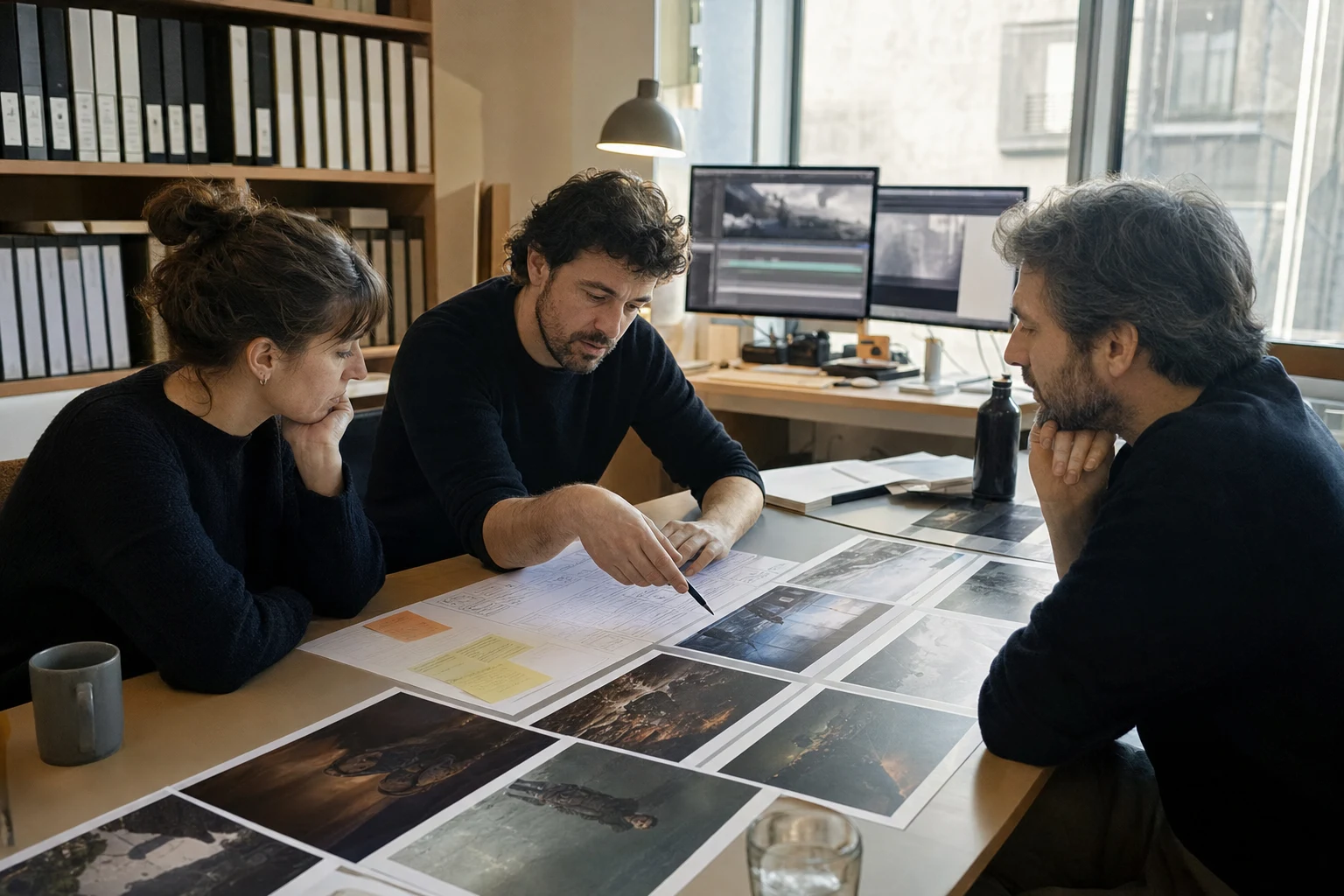 Post-production team comparing AI shots and continuity notes.
AI accelerates trials, but validation remains a production decision.
Successful Applications Today
The most robust applications are those that accelerate a specific step without deciding for the director, producer, or post-production supervisor. The more AI touches on image, voice, or a person's identity, the more documentation must be maintained.
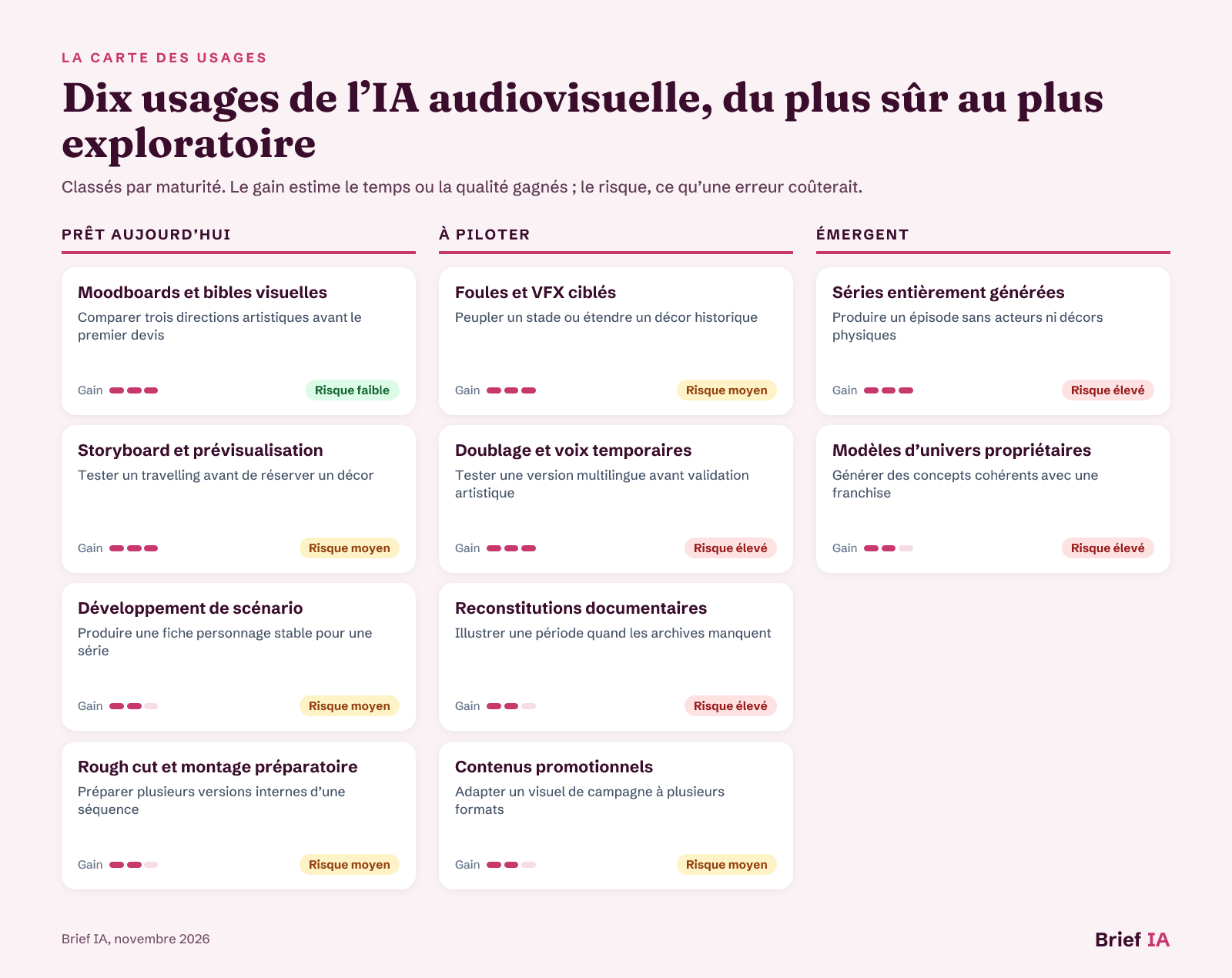 Map of AI applications for Our analyses for producers, directors, studios, channels, platforms, and post-production teams
Applications categorized by maturity, with expected gains and risks in case of error.
Ready-to-Use Applications
Moodboards and visual bibles. Creating quick visual references helps the director, cinematographer, and production designer discuss concrete images. Midjourney, Firefly, Runway, Google Veo, and Luma Dream Machine are cited in our analysis of AI tools for film preproduction. The use remains safe if each image is annotated: light, texture, scale, movement, feasibility, and legal status.
Storyboarding and pre-visualization. Transforming a written scene into reference shots allows for identifying staging difficulties before filming. Runway is used to explore movements, atmospheres, and complex sequences, without being presented as a generator of final shots for blockbusters. The method involves producing short clips, then deciding what will be filmed, animated, or handed over to VFX.
Script development. A text assistant can help structure a synopsis, a series bible, character sheets, or dialogue variations. It should not solely determine the perspective of a scene, the dramatic progression, or the continuity of a character. Best practice is to lock in the narrative intent before any video generation, then keep validated versions as production documents.
Rough cut and preparatory editing. Preparatory editing, rhythm variations, and certain visual adjustments lend themselves well to AI when the editor retains the final decision. Professional productions are already using AI for rough cuts and some post-production elements. The goal is to reduce repetitive manipulations, not to delegate the meaning of a cut, emotional progression, or coherence of a sequence.
Applications to Manage
Crowds and targeted VFX. Netflix cites uses in stadium scenes, battle shots, historical reconstructions, and establishing shots. Ted Sarandos indicated that The American Experiment contained about 17 minutes of AI-generated visual material, produced "twice as fast and at half the cost" of traditional methods. These gains require a VFX supervisor, acceptance criteria, and traceability of generated shots.
Dubbing and temporary voices. AI dubbing can accelerate localization trials or produce temporary voices, but voice directly impacts contracts, credits, and actor compensation. Our analysis on creative jobs highlights that voice cloning and multilingual versions can reduce human sessions. A producer must therefore separate internal mock-ups, working voices, and publishable voices, with explicit consents and validations.
Documentary reconstructions. Documentaries can use AI to fill gaps in archives, create atmospheres, or represent a vanished location. The editorial risk is high: the viewer must understand what falls under archive, reconstruction, and generation. The operational rule is to clearly signal the relevant content, keep prompts and validations, and have editorial management review the choices.
Promotional content. Work posters, internal teasers, social variants, and short formats can benefit from image or video generation tools. The use must remain aligned with the film's marketing rights, talent contracts, and brand rules. For a platform, AI can test more creative avenues; for an independent producer, it can reduce the cost of initial commercial presentations.
Emerging Applications
Fully generated series. The Arc, a science fiction series of 83 minutes, mobilized about $38,000 in AI credits, and the first episode was delivered in three and a half weeks. Our analysis of The Arc method shows the true cost: 8 to 10 generations needed per shot, fragile continuity, and a lot of human selection. This format remains experimental for premium production.
Proprietary universe models. Custom models interest studios that own highly codified characters, sets, and visual styles. The Disney Adobe agreement illustrates this direction with Firefly Foundry, presented as a means to create proprietary models for commercially safe renders. The potential is significant, but implementation requires controlled data, brand rules, limited access, and tight legal oversight.
Tools to Know
There is no universal ranking: the right choice depends on the shot to be created, the expected level of control, the cost of variations, and the legal status of the result.
- Video preview generators. Runway, Pika, Google Veo, or Luma Dream Machine are used to test an atmosphere, movement, or composition before filming. In our analysis of the AI method for creating a film, published costs vary based on the model, duration, and resolution. Requirements: clear maximum duration, disableable watermark, generation history, usage rights, export suitable for workflow.
- Image and concept tools. Midjourney and Adobe Firefly are useful for moodboards, sets, reference characters, and pitch decks. Firefly operates on monthly credits, and video consumes this budget much faster than still images. Requirements: image status, reference control, credit management, suitable resolution, validation annotations.
- Writing and production assistants. Claude is mentioned in The Arc for moving from an idea to a revised script, then to production documents. These assistants should produce bibles, sheets, and inspectable breakdowns rather than final decisions. Requirements: preserved versions, confidentiality guidelines, human validation, data limits, change traceability.
- Assisted VFX and post-production tools. Netflix concentrates a large part of its AI uses in post-production: crowds, VFX, reconstructions, visual adjustments, and deliverable preparation. The value comes from integration into the existing pipeline, not from an isolated tool. Requirements: editing and VFX compatibility, shot log, quality controls, acceptance criteria, human supervision.
- Custom model platforms. Firefly Foundry illustrates the rise of models tailored to a proprietary universe. These tools mainly interest studios or groups capable of defining visual rules, access, and controlled datasets. Requirements: data governance, project separation, training rights, access security, output auditing.
Le brief IA que les pros lisent chaque soir
Les 7 actus IA du jour, décryptées en 5 min. Gratuit.
Inclus dès l'inscription : notre sélection des meilleurs guides & comparatifs IA.
Choisissez votre rythme
Gratuit · Pas de spam · Désabonnement en 1 clic
The Framework: AI Act, Transparency, CSE, and Personal Data
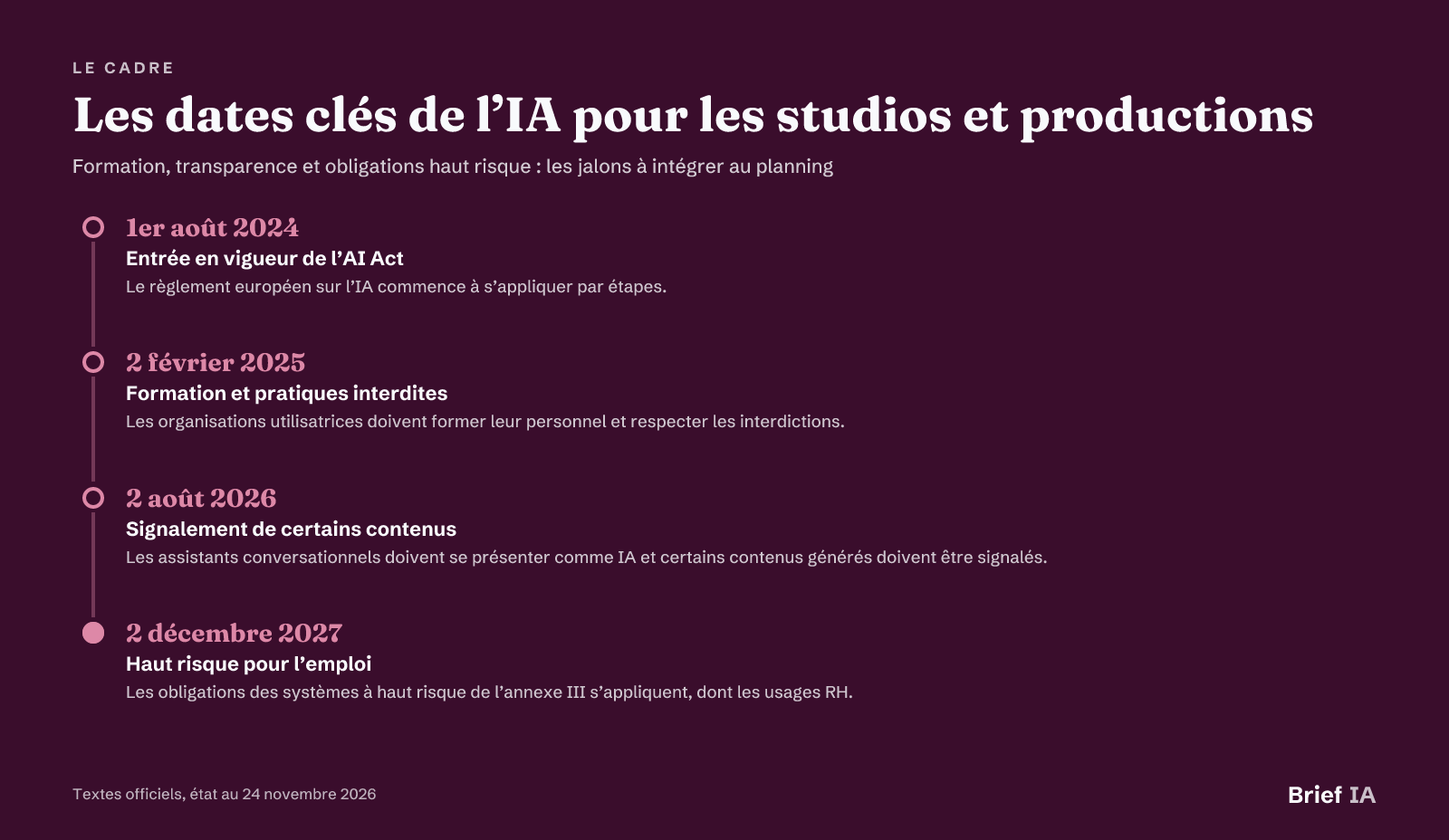 Key dates for AI for studios and productions
Key dates, status as of November 24, 2026.
Training and Prohibitions
Since February 2, 2025, any organization using AI systems must ensure a sufficient level of AI proficiency among its staff. For a producer, channel, or studio, this requires training teams that use writing assistants, image generation, editing, or post-production. Practices prohibited by the AI Act are also banned, including manipulation exploiting vulnerabilities and emotion recognition in the workplace, except for medical or safety reasons.
Content Transparency
Since August 2, 2026, the transparency obligations of the AI Act apply. A conversational assistant must indicate that it is an AI, and certain generated content must be labeled as such. For audiovisual content, this rule may concern published content, viewer interfaces, reconstructions, promotional content, and interactive experiences. Production must decide from the outset how to identify generated images, voices, or sequences that require public notification.
Employees and New Technologies
The Labor Code stipulates that the social and economic committee must be informed and consulted when introducing new technologies in the company. A production company or studio deploying AI tools in editing, VFX, planning, team evaluation, or productivity tracking must therefore anticipate social dialogue. The topic is not limited to software: it concerns work organization, responsibilities, skills, and effects on jobs.
High Risk and Human Decisions
The obligations of high-risk AI systems in Annex III will apply starting December 2, 2027. They may concern employment uses: recruitment, selection, promotion, dismissal, task distribution, evaluation, and employee monitoring. A creative tool for writing, summarizing, accounting, cash flow forecasting, or fraud detection is not high risk if it does not have that use. The GDPR, applicable since May 25, 2018, also regulates exclusively automated decisions producing legal or significant effects.
Pitfalls to Avoid
Confusing mock-up and deliverable. A generated shot useful in pre-visualization may be unsuitable for distribution. Before publication, check duration, resolution, continuity, artifacts, rights, and reporting obligations. The file status must be visible in the schedule.
Underestimating variations. The real cost is not that of a successful generation but that of all the necessary attempts. The Arc required 8 to 10 generations per shot, which changes the budget, timeline, and need for supervision.
Forgetting about people. Voice, face, movement, and performance are not just technical parameters. Any reuse must be planned in contracts, validated by the individuals concerned, and distinguished between internal trials, mock-ups, and distribution.
Losing continuity. Generators can easily alter a costume, accessory, face, or light between two shots. Production must maintain character sheets, visual references, and rejection criteria by sequence.
Measuring only adoption. A dashboard of tokens or connections does not prove value. Track time saved, re-takes avoided, cost per accepted shot, and final quality, as highlighted in our news on measuring the value of AI.
Taking Action: The 90-Day Plan
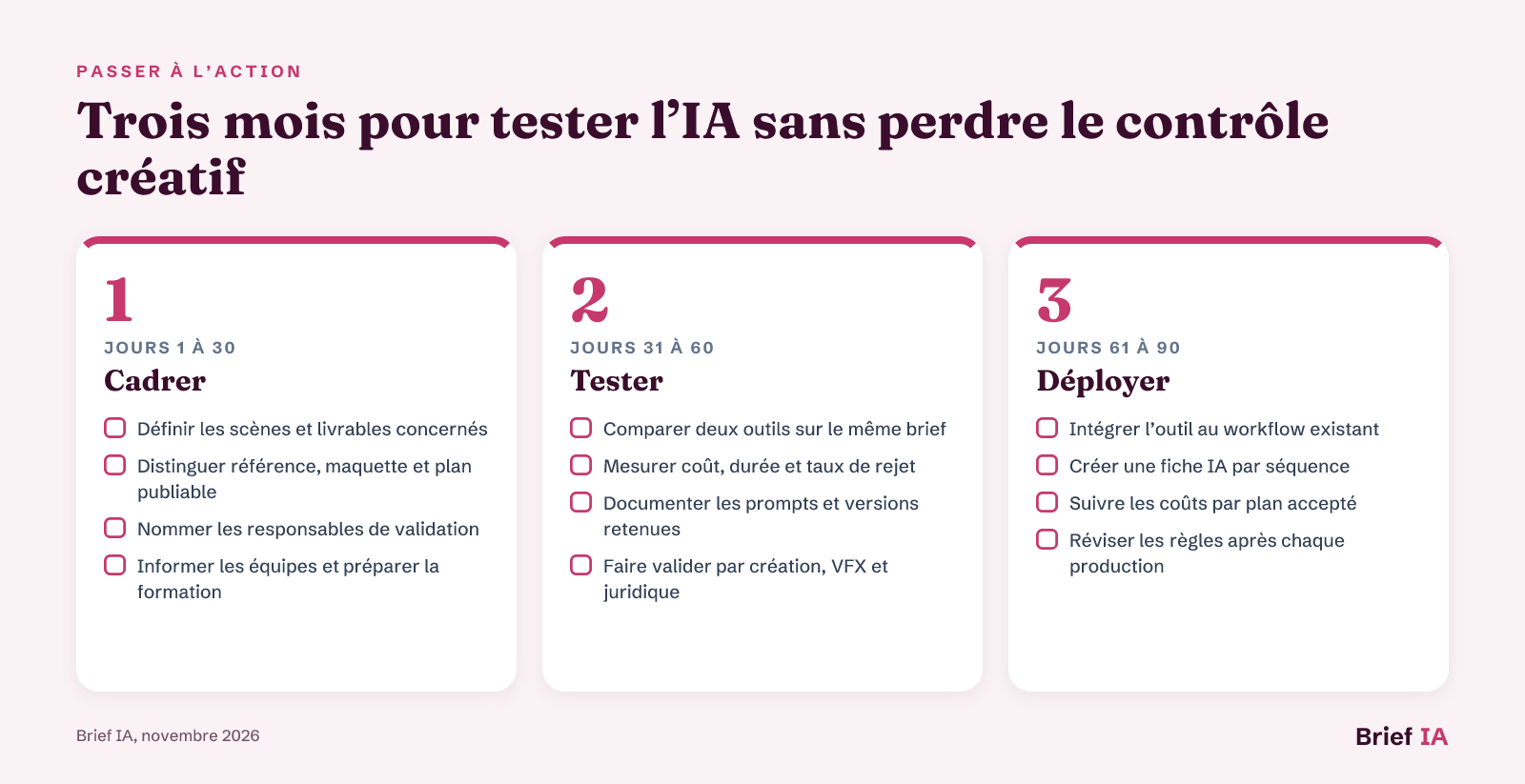 Three months to test AI without losing creative control
Three steps: frame, test, deploy.
Start with a short, non-critical, measurable project: a pre-visualization sequence, a visual bible, or a VFX test. For three months, frame the rights and responsibilities, test two families of tools on comparable deliverables, then deploy only the uses validated by creative, legal, and technical teams. The news on PwC and NBCUniversal reminds us of the importance of starting from repeatable processes and clean data.
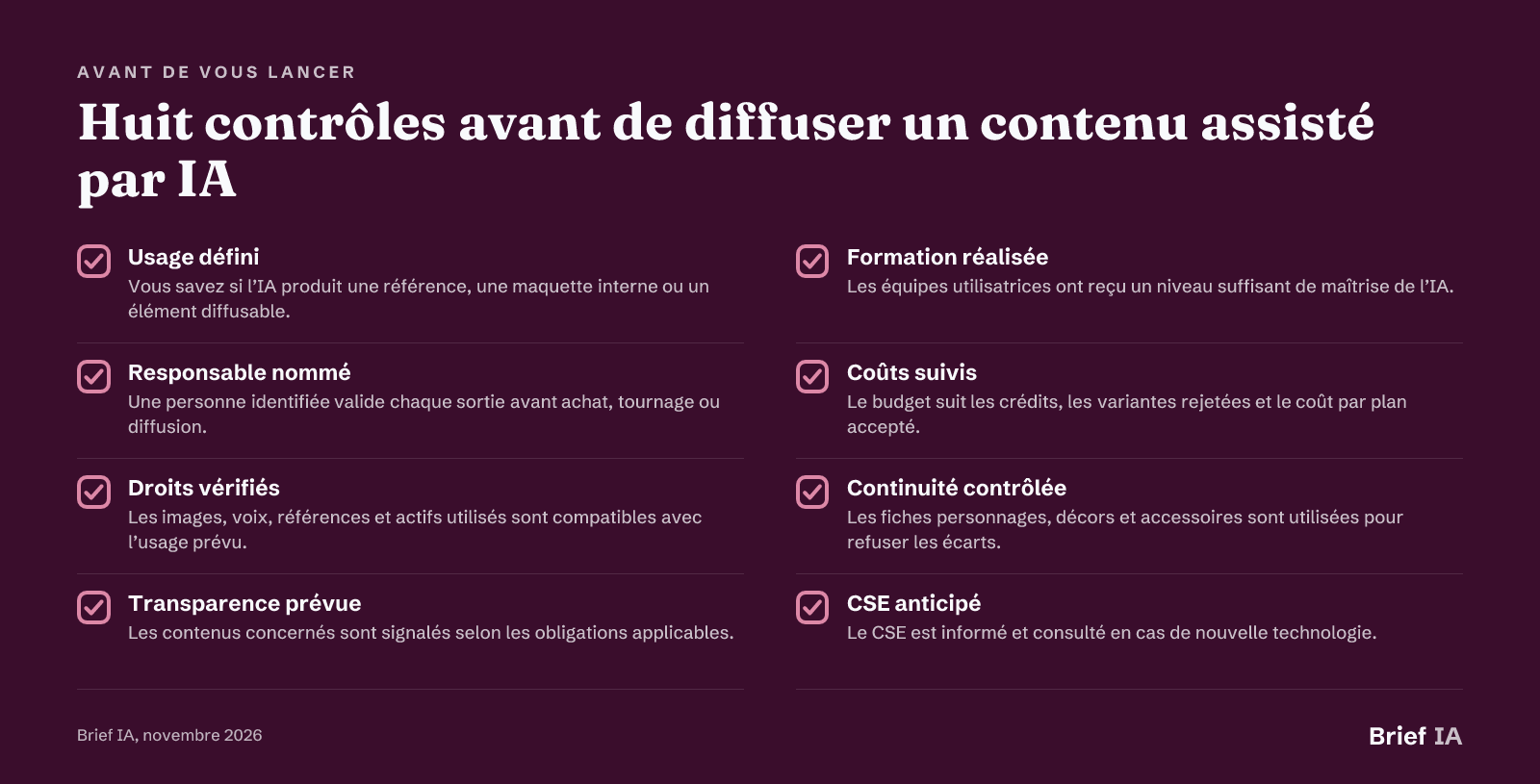 Eight checks before releasing AI-assisted content
Eight verifications to perform before each new use.
Further Reading
Our analyses for producers, directors, studios, channels, platforms, and post-production teams
- How Netflix Uses AI on Approximately 300 Titles. Concrete uses of Netflix in post-production, from crowds to historical reconstructions.
- Five AI Tools for Film Preproduction. The strengths and limitations of Midjourney, Firefly, Runway, Veo, and Luma for preparing a shoot.
- Method for Integrating AI into Audiovisual Production. A tiered approach: preproduction, production, post-production, and human validations.
- The Arc: Producing an 83-Minute AI Series. A detailed method, credit costs, and continuity limits of a generated project.
- Disney and Adobe Bet on Custom AI Models. What proprietary models change for franchises, parks, and studios.
- Actors, Voices, and Avatars: Creative Jobs Facing AI. The economic effects of synthetic voice, digital doubles, and reusable assets.
Key News to Note
- Chinese Short Dramas Accelerate Audiovisual Production through AI
- PwC and NBCUniversal Advocate for Human-Led AI Integration
- Disney Tracks AI Token Usage with an Internal Dashboard
- Capgemini Calls for Measuring the Value Created by AI
- AI Production: Framing Delegation with Judgment Points
Are you publishing a solution for cinema and audiovisual?
This guide is read by producers, directors, studios, channels, platforms, and post-production teams. Brief IA offers publishers of AI solutions for cinema, audiovisual, and post-production dedicated articles, features in the evening brief, and promotion in the directory. Formats and rates at briefia.fr/partenaires.
The Essentials in Questions
How to Use AI in Film Preproduction?
Start with reversible uses: moodboards, set references, storyboards, and short pre-visualizations. Define the status of each output, keep validated versions, and add useful annotations for the professions: light, assumed focal length, movement, texture, scale, and feasibility. AI then serves to accelerate choices, not to replace the breakdown.
Can a Film Be Fully Generated by AI in 2026?
Experimental projects exist, such as The Arc, an 83-minute science fiction series produced without actors or physical sets with about $38,000 in AI credits. However, these formats remain difficult to industrialize: visual continuity, actor direction, rights, sound, editing, and the number of required variations demand constant supervision.
Should AI-Generated Images Be Disclosed in an Audiovisual Program?
Since August 2, 2026, the AI Act imposes transparency obligations: a conversational assistant must indicate that it is an AI, and certain generated content must be labeled as such. For audiovisual production, it is necessary to decide during preparation which sequences, voices, images, or reconstructions require public information.
What AI Tools to Choose for VFX and Post-Production?
The choice should start from the shot to be created. A video generator is suitable for pre-visualization or certain variations, while final VFX require integration into the pipeline, quality control, human supervision, and rejection criteria. Netflix shows that the most robust uses focus on crowds, reconstructions, establishing shots, and visual adjustments.
How to Avoid Cost Overruns with AI Video?
Manage the cost per accepted shot, not just the cost displayed per generation. Integrate rejected variations, resolution, duration, the model used, and human selection time. For each test, measure the success rate, time saved compared to a traditional method, and the necessary re-takes before delivery.
Brief IA — L'actualité IA en français
L'essentiel de l'actualité de l'intelligence artificielle, décrypté et expliqué chaque jour.