AI for Pharmaceutical Research: The 2026 Reference Guide

In 2025, DealForma recorded 114 R&D partnerships in AI and machine learning for drug discovery and licensing, up from 84 in 2024, representing a growth of about 36%. Pharmaceutical AI has thus moved beyond isolated demonstrations, but it has not eliminated biological risk: no AI-designed drug has yet received regulatory approval or completed clinical trials. This guide outlines the successful applications, tools, rules, pitfalls, and a plan to get started.
What AI Really Changes in Pharmaceutical Research
The first shift concerns the continuity of the research flow. Augmented R&D is not limited to a model proposing a molecule; it connects biological targets, omics data, imaging, chemical libraries, lab results, and program decisions. According to DealForma, 114 R&D partnerships in AI and machine learning were recorded in 2025 for drug discovery and licensing, compared to 84 in 2024. Our analysis on the £500M British investment shows that alliances are shifting towards capital, data, and computing capacity.
The second shift is more sobering: AI improves the map, not the proof. AlphaFold 3 can predict interactions between proteins, small molecules, nucleic acids, and other biological components, but a credible molecule in simulation can fail in a cell, be eliminated by the body, or exhibit toxicity. Our analysis on Isomorphic Labs and AlphaFold reminds us that no AI-designed treatment has yet been approved or completed clinical trials.
The third shift is organizational. Bristol Myers Squibb and Nvidia, Novo Nordisk and AWS, or the collaborations mentioned around AstraZeneca, Sanofi, and Pfizer illustrate the same logic: AI is becoming a decision-making infrastructure, not just a researcher’s tool. Gains come from workflows capable of chaining generation, filtering, documentation, and arbitration, with governance robust enough to trace data, models, versions, and validations.
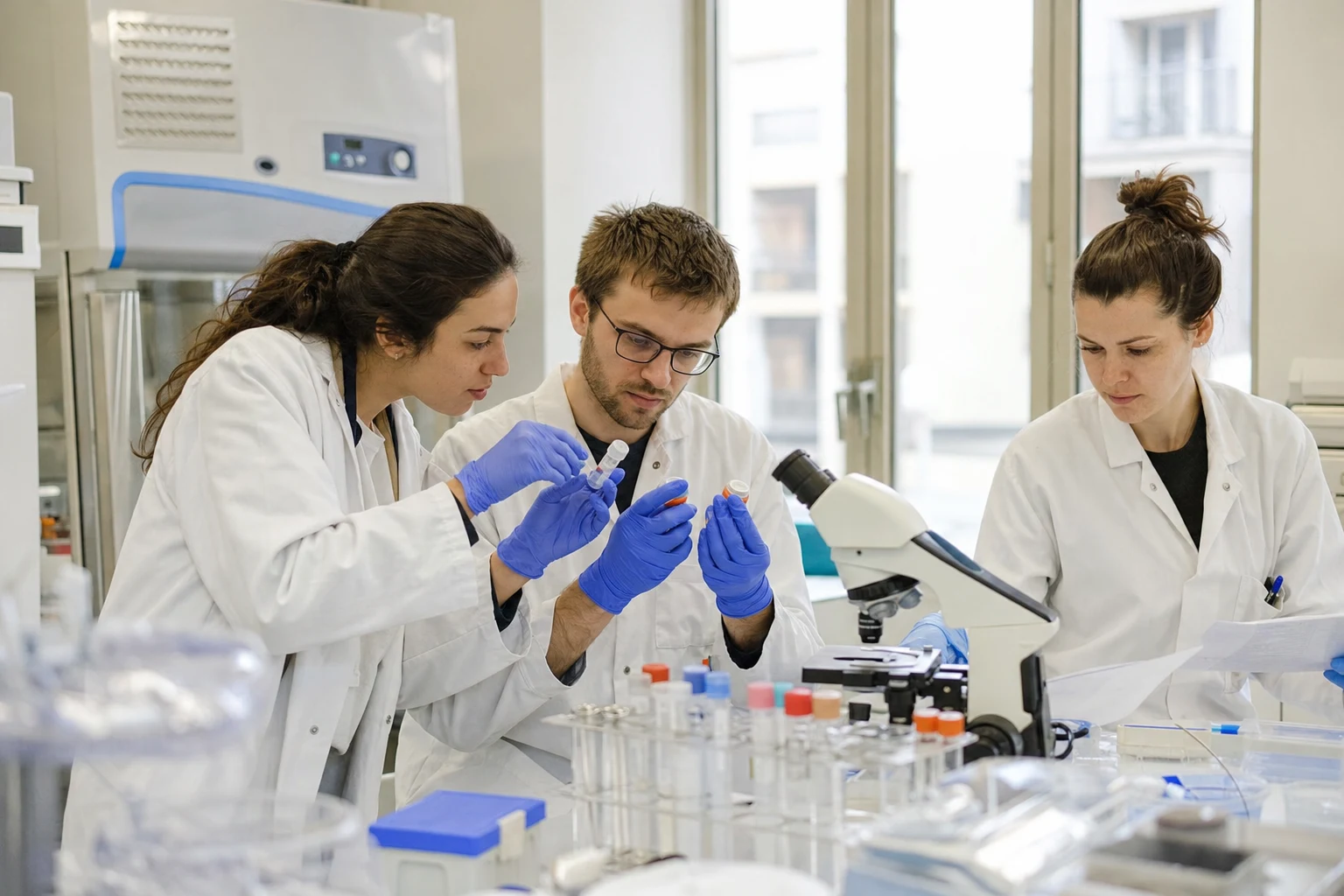 Researchers preparing samples in a pharmaceutical lab in Lyon
AI accelerates decision-making only if experience remains the final arbiter.
Applications That Work Today
The most useful applications are found where R&D loses time between data, hypotheses, and experiments. Maturity depends less on technical demonstration than on integration into decision cycles.
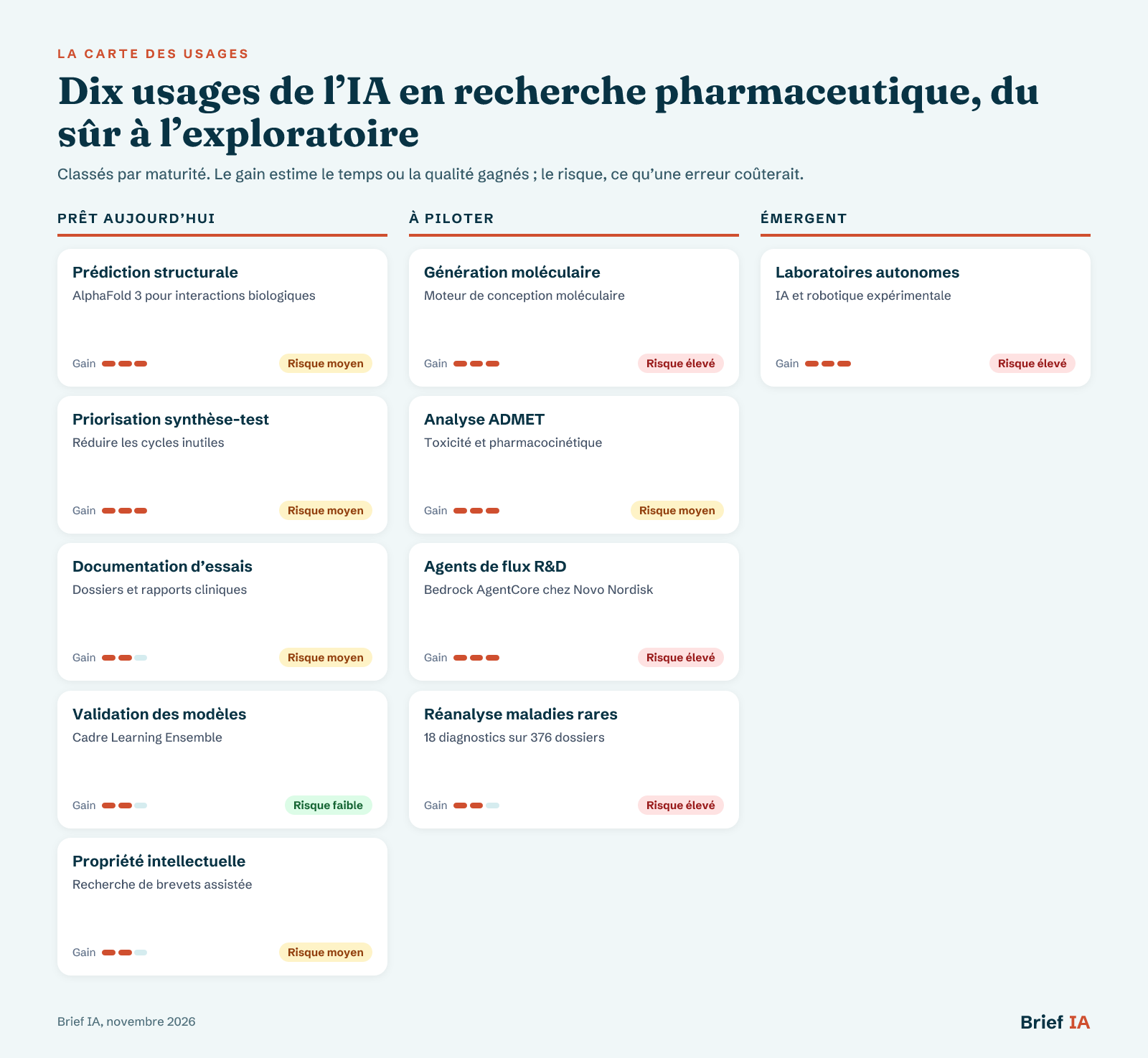 Map of AI applications for our analyses for R&D leaders, pharmaceutical labs, biotech, and innovation managers using AI to accelerate the discovery, validation, and testing of new treatments.
Applications ranked by maturity, with expected gain and risk in case of error.
Ready-to-Use Applications
Structural Prediction. Structural models help formulate hypotheses about targets, biological complexes, and binding sites more quickly. AlphaFold 3, developed by Google DeepMind with contributions from Isomorphic Labs, expands prediction to interactions between proteins, small molecules, and nucleic acids. The correct use is to prioritize experiments, not to conclude on the efficacy of a candidate.
Synthesis-Test Prioritization. The most robust application is to reduce the number of compounds to synthesize and test. Models estimate affinity, selectivity, stability, or certain administration-related properties, then guide teams towards the most consistent candidates. The gain comes from avoiding cycles of design, synthesis, and testing, provided each prediction is linked to an experimental result.
Trial Documentation. Large models can prepare summaries, check document consistency, and accelerate report writing, provided an expert validates each content. There is a strong interest in reducing the administrative burden on clinical and regulatory teams. Checks must focus on omissions, erroneous citations, data versions, and the separation between editorial assistance and medical decision-making.
Model Validation. Validation becomes a key building block of AI projects in health. The Learning Ensemble framework, presented by researchers from the University of Bristol on September 21, 2026, recommends documenting usage limits, reliability across patient groups, and clinical appropriateness. This approach helps avoid models that perform well on a dataset but are fragile in practice.
Intellectual Property. AI helps accelerate prior art searches, analyze patent trends, and document innovation spaces. The available figure pertains to tech startups: 70% are already using AI in their intellectual property strategy. For a biotech, the tool must remain an aid: patentability, freedom to operate, and trade secrets require human expertise.
Applications to Pilot
Molecular Generation. Generative models can propose new chemical structures based on biological and pharmacological constraints. Isomorphic Labs presented a drug design engine in February 2026 aimed at optimizing candidate molecules. The risk lies in false positives: a computationally plausible molecule still needs to be synthesized, tested, and compared against safety criteria.
ADMET Analysis. Predicting toxicity properties, pharmacokinetics, and other development criteria allows for earlier elimination of fragile candidates. In our analysis on Bristol Myers Squibb and Nvidia, the BioNeMo Agent Toolkit is presented as a suite capable of orchestrating generation, ADMET modeling, biological image analysis, and virtual screening.
R&D Workflow Agents. AI agents can execute multi-step workflows: connecting genomic data, imaging, and clinical data, generating hypotheses, preparing trials, or producing documentation. The partnership Novo Nordisk and AWS highlights Amazon Bio Discovery and Amazon Bedrock AgentCore. The priority is to define action rights, human validations, and execution logs.
Reanalysis of Rare Diseases. In rare diseases, AI can reexamine clinical and genomic records already analyzed by experts. A NEJM AI study from June 18, 2026, conducted on 376 anonymized pediatric records, led to 18 confirmed diagnoses, representing an additional yield of 4.8%. This case demonstrates the potential of AI for stratifying targeted trials.
Emerging Applications
Autonomous Laboratories. Laboratories combining AI and robotics aim to close the loop between hypothesis, experimentation, and optimization. Eli Lilly has entered into a deal potentially worth $1 billion over five years with Nvidia to build a closed discovery lab, combining AI and experimental robotics. The main risk is delegating scientific arbitrations too early to a technical chain that is still difficult to audit.
Tools to Know
There is no one-size-fits-all ranking for laboratories: one must think in terms of tool families, available data, and expected proof level.
- Structural and Molecular Design Models. They predict structures, interactions, and possible candidates, then guide experiments. AlphaFold 3 and the design engine from Isomorphic Labs illustrate this family for the upstream phase. Requirements: defined domain of use, described training data, associated experimental results, version tracking.
- AI Agent Biological Platforms. They orchestrate multiple tasks on biological, chemical, and clinical data. The partnership Novo Nordisk and AWS cites Amazon Bio Discovery for access to biological models and Bedrock AgentCore for enterprise agents. Requirements: limited action rights, human validation, execution logs, connection to existing systems.
- Computing Infrastructures for Large-Scale R&D. They enable training of more complex models and execution of thousands of simulations or virtual screenings. According to Nvidia, Bristol Myers Squibb's SuperPOD Vera Rubin delivers up to 10 times the performance per megawatt of the previous infrastructure. Requirements: total cost, security, data isolation, energy plan, reversibility.
- Clinical Analysis and Stratification Tools. They bring together records, genomic data, digital pathology, and inclusion criteria. Waiv, spun out from Owkin, raised $33 million to develop AI-based oncology tests and collaborate with the pharmaceutical industry. Requirements: clinical proof, measured biases, consent, suitable hosting, patient traceability.
- Validation and Governance Frameworks for Models. They document where the tool works, for whom, and in what pathway. Learning Ensemble proposes to describe limits, fairness, and clinical appropriateness before and after deployment. Requirements: usage sheet, population testing, alert thresholds, external review, regular reassessment.
Le brief IA que les pros lisent chaque soir
Les 7 actus IA du jour, décryptées en 5 min. Gratuit.
Inclus dès l'inscription : notre sélection des meilleurs guides & comparatifs IA.
Choisissez votre rythme
Gratuit · Pas de spam · Désabonnement en 1 clic
The Framework: AI Act, Health Data, and Medical Software
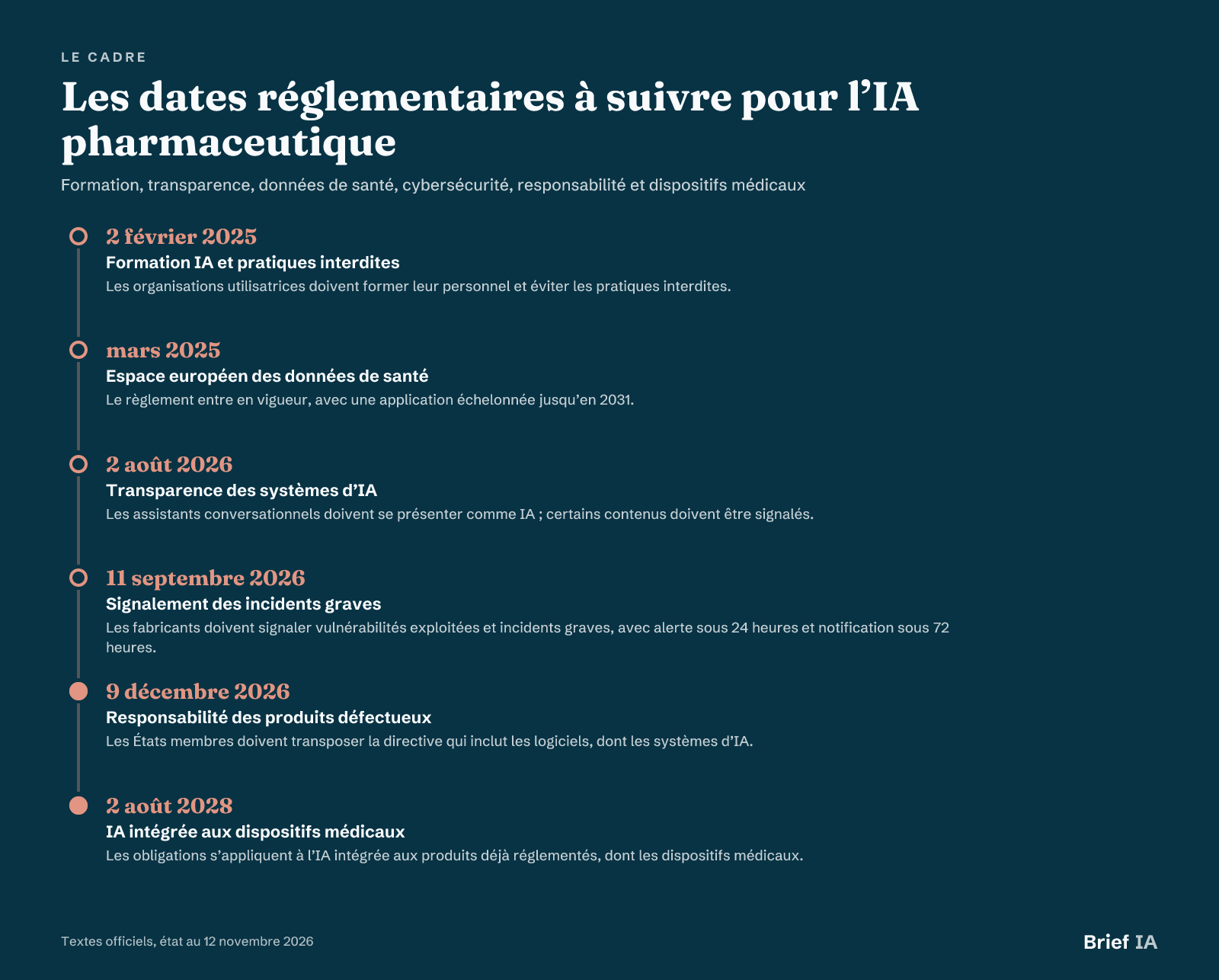 Regulatory dates to follow for pharmaceutical AI
Key dates, status as of November 12, 2026.
AI Act: Obligations Already Active
Regulation (EU) 2024/1689 came into effect on August 1, 2024, and applies in phases. Since February 2, 2025, prohibited practices are banned, and any organization using AI systems must ensure a sufficient level of AI mastery among its staff. Since August 2, 2026, transparency obligations apply: a conversational assistant must indicate that it is AI, and certain generated content must be labeled as such. In French companies, the CSE is informed and consulted when introducing new technologies.
Medical Products: The Major Deadline
After the Digital Omnibus, published in the Official Journal on July 24, 2026, and effective from July 27, 2026, the obligations of high-risk systems in Annex III will apply from December 2, 2027. For AI integrated into already regulated products, including medical devices, obligations will apply from August 2, 2028. They do not apply yet.
Health Data and Automated Decisions
The GDPR has been applicable since May 25, 2018. Its Article 22 regulates decisions based solely on automated processing that produce legal or significant effects on a person. In France, hosting health data requires a certified HDS provider. The European Health Data Space, which came into effect in March 2025, provides for a phased application until 2031. These milestones must be integrated into projects that exploit health data.
Software, Security, and Liability
Directive (EU) 2024/2853 on liability for defective products includes software, including AI systems, and member states must transpose it by December 9, 2026, at the latest. The Cyber Resilience Act requires manufacturers of products containing digital elements to report actively exploited vulnerabilities and serious incidents since September 11, 2026, with alerts within 24 hours and notifications within 72 hours.
Pitfalls to Avoid
Confusing Prediction and Proof. A predicted structure, an estimated affinity, or a suggested biomarker does not prove the efficacy of a treatment. Each model output must be linked to a testable hypothesis, an experimental protocol, and a defined decision threshold before use.
Industrializing Fragile Data. AI relies on reliable, comparable, and accessible data. Data siloed by team, poorly annotated, or heterogeneous can produce misleading rankings of candidates. Before purchasing a platform, one must map datasets, formats, access rights, and responsibilities.
Delegating Clinical Decision-Making. Health and research agents can suggest adjustments, sort information, or prepare documents. They should not replace medical or regulatory decision-making. The news on Robin de Ro reminds us of the demands for proof of efficacy and confidentiality issues.
Creating Supplier Dependency. Large laboratories rely on external suppliers for models, cloud, and computing. This dependency must be managed with clauses on reversibility, data, logs, intellectual property, security incidents, and continuity of access to critical capabilities.
Forgetting Real Use. A model that performs well in an evaluation dataset may fail in a laboratory, clinical center, or different population. Validation must specify the user, material, type of data, targeted patients, and situations where the tool should not be used.
Taking Action: The 90-Day Plan
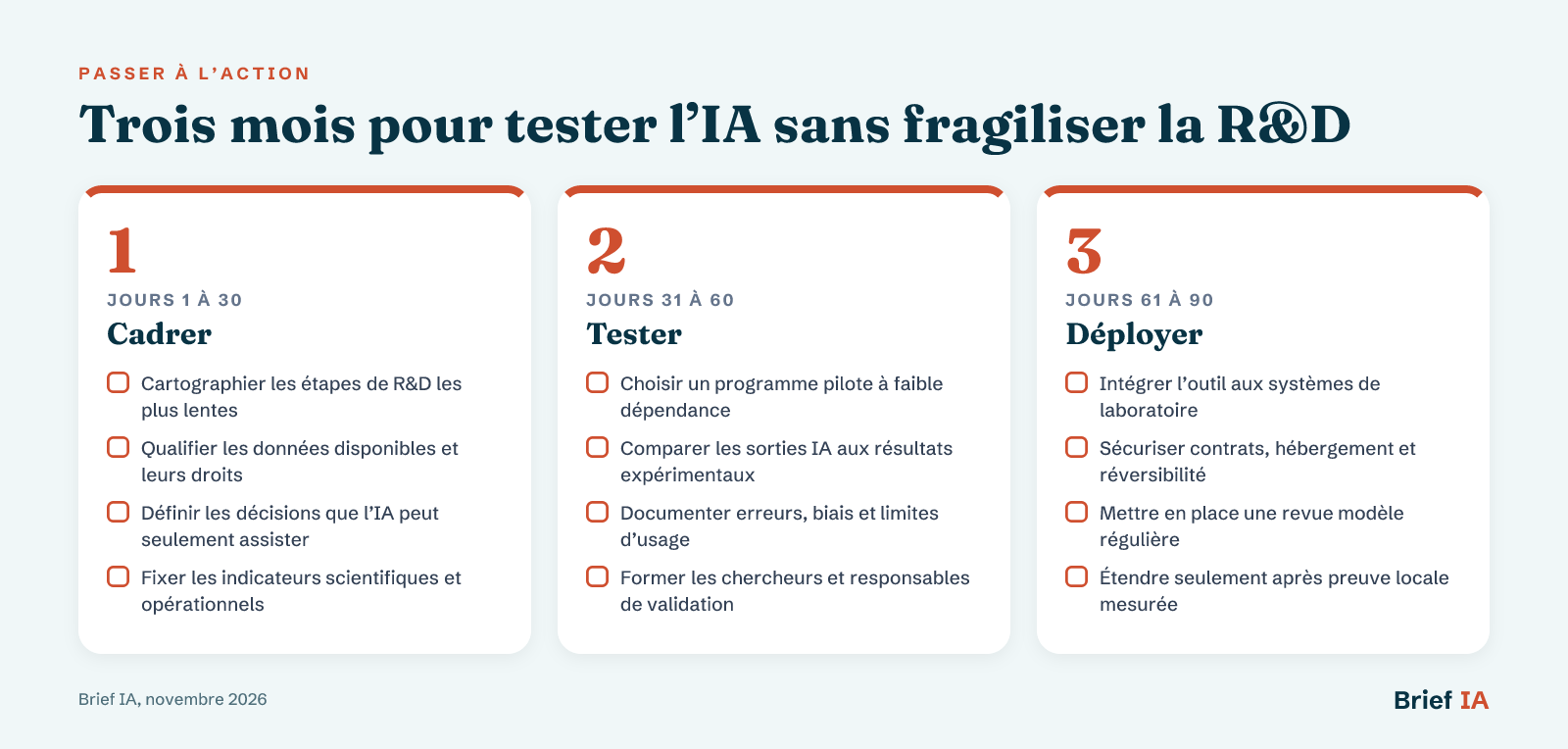 Three months to test AI without jeopardizing R&D
Three steps: frame, test, deploy.
Start with a program where an operational friction point is visible: overly long cycles between design and testing, dispersed trial data, or slow clinical documentation. The first month serves to frame data, responsibilities, and indicators. The second tests a limited case with human validation. The third prepares for scaling: security, contracts, training, information-consultation of the CSE in relevant French companies, and a decision to halt or scale up.
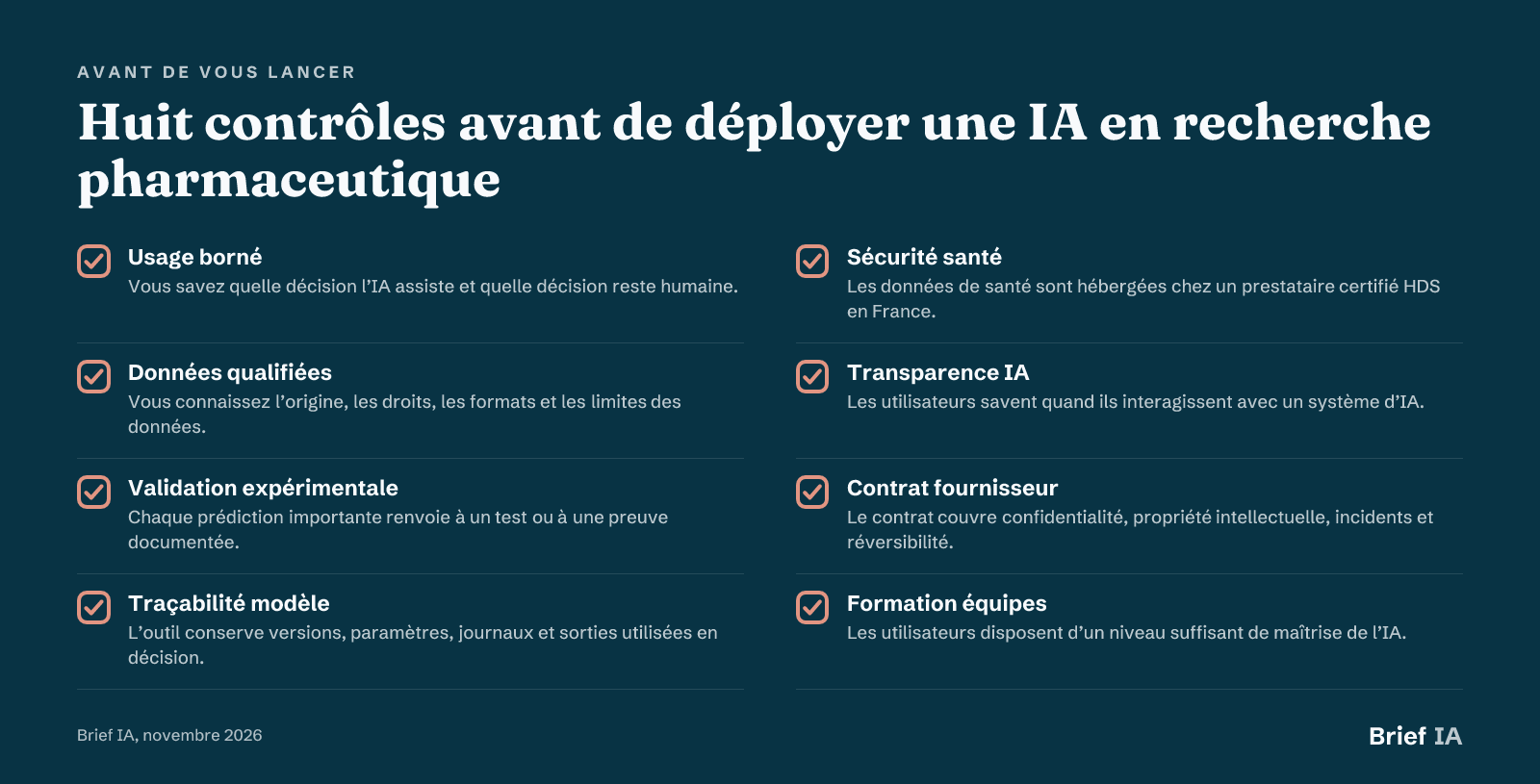 Eight checks before deploying AI in pharmaceutical research
Eight verifications to perform before each new application.
Further Reading
Our analyses for R&D leaders, pharmaceutical labs, biotech, and innovation managers using AI to accelerate the discovery, validation, and testing of new treatments.
- Isomorphic Labs: AI Facing Clinical Trials. Why AlphaFold accelerates design without eliminating biological, preclinical, and clinical validation.
- Pharmaceutical R&D: Structuring an AI-Augmented Flow. How to move from point tools to an integrated flow between target, molecule, experiment, and decision.
- Bristol Myers Squibb and Nvidia: The AI Factory Applied to Research. What a dedicated infrastructure for computing, biological agents, and discovery flows changes.
- Novo Nordisk and AWS: Integrating AI Across R&D. The role of Amazon Bio Discovery, Bedrock AgentCore, and the London co-innovation hub.
- Learning Ensemble: Validating Medical AIs Through Real Use. A method to document limits, fairness, and clinical appropriateness of models before deployment.
Key News to Note
- 10x Science raises $4.8 million to characterize AI candidates
- Waiv raises $33 million for AI-based oncology tests
- Ro launches Robin, AI health agent, with questions about proof and confidentiality
- OpenAI and Anthropic tested by U.S. public health agencies
- Open-H-Embodiment brings together 35 organizations around health robotics
- Google presents Gemini for Science at Google I/O
Are you developing a solution for pharmaceutical research?
This guide is read by R&D leaders, pharmaceutical labs, biotech, and innovation managers. Brief IA offers AI platform publishers for pharmaceutical R&D dedicated articles, evening brief inserts, and highlighting in the directory. Formats and rates at briefia.fr/partenaires.
The Essentials in Questions
How to Use AI in Drug Discovery?
Start with a specific point in the process: structural prediction, molecular generation, compound prioritization, ADMET analysis, or trial documentation. The right criterion is not the sophistication of the model but its ability to reduce unnecessary cycles between design, synthesis, and testing, with clear experimental validation.
Can AI Design an Approved Drug Alone?
No, given the available evidence. No AI-designed treatment has yet been approved or completed clinical trials. AI can propose, rank, and optimize candidates, but proof still comes through experiments, preclinical tests, human trials, and regulatory evaluation.
What Data is Needed for a Pharmaceutical AI Project?
Traceable, qualified data linked to a scientific question is needed: structures, biological results, omics data, imaging, clinical data, or experimental measurements. In France, health data must be hosted by a certified HDS provider. Access and reuse rights must be clarified from the outset.
Does the AI Act Block AI Projects in Pharmaceutical R&D?
No, but it already imposes general obligations, including staff training since February 2, 2025, and transparency since August 2, 2026. Obligations related to AI integrated into already regulated products, such as medical devices, will apply from August 2, 2028.
How to Choose Between Building a Model or Buying a Platform?
Building may be justified if data, skills, and intellectual property are strategic. Buying accelerates startup but requires checking reversibility, confidentiality, validation, security, total cost, and integration. In both cases, the tool should be tested on a real case before scaling up.
Brief IA — L'actualité IA en français
L'essentiel de l'actualité de l'intelligence artificielle, décrypté et expliqué chaque jour.