AI for Lawyers and Legal Professionals: The 2026 Reference Guide

Since March 17, 2026, lawyers have a compass. The National Bar Council has adopted a guide dedicated to ethics and generative artificial intelligence, and its message can be summed up in one sentence: AI is allowed, provided that the lawyer maintains intellectual control over their work at all times. This reference guide gathers what a lawyer, in-house counsel, or legal department needs to know to leverage AI without ever exposing professional secrecy: the effective uses, tools, rules, pitfalls, and a plan to get started.
What AI Really Changes in Legal Work
The work of a legal professional relies on three actions: searching, reading, writing. These are precisely the three actions that generative AI accelerates. A question posed in natural language replaces a series of keyword queries. A two-hundred-page file condenses into a timeline. A first draft of a note appears in seconds.
The profession does not disappear; it shifts. The time saved on production is redirected to verification, reasoning, and advising. This is exactly what the CNB demands: the tool proposes, the lawyer disposes, and they remain responsible for every word that goes to a client or a court.
The profession has already taken the plunge: according to the CNB, 62% of active lawyers use artificial intelligence. On Brief IA, stories dedicated to legal tools and the evolution of the profession are what most captivates our readers in the sector, far ahead of the regulation of AI itself.
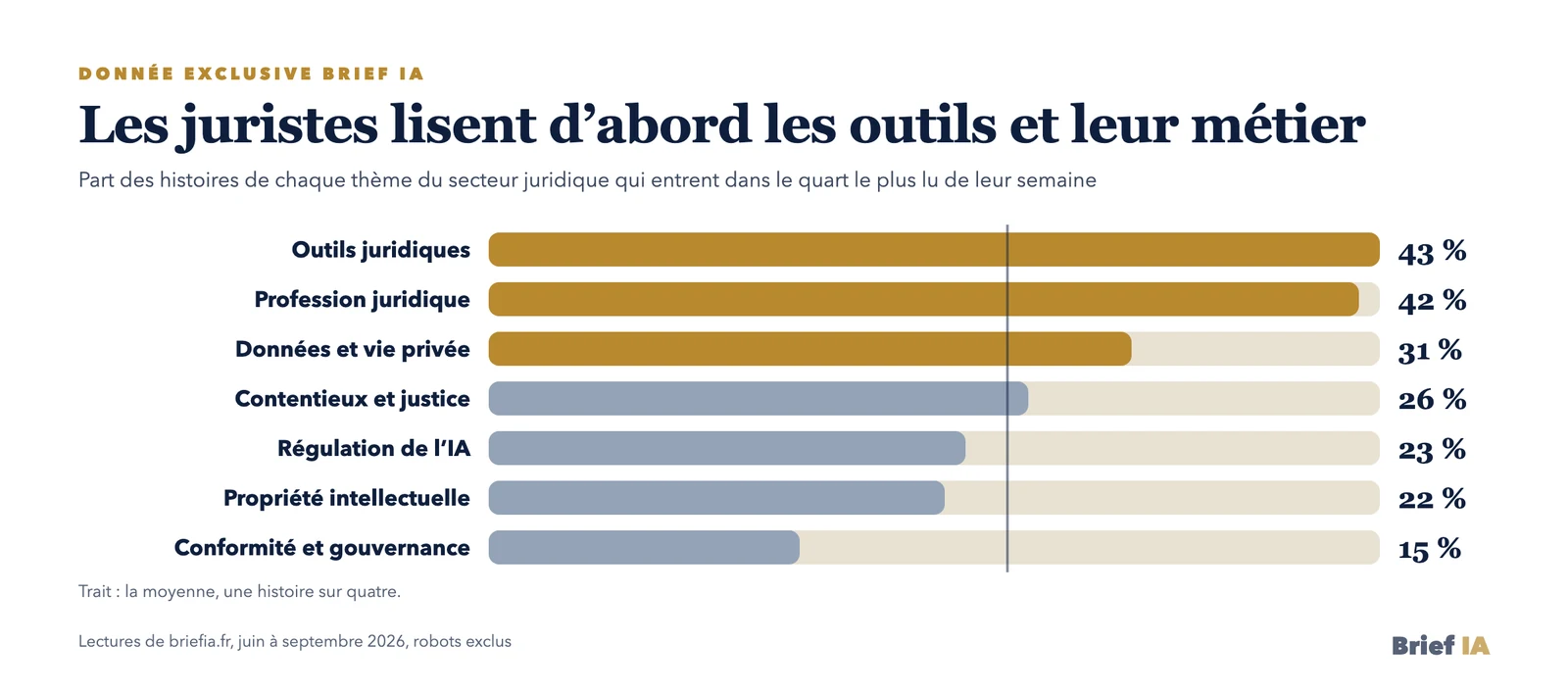 What legal professionals read on Brief IA
Share of stories from each legal sector theme that enter the top quartile of their weekly readership, June to September 2026.
Effective Uses Today
Not all uses are equal. Some are already safe and profitable, others require a controlled pilot, and a few remain exploratory. The map below classifies them by maturity.
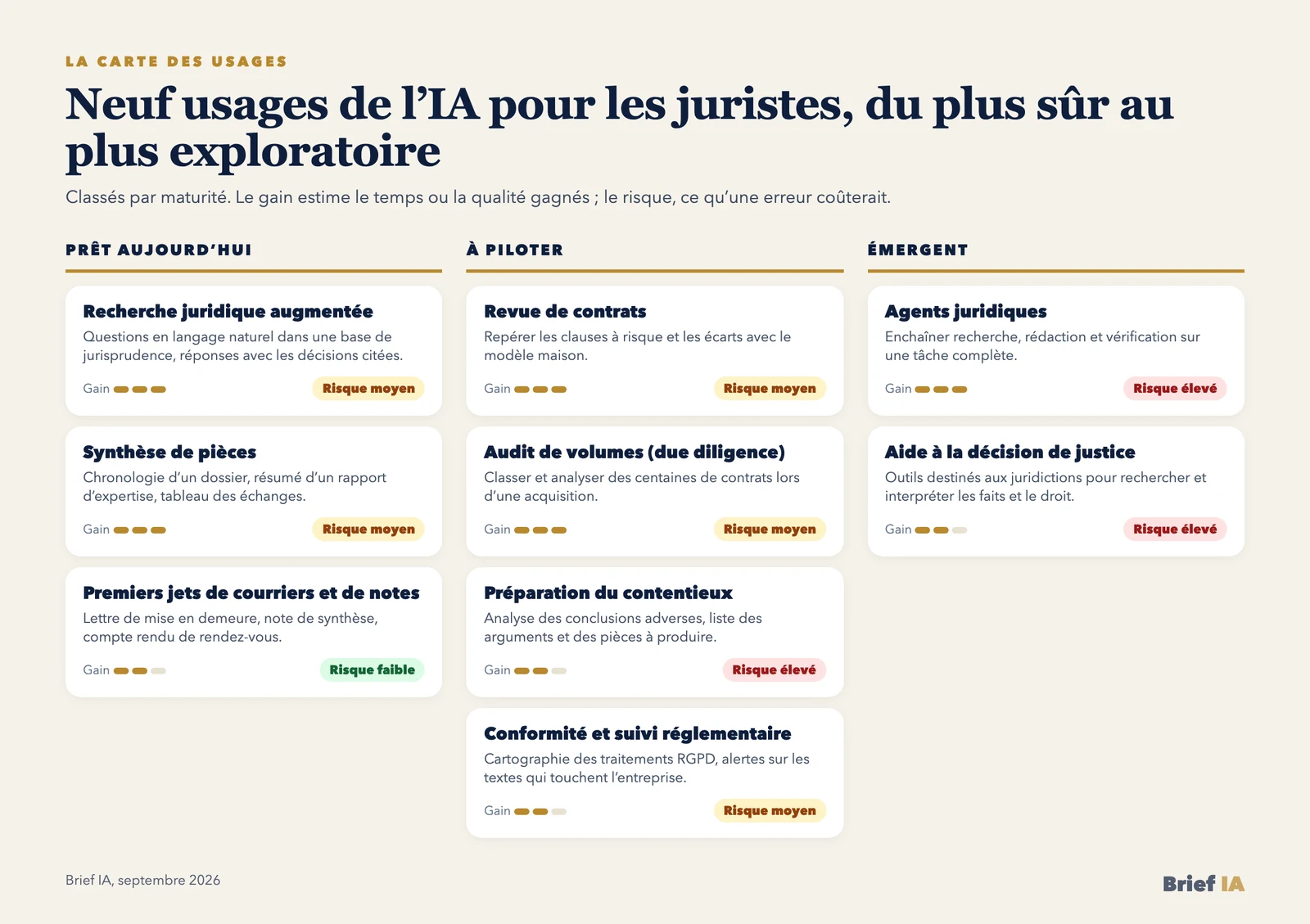 Map of AI Uses for Legal Professionals
Nine uses classified by maturity, with expected gains and risks in case of error.
Ready-to-Use Applications
Augmented Legal Research. Major legal databases now allow users to pose a question as they would to a colleague and receive an answer accompanied by the decisions and texts on which it is based. The gain is real, provided that each cited source can be opened. An answer without a verifiable reference is worthless before a judge.
Document Summarization. Timeline of a case, summary of an expert report, table of exchanges between parties: this is the most profitable use for a firm, as it transforms hours of reading into minutes of review. Verification remains straightforward since the documents are right in front of you.
First Drafts. Demand letters, summary notes, meeting reports: AI provides a framework that the legal professional corrects and enriches. The risk is low as long as the text is proofread, and the gain can be measured within the first week.
Uses to Pilot
Contract Review. Identifying liability, termination, or non-compete clauses, flagging deviations from the in-house model, proposing fallback wording: specialized tools save considerable time. They still lack reliability on atypical clauses, hence the need for a pilot on a well-known type of contract before generalizing.
Volume Audits. During an acquisition, AI classifies and analyzes hundreds of contracts to isolate those that pose problems. The team focuses on flagged cases but must check a sample of contracts deemed low-risk.
Litigation Preparation. Analyzing opposing conclusions, listing arguments, preparing the document index: assistance is valuable, but so is the risk. A reasoning error or fabricated case law can have serious consequences in court.
Compliance. Mapping personal data processing, identifying texts relevant to the company, preparing a register: legal departments find solid support here, provided they validate each conclusion.
Emerging Uses
Legal Agents autonomously chain several steps, from research to drafting. They progress quickly, but their autonomy multiplies the necessary control points. Finally, decision-support tools for courts fall into a separate category: the AI Act classifies them as high-risk.
 Two legal professionals reviewing a contract analyzed by AI
AI identifies, the legal professional decides: proofreading remains at the heart of the profession.
Tools to Know
The market evolves every month. Rather than a ranking, here are the main categories of tools and what to demand from each.
- Augmented Legal Databases. Publishers are adding conversational search to their document collections, and the market is consolidating: RELX has completed the acquisition of Doctrine, now integrated into LexisNexis. What to demand: systematic citations and a dated corpus. Even specialized tools can make mistakes, as highlighted in our analysis of legal libraries.
- Specialized Legal Assistants. Harvey, valued at $11 billion, has opened an office in Paris, and the CNB is making the Jimini assistant available to over 4,000 law students. What to demand: hosting location, non-reuse of data, encryption.
- Legal Offers from Giants. Google launched Gemini Enterprise for Legal committing not to train its models on client data, Anthropic has expanded its legal offering for Claude, and Microsoft integrates a contract review agent into Word, initially in the United States.
- Generalist Assistants like ChatGPT, Claude, or Le Chat de Mistral: useful for rephrasing or structuring, but reserved for content without data covered by secrecy, unless a professional offer comes with contractual guarantees.
- Public Tools. The French judiciary is developing its own assistants, such as Mon Assistant Justice, and reminds that the nationality of the provider is as important as the hosting location.
Le brief IA que les pros lisent chaque soir
Les 7 actus IA du jour, décryptées en 5 min. Gratuit.
Inclus dès l'inscription : notre sélection des meilleurs guides & comparatifs IA.
Choisissez votre rythme
Gratuit · Pas de spam · Désabonnement en 1 clic
Ethics and Legal Framework: What Already Applies
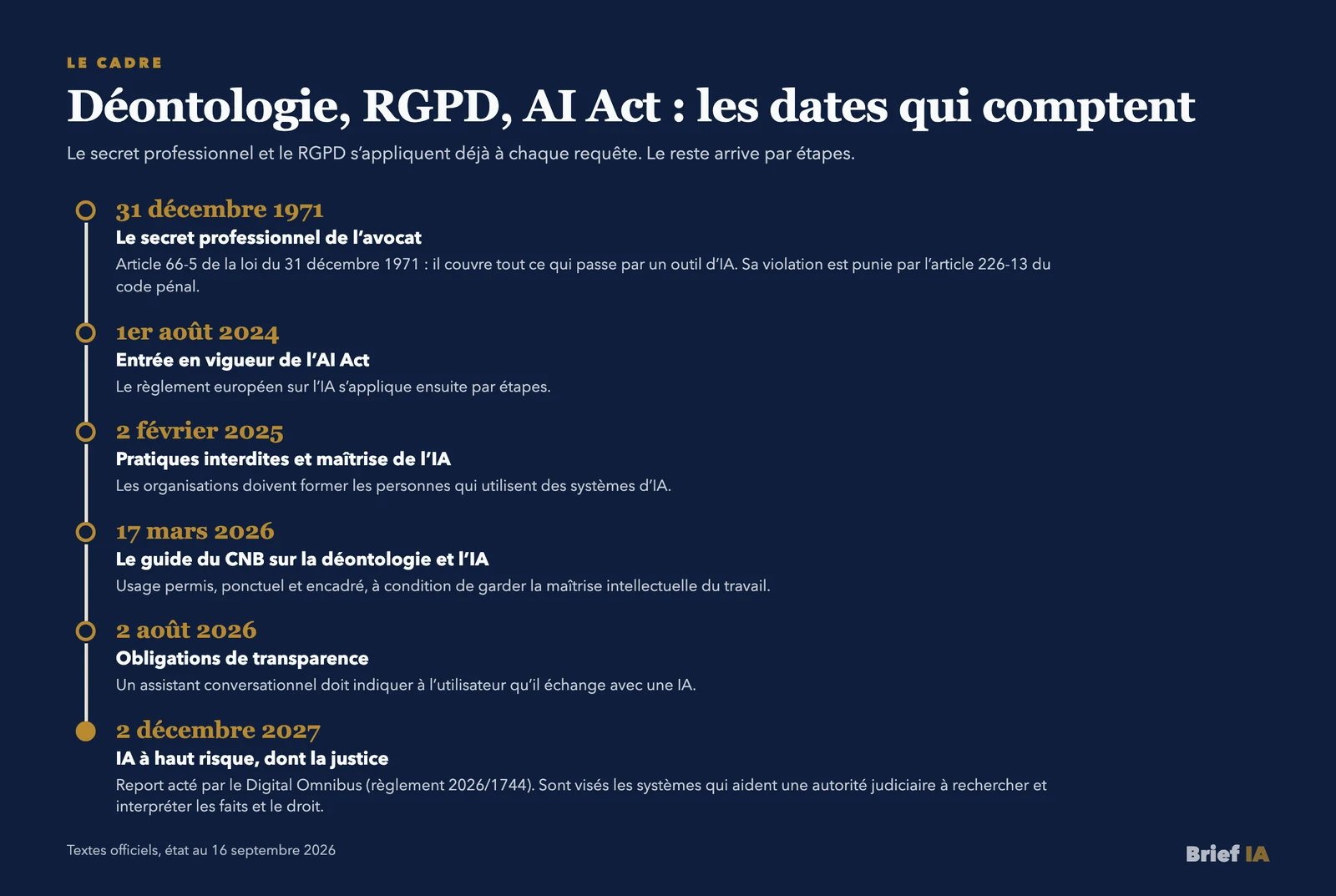 Calendar of Ethics and AI Regulation for Legal Professionals
Key dates, from professional secrecy to the AI Act.
Professional Secrecy, Above All
Article 66-5 of the law of December 31, 1971, covers everything related to the mission of advice and defense, and its violation is punished by Article 226-13 of the Penal Code. Entering a client's name, an amount, or a strategy into a public tool amounts to entrusting this information to a third party. Two reflexes are essential: pseudonymize the data before submission, and prioritize tools whose conditions exclude the reuse of queries to train models.
The CNB Guide of March 17, 2026
The guide does not prohibit generative AI. It tolerates it on a case-by-case basis and reminds that the essential principles of the profession fully apply: competence, caution, independence, client information, and balanced fee setting. Specifically, the lawyer must understand the tool they use, verify what it produces, protect their client's data, and consider the actual time spent on the case in their fees.
GDPR
The data in a case file is almost always personal data. The firm remains responsible for processing: it needs a subcontracting contract with the publisher, clear information on the hosting location, and a legal basis for each use.
The AI Act
The European regulation on AI applies in phases. Since February 2, 2025, any organization using AI systems must train the relevant personnel. Since August 2, 2026, a conversational assistant, for example on a law firm’s website, must indicate that it is an AI. Systems intended to assist a judicial authority in researching and interpreting facts and law are classified as high-risk; their obligations will apply from December 2, 2027, following the postponement decided by the Digital Omnibus. Tools used by lawyers for their own work are not, by principle, classified as high-risk. Brussels' guidelines on high-risk systems provide further clarification.
Pitfalls to Avoid
Invented Decisions. A language model can produce plausible yet entirely false case law. No reference should leave the firm without being found and read in an official source.
Default Confidentiality. Many free tools retain queries. A professional account with contractual guarantees is not a luxury; it is a condition of practice.
False Assurance. A well-written text inspires confidence. This is precisely why it should be proofread with the same care as a draft written by a brilliant but distracted intern.
Fees. Charging by the hour for work that AI has reduced by tenfold raises both ethical and commercial questions. The CNB guide invites reflection on this, and many firms are shifting to fixed fees.
Precedents Are Multiplying. In France, the administrative court of Orléans reminded, in a decision dated December 29, 2025, of the obligation to verify references that turned out to be nonexistent. In the United States, judges in Mississippi removed four lawyers from a case and barred two of them from practicing for two years. Researcher Damien Charlotin has documented nearly 1,600 cases where AI-generated content was flagged by a judge.
Conversations Are Not Confidential. In a cryptocurrency fraud case, U.S. Judge Jed Rakoff ruled that AI platforms are third parties and not legal advisors, and conversation histories were seized. What is typed into a chatbot can end up in a case file.
Taking Action: The 90-Day Plan
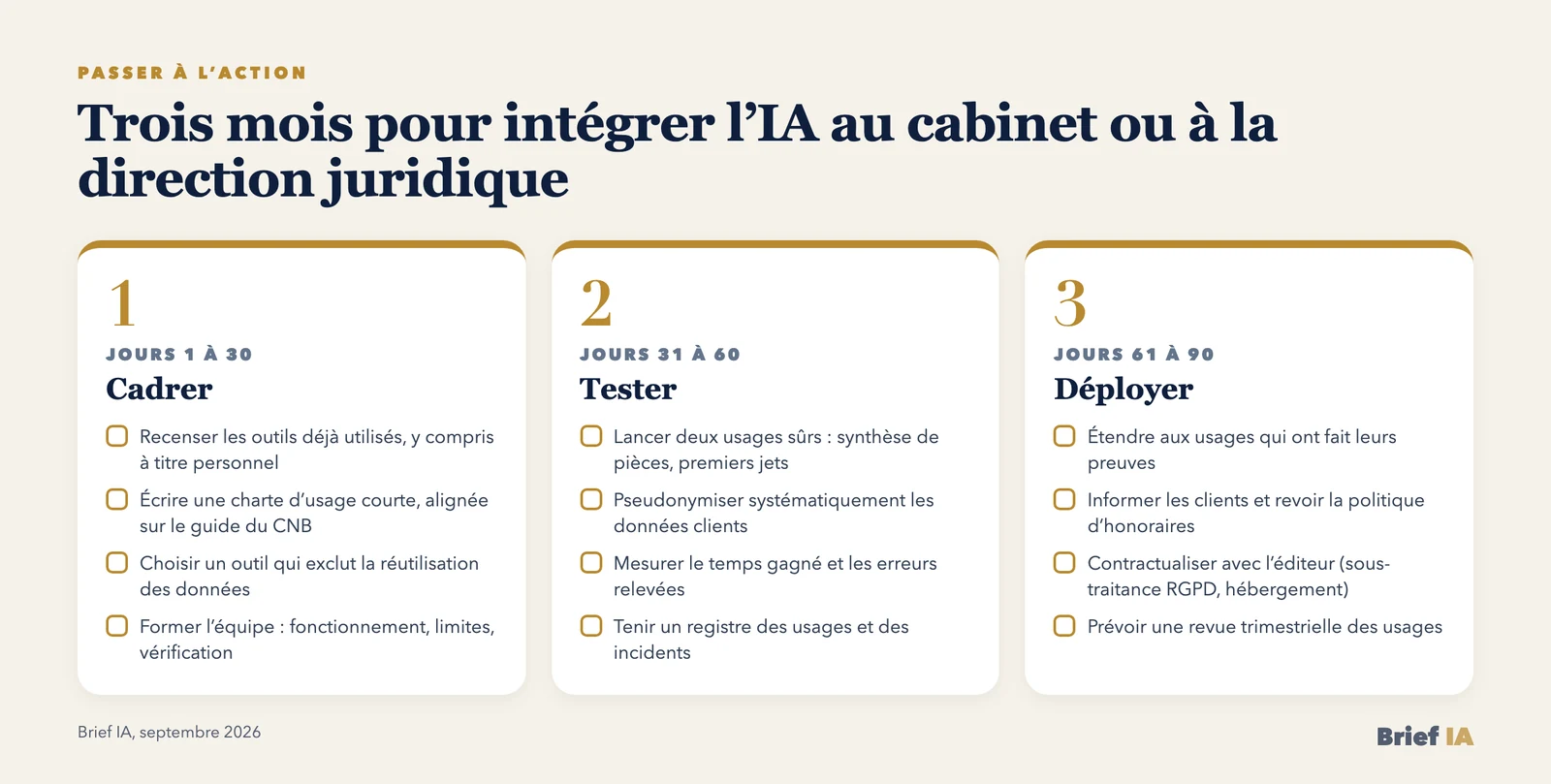 90-Day Plan for Integrating AI into a Law Firm or Legal Department
Three steps: frame, test, deploy.
The safest approach is to start small. One month to set the rules and choose a tool, one month to test two low-risk uses, one month to expand what has worked. At each stage, a simple log of uses and incidents allows for measuring progress and demonstrating, if necessary, that the firm maintains control over its work.
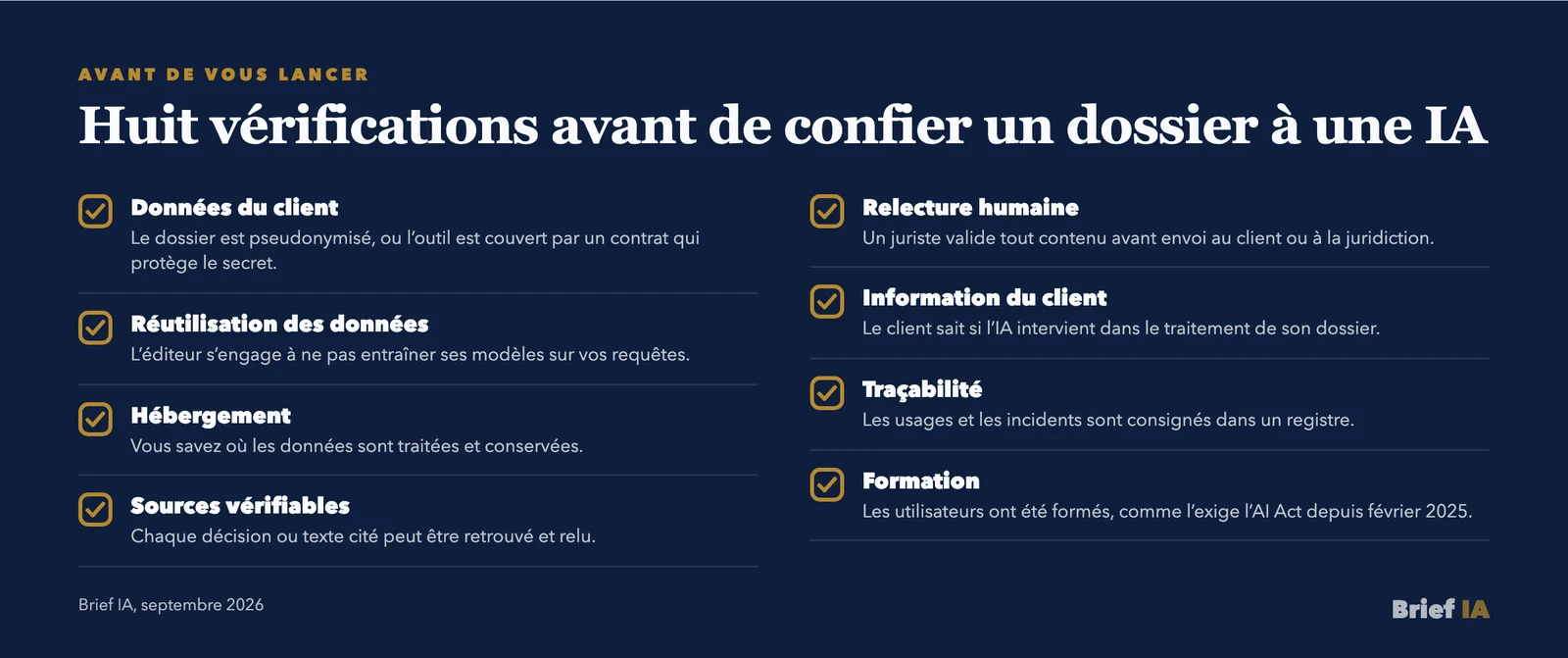 Checklist before entrusting a case to AI
Eight checks to perform before each new use.
To Go Further
Our analyses for legal professionals
- AI and the Paris Bar: What Lawyers Need to Change. Proofread every generated content and discard tools that reuse case data.
- Building a Reliable Legal Library with AI. Dated corpus, mandatory citations, responses without blocked sources.
- European AI Law: Concrete Impacts for Businesses. The timeline after the postponement and obligations that are already enforceable.
- Claude for Legal Review of SMEs. A useful first contract review, never a validation.
- Apple vs. OpenAI: Limiting Legal Risks. Usage policy, controlled departures, supplier clauses.
Key News to Note
- The CNB offers Jimini AI to law students
- Harvey, the unicorn of legal AI, sets up in Paris
- RELX completes the acquisition of Doctrine
- Judges lose patience with lawyers' AI errors
- Suno condemned in Germany for rights violations
- Cultural Content and AI: The Law Passed in the Senate
Do you provide a solution for legal professionals?
This guide is read by lawyers, in-house counsels, and legal departments. Brief IA offers legal tech publishers dedicated articles, slots in the evening brief, and promotion in the directory. Formats and rates at briefia.fr/partenaires.
The Essentials in Questions
Is a lawyer allowed to use ChatGPT?
Yes, within a specific framework. The CNB guide of March 17, 2026, permits occasional and controlled use of generative AI, provided that the lawyer maintains intellectual control over their work, verifies everything produced, and protects professional secrecy, for example by pseudonymizing data.
Can client data be entered into an AI?
Only with guarantees: a tool that excludes data reuse, a subcontracting contract compliant with GDPR, and preferably, pseudonymized data. The professional secrecy of Article 66-5 of the 1971 law applies to everything entered.
What AI uses are the safest for a legal professional?
Document summarization, first drafts of letters and notes, and legal research when each cited source can be verified. Litigation preparation and autonomous agents require more control.
What does the AI Act say for legal professions?
Users must be trained since February 2025, conversational assistants must identify themselves as AIs since August 2026, and tools assisting jurisdictions are classified as high-risk, with obligations starting December 2, 2027.
How to get started in a law firm?
Inventory the tools already in use, write a short charter, choose a tool that protects data, then test two low-risk uses for a month before expanding those that have proven effective.
Brief IA — L'actualité IA en français
L'essentiel de l'actualité de l'intelligence artificielle, décrypté et expliqué chaque jour.